
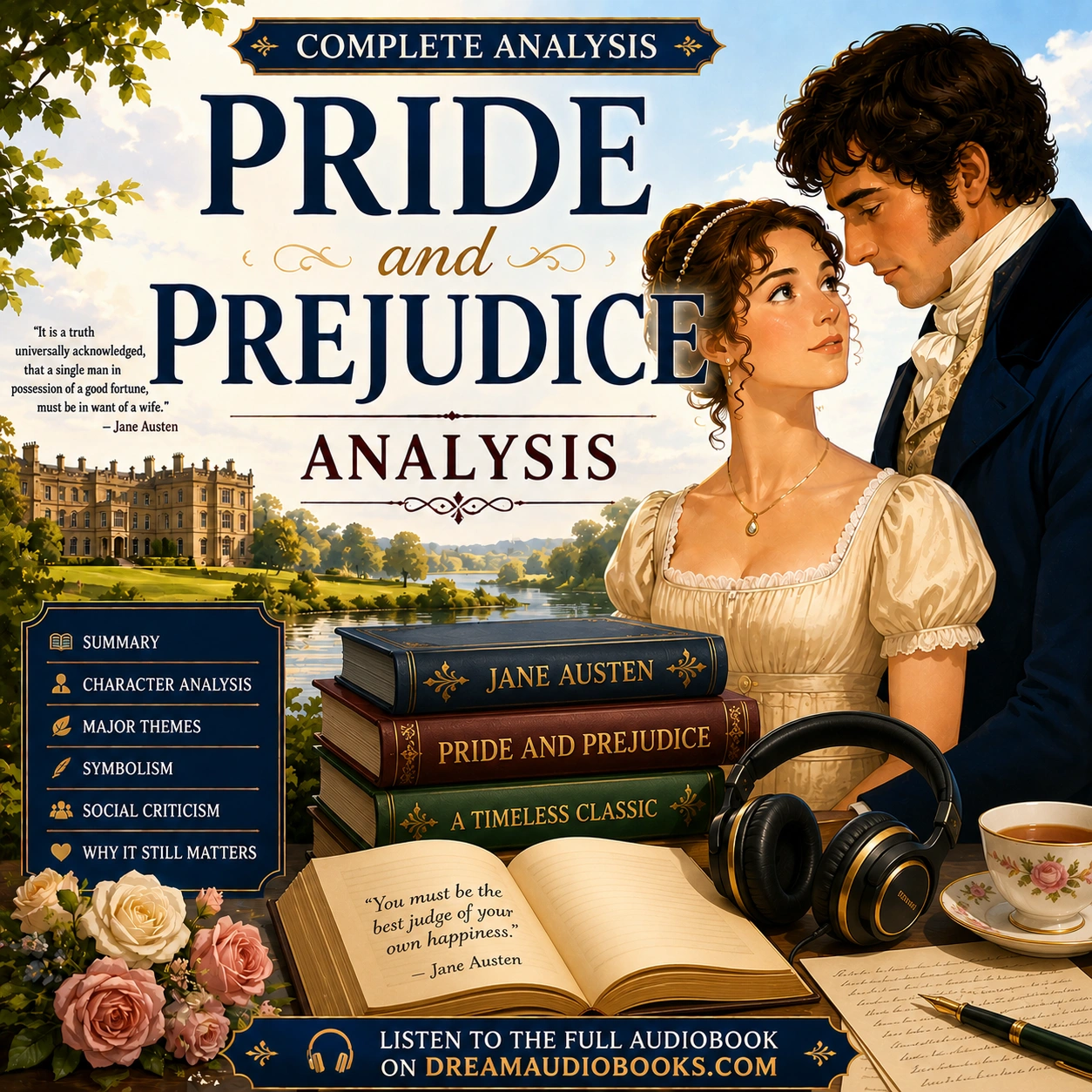
Pride and Prejudice Analysis (Themes, Characters & Meaning)
# Pride and Prejudice Analysis (Themes, Characters & Meaning)
## Introduction
Jane Austen’s *Pride and Prejudice*, first published in 1813, remains one of the most beloved novels in English literature. More than two centuries after its publication, readers continue to be fascinated by its memorable characters, witty dialogue, social commentary, and timeless exploration of love and personal growth. The novel follows Elizabeth Bennet and Fitzwilliam Darcy as they navigate misunderstandings, family expectations, social class, and their own personal flaws before finding happiness together.
A complete **Pride and Prejudice analysis** reveals that the novel is much more than a romantic story. Beneath its charming surface lies a sharp critique of social conventions, gender roles, class divisions, and the importance of self-awareness. Austen examines how first impressions can be misleading and how personal growth is essential for meaningful relationships.
For listeners who enjoy classic literature, the full audiobook is available on DreamAudiobooks:
**Listen here:** https://dreamaudiobooks.com/pride-and-prejudice-by-jane-austen-full-audiobook/
—
## Pride and Prejudice Summary
The story centers on Elizabeth Bennet, the second of five daughters in the Bennet family. Because English inheritance laws favor male heirs, the Bennet estate will eventually pass to Mr. Collins, a distant male relative. This situation places pressure on the Bennet daughters to marry well.
When the wealthy and amiable Charles Bingley moves into the neighborhood, he quickly becomes attracted to Jane Bennet, Elizabeth’s older sister. Accompanying Bingley is his friend Mr. Darcy, a wealthy landowner whose reserved and proud manner makes him unpopular among the local community.
Elizabeth immediately develops a negative opinion of Darcy after overhearing him dismiss her as not handsome enough to attract his attention. As the story progresses, misunderstandings and false impressions deepen her prejudice against him.
Meanwhile, the charming officer George Wickham gains Elizabeth’s sympathy by presenting himself as a victim of Darcy’s cruelty. Elizabeth readily believes Wickham because his story confirms her existing negative assumptions.
The turning point of the novel occurs when Darcy unexpectedly proposes marriage to Elizabeth. She rejects him, criticizing both his arrogance and his alleged mistreatment of Wickham. In response, Darcy writes a letter explaining the truth about Wickham and his concerns regarding Bingley’s relationship with Jane.
Gradually, Elizabeth realizes that her judgments have been flawed. At the same time, Darcy begins to overcome his pride and learns to act with greater humility and consideration.
After numerous challenges, misunderstandings, and personal transformations, Elizabeth and Darcy finally recognize their mutual affection and marry. Their union represents the triumph of self-knowledge, respect, and genuine love.
—
## Main Characters
### Elizabeth Bennet
Elizabeth Bennet is the novel’s protagonist and one of literature’s most admired heroines. Intelligent, independent, witty, and observant, she refuses to marry solely for financial security.
Elizabeth’s greatest strength is her intelligence, but she also possesses a significant flaw: she often trusts her first impressions too much. Her confidence in her own judgment contributes to her misunderstanding of Darcy and Wickham.
Throughout the novel, Elizabeth undergoes substantial personal growth. She learns to question her assumptions and becomes more self-aware. This transformation is central to Austen’s message about maturity and understanding.
### Fitzwilliam Darcy
Mr. Darcy initially appears proud, distant, and arrogant. His wealth and social status make him seem intimidating and unapproachable.
However, Austen gradually reveals Darcy’s true character. He is loyal, responsible, generous, and deeply honorable. His reserved nature is often mistaken for pride.
Darcy’s development mirrors Elizabeth’s. He learns that his behavior can appear arrogant and that genuine respect requires humility. His willingness to change makes him one of literature’s most compelling romantic heroes.
### Jane Bennet
Jane Bennet represents kindness, optimism, and compassion. She consistently sees the best in others and avoids judging people harshly.
Her relationship with Charles Bingley contrasts with Elizabeth and Darcy’s more complicated romance. Jane and Bingley’s love develops naturally and demonstrates the value of sincerity and trust.
### Charles Bingley
Bingley is friendly, generous, and easygoing. Unlike Darcy, he quickly wins the affection of the local community.
His relationship with Jane reflects mutual kindness and genuine affection. Although easily influenced by others, Bingley remains fundamentally good-hearted.
### Lydia Bennet
Lydia is impulsive, immature, and reckless. Her actions create one of the novel’s major crises when she elopes with Wickham.
Through Lydia, Austen highlights the dangers of poor judgment and lack of self-control.
### Mr. Collins
Mr. Collins provides much of the novel’s humor. He is pompous, self-important, and eager to impress those of higher social status.
His proposal to Elizabeth demonstrates the limitations placed on women during Austen’s era, as marriage was often viewed as a practical necessity rather than a matter of love.
### Lady Catherine de Bourgh
Lady Catherine symbolizes aristocratic privilege and social hierarchy. She believes strongly in class distinctions and attempts to control the lives of others.
Her opposition to Elizabeth and Darcy’s relationship ultimately strengthens their determination to be together.
—
## Major Themes
### Pride
Pride is one of the novel’s central themes. Darcy’s excessive pride initially prevents him from connecting with others and contributes to Elizabeth’s negative perception of him.
However, Austen shows that pride itself is not inherently bad. Healthy self-respect differs from arrogance. Darcy learns to balance confidence with humility.
### Prejudice
Elizabeth’s prejudice against Darcy is equally important. She forms opinions based on limited information and allows her emotions to influence her judgment.
The novel demonstrates how prejudice can distort perception and prevent genuine understanding.
### Love and Marriage
Austen presents several different types of marriage throughout the novel.
Elizabeth and Darcy represent a union based on mutual respect and personal growth.
Jane and Bingley embody sincere affection and compatibility.
Charlotte Lucas and Mr. Collins illustrate marriage as economic security.
Lydia and Wickham demonstrate the dangers of impulsive attraction without deeper understanding.
Through these relationships, Austen explores what makes a successful marriage.
### Social Class
Class divisions influence nearly every aspect of the story. Characters are judged according to wealth, family connections, and social position.
Austen critiques these rigid social structures while acknowledging their importance in early nineteenth-century England.
Elizabeth’s eventual marriage to Darcy challenges certain class expectations and emphasizes personal merit over social rank.
### Reputation
Reputation plays a crucial role in the novel’s society. A damaged reputation can have serious consequences, particularly for women.
Lydia’s scandal demonstrates how quickly public opinion can affect a family’s future.
Austen highlights both the importance and the limitations of social reputation.
—
## Symbolism
### Pemberley
Darcy’s estate, Pemberley, symbolizes his true character.
Before visiting Pemberley, Elizabeth sees Darcy as proud and unpleasant. After seeing the estate and learning about his reputation among his servants and tenants, she begins to understand his genuine qualities.
Pemberley represents harmony, responsibility, and moral integrity.
### Letters
Letters are significant throughout the novel because they reveal truth and encourage reflection.
Darcy’s letter to Elizabeth serves as a turning point. It forces her to reconsider her assumptions and begins her process of self-discovery.
Letters symbolize communication, honesty, and personal growth.
### Marriage Proposals
Marriage proposals function as important symbolic moments.
Each proposal reveals the values and motivations of the characters involved.
Elizabeth’s rejection of Mr. Collins and later acceptance of Darcy reflect her commitment to marrying for love rather than convenience.
—
## Jane Austen’s Social Criticism
One reason *Pride and Prejudice* remains relevant is Austen’s sharp social criticism.
She exposes the limitations placed on women, who often depended on marriage for financial security.
She criticizes excessive concern with status and wealth.
She satirizes characters who blindly follow social conventions without independent thought.
Through humor and irony, Austen encourages readers to question societal expectations and evaluate individuals based on character rather than social position.
—
## Why Pride and Prejudice Still Matters Today
Although the novel was written more than two hundred years ago, its themes remain remarkably modern.
People still struggle with first impressions, misunderstandings, social expectations, and personal growth.
The relationship between Elizabeth and Darcy continues to resonate because it is built on mutual respect, self-improvement, and emotional maturity.
Modern readers can recognize themselves in the characters’ mistakes and successes.
The novel’s exploration of communication, prejudice, and personal transformation remains relevant across generations.
—
## Listen to the Full Audiobook
After exploring this **Pride and Prejudice analysis**, many readers choose to experience the complete story through audio.
Listen to the full audiobook here:
https://dreamaudiobooks.com/pride-and-prejudice-by-jane-austen-full-audiobook/
The audiobook format allows listeners to appreciate Austen’s wit, dialogue, and character development in an engaging and accessible way.
—
## Conclusion
A thorough **Pride and Prejudice analysis** reveals why Jane Austen’s masterpiece continues to captivate readers worldwide. Beneath its celebrated romance lies a sophisticated exploration of pride, prejudice, class, reputation, and personal growth.
Elizabeth Bennet and Mr. Darcy endure as literary icons because they learn from their mistakes and become better versions of themselves. Their journey demonstrates that genuine love requires humility, understanding, and self-awareness.
More than two centuries after its publication, *Pride and Prejudice* remains one of the finest achievements in English literature. Its timeless themes, unforgettable characters, and insightful social commentary ensure that new generations will continue to discover and appreciate its brilliance.