
The Iron Heel Audiobook (Unabridged) – Listen Free
Listen to The Iron Heel Audiobook Free
The Iron Heel Audiobook by Jack London is available as a complete unabridged listening experience on several popular podcast and audiobook platforms. Choose your preferred service below and enter one of the earliest, most influential, and most unsettling works of dystopian political fiction.
Introduction to The Iron Heel by Jack London
The Iron Heel is one of Jack London’s boldest and most intellectually ambitious novels. First published in 1908, it imagines the rise of a powerful corporate oligarchy that gradually destroys democratic institutions, defeats organized labor, controls information, and rules society through wealth, law, military force, and fear. Long before modern dystopian fiction became a major literary genre, London created a chilling vision of concentrated power and organized resistance.
The novel is presented through the memoir of Avis Everhard, a privileged young woman whose life changes after meeting Ernest Everhard, a passionate socialist intellectual and revolutionary leader. Through Ernest, Avis begins to question the social order she once accepted. She encounters poverty, unsafe labor, institutional injustice, and the hidden influence of corporations over courts, universities, newspapers, churches, and elected government.
At the center of the story stands the symbolic Iron Heel: an alliance of industrial and financial elites that protects its wealth by crushing democratic opposition. It is not merely a group of rich individuals. It becomes a coordinated political system with the ability to control employment, communication, law enforcement, military power, and public opinion.
The story combines romance, political debate, social criticism, revolution, personal sacrifice, and speculative history. Its structure is unusual and highly effective. Avis’s manuscript is supposedly discovered centuries after the events she describes. A scholar from a future cooperative society adds footnotes explaining the people, institutions, customs, and political conflicts of the earlier age.
This layered structure gives the novel the feeling of a historical document from a civilization that has already witnessed the rise and fall of oppression. The reader knows that the Iron Heel will not rule forever, but also learns that its power will last far longer than Avis and Ernest expect.
Listeners familiar with Jack London’s other works will recognize his fascination with conflict, survival, strength, and transformation. In The Sea-Wolf Audiobook, power is concentrated in the hands of the ruthless Captain Wolf Larsen. In The Iron Heel, that same question of domination expands from one ship to an entire social system.
What Is The Iron Heel About?
The story begins with Avis Cunningham, the daughter of a respected university professor. She belongs to a comfortable social class and has little direct experience of the suffering endured by industrial workers. Her assumptions are challenged when Ernest Everhard visits her family home.
Ernest is physically powerful, intellectually confident, and skilled at exposing contradictions. During discussions with ministers, businessmen, professors, and members of the upper classes, he argues that society is structured around economic power. According to Ernest, institutions that appear independent often serve the interests of those who control property and industry.
Avis initially resists his conclusions. She believes that courts, employers, newspapers, and universities may be imperfect but are fundamentally fair. Ernest encourages her to investigate specific cases rather than rely on inherited assumptions.
One important investigation concerns a worker who loses an arm in an industrial accident. Avis discovers that responsibility is denied, evidence is manipulated, witnesses fear losing their employment, and legal remedies are effectively unavailable. Her search for truth reveals how institutions can protect themselves while leaving injured workers powerless.
This experience begins Avis’s political transformation. She moves from curiosity to anger, from observation to commitment. She also develops a deep emotional connection with Ernest, whose courage and intellectual force inspire her.
Ernest warns that the owners of major industries are becoming more coordinated. Competition among individual capitalists is being replaced by consolidation. Smaller businesses disappear, independent farmers face debt and pressure, and the largest corporations gain control over transportation, finance, communication, and essential goods.
As political resistance grows, the ruling class does not surrender its power peacefully. Instead, it organizes itself into the Iron Heel. Political parties are manipulated, opposition leaders are attacked, newspapers are controlled, and labor organizations are divided.
Some workers are offered better wages and security in exchange for loyalty, creating a privileged labor group separated from the larger population. Others face unemployment, poverty, surveillance, or violence. This strategy allows the oligarchy to weaken solidarity and maintain control.
Ernest is elected to political office, but parliamentary victory proves insufficient. The legal system itself is gradually neutralized. Representatives are removed, debates become meaningless, and democratic institutions continue to exist only as empty forms.
Resistance therefore moves underground. Ernest, Avis, and their allies become part of a revolutionary network preparing for a broader uprising. They must use secret identities, coded communication, hidden meeting places, and carefully organized cells.
The conflict eventually erupts into open violence. The ruling oligarchy responds with superior organization and force. The first major revolutionary effort fails, leading to mass arrests, executions, destruction, and the collapse of immediate hopes for liberation.
The novel does not offer a simple triumph. Instead, it presents resistance as a struggle extending across generations. Avis and Ernest fight knowing that they may not live to see the society they desire.
This combination of personal courage and long-term historical conflict gives the novel unusual emotional weight. Like Martin Eden Audiobook, it follows people who refuse to accept the limits imposed upon them. However, where Martin’s struggle is mainly individual and literary, Ernest and Avis confront an entire political order.
The Manuscript and Historical Commentary
One of the most distinctive features of The Iron Heel is its fictional documentary structure. The main narrative is presented as a manuscript written by Avis Everhard during the early years of the revolutionary struggle.
The manuscript is supposedly discovered centuries later, after humanity has passed beyond the era of oligarchic rule. A future scholar, Anthony Meredith, edits the document and adds explanatory notes.
These footnotes serve several purposes. They clarify references to institutions, customs, political movements, public figures, and economic systems that no longer exist in the scholar’s future society. They also create dramatic irony.
Avis writes from within events, often uncertain about what will happen next. The future editor already knows the larger historical outcome. He can explain which predictions proved correct, which uprisings failed, and how long the Iron Heel remained in power.
This technique makes the story feel like an artifact from a lost civilization. The present day of Avis and Ernest becomes ancient history from the perspective of the editor.
The structure also prevents the novel from becoming completely hopeless. The reader knows from the beginning that the oligarchy will eventually fall and that a more cooperative society will emerge. Yet the editor repeatedly reminds us that this victory lies far in the future.
For the characters living through the struggle, no such certainty exists. They must act without knowing whether their sacrifices will produce immediate results.
The footnotes sometimes contradict, correct, or expand Avis’s understanding. This creates a sense of historical distance and emphasizes that individuals rarely see the complete meaning of the age in which they live.
The documentary style later became common in speculative fiction. Writers often use invented histories, reports, diaries, government records, and scholarly commentary to make imaginary societies feel real. Jack London’s use of this device was remarkably early and effective.
Main Characters in The Iron Heel
Ernest Everhard
Ernest Everhard is the intellectual and revolutionary center of the novel. He is a socialist speaker, political organizer, and critic of concentrated economic power.
Ernest combines physical strength with intellectual discipline. He is direct, confrontational, and unwilling to soften his arguments to protect the feelings of comfortable listeners.
He believes that history is shaped by material interests and class conflict. Those who control production, finance, transportation, and communication possess the power to influence nearly every institution.
Ernest is not portrayed as a detached academic. He is active in politics, labor organization, public debate, and underground resistance. His ideas are constantly tested through action.
His greatest strength is clarity. He sees the direction in which power is moving before most people understand the danger. His tragedy is that recognizing the future does not give him the ability to prevent it immediately.
Avis Everhard
Avis is the narrator and emotional center of the novel. Her transformation allows the reader to experience the political world gradually.
At first, she is intelligent but protected by class privilege. She assumes that injustice can be corrected through honest investigation and reasonable reform.
Her encounters with injured workers, fearful witnesses, controlled newspapers, and institutional indifference force her to reconsider those beliefs.
Avis becomes more than Ernest’s admirer or wife. She develops into an investigator, organizer, courier, underground operative, and witness to revolution.
Her voice gives the political narrative a personal dimension. Large historical forces are experienced through love, fear, loyalty, grief, and sacrifice.
Professor Cunningham
Avis’s father is an academic who initially belongs comfortably within respectable society. Ernest’s arguments and Avis’s investigations challenge him to reconsider the role of universities and intellectual institutions.
He gradually recognizes that academic freedom may be limited when universities depend on wealthy donors and powerful interests. His change of position carries serious social and economic consequences.
Bishop Morehouse
Bishop Morehouse is a religious figure whose conscience is awakened by Ernest’s criticism and direct encounters with poverty.
He begins to ask whether religious institutions truly follow the teachings of compassion and justice they publicly defend. His moral transformation leads him into conflict with the institution he serves.
Through the bishop, London explores the difference between official religion and radical ethical commitment.
Jackson
Jackson is the worker whose industrial injury becomes central to Avis’s awakening. His suffering is not treated as an isolated accident. It reveals a system in which the injured individual has fewer resources than the employer responsible for the workplace.
His case demonstrates how economic dependence affects testimony, legal access, public attention, and the possibility of justice.
What Is the Iron Heel?
The Iron Heel is the name given to the ruling oligarchy that emerges from the concentration of industrial, financial, and political power.
Its authority does not appear overnight. It develops gradually as large corporations eliminate competition, absorb smaller enterprises, influence government, control credit, and shape public information.
The oligarchy gains power because economic control can be converted into political control. A person who controls employment can influence workers. A company that controls newspapers can shape public opinion. A financial institution that controls credit can determine which businesses survive.
Once these powers become coordinated, elections alone are no longer enough to challenge them. The machinery of democracy may remain visible, but the range of possible outcomes becomes restricted.
The Iron Heel also understands that repression alone is unstable. It creates privileged groups whose loyalty can be purchased. Certain skilled workers receive better conditions, while the broader population becomes increasingly insecure.
This division prevents unified resistance. Groups benefiting from the system may defend it even when others suffer.
London’s oligarchy is therefore sophisticated. It does not depend only on soldiers or police. It maintains power through institutions, incentives, propaganda, employment, surveillance, and controlled opposition.
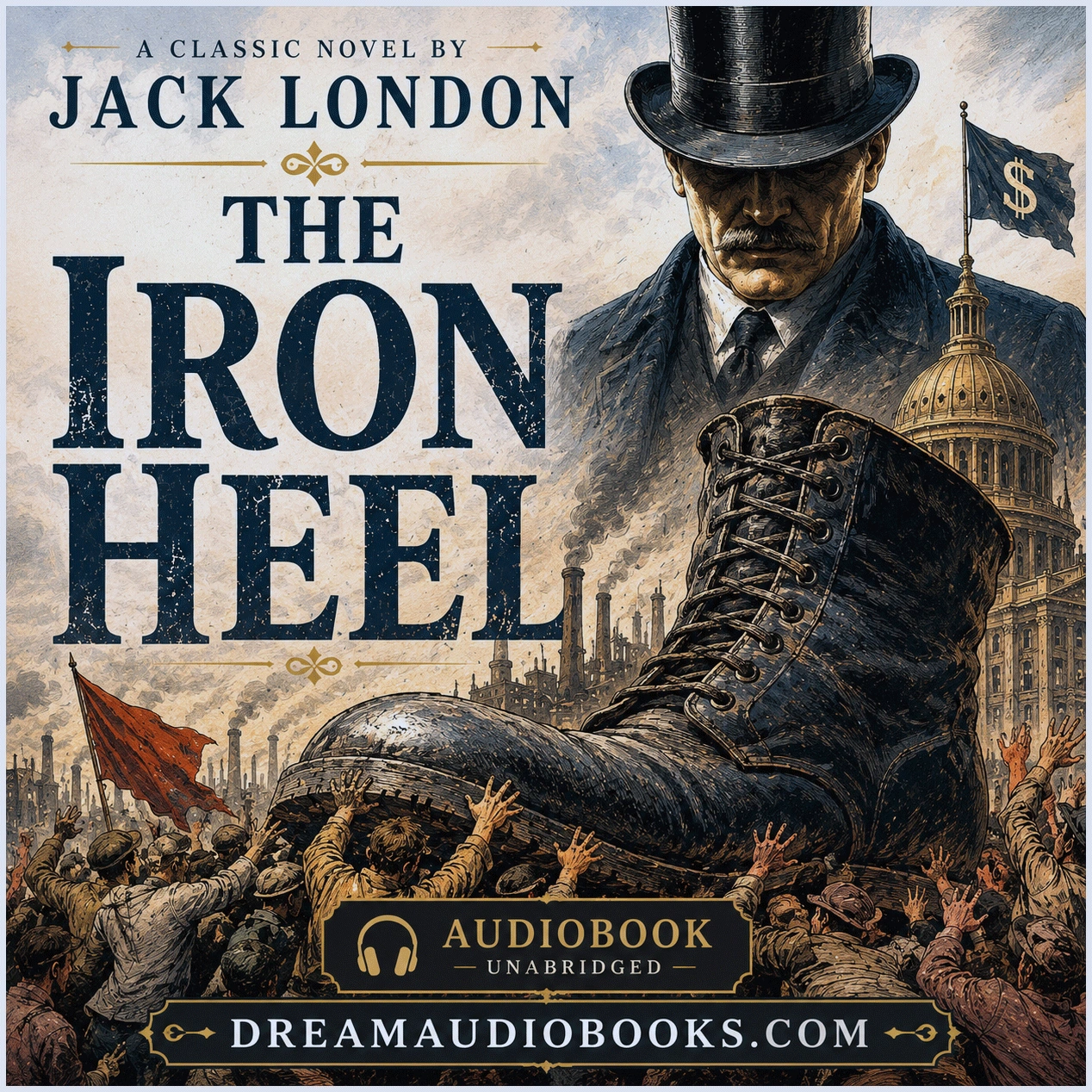
The giant boot represented in the novel’s title symbolizes this system. It suggests pressure from above, the destruction of individual resistance, and the use of organized force against ordinary people.
The image is powerful because a heel does not debate or persuade. It crushes. Yet the novel also shows that the boot is supported by laws, money, information, and social divisions rather than physical violence alone.
Major Themes in The Iron Heel
Concentrated Power
The central theme is the danger created when economic and political power becomes concentrated in the hands of a small group.
London suggests that wealth does not remain confined to private luxury. It can purchase newspapers, influence elections, shape education, control employment, and determine access to justice.
Class Conflict
The novel presents society as divided by material interests. Workers seek safety, wages, dignity, and control over their labor. Owners seek profit, stability, and protection of property.
These interests may sometimes be negotiated, but London argues that severe inequality eventually produces open conflict.
Democracy and Its Limits
Ernest initially participates in electoral politics, but the story questions whether democratic institutions can function when wealth is extremely unequal.
A vote may be formally equal, yet citizens do not possess equal control over newspapers, courts, employment, transportation, or political funding.
Propaganda and Information
Control of information is one of the oligarchy’s greatest weapons. Events can be hidden, distorted, or presented in ways that protect ruling interests.
Opposition leaders may be portrayed as criminals, dangerous extremists, or enemies of social order. Violence committed by authorities may be justified as necessary security.
Institutional Loyalty
Universities, churches, courts, newspapers, and political parties often present themselves as independent. The novel asks whether they can remain independent when they rely on powerful financial interests.
Individuals within these institutions may possess integrity, but institutional survival can encourage silence and conformity.
Resistance and Sacrifice
Ernest and Avis understand that they may not personally experience victory. Their struggle becomes an act of commitment to future generations.
This distinguishes sacrifice from immediate self-interest. They continue because they believe their actions contribute to a history larger than their own lives.
Love and Political Commitment
The relationship between Ernest and Avis is inseparable from their political struggle. Their love gives them strength, but it also increases their vulnerability.
They do not retreat into private happiness. Instead, their partnership becomes part of their resistance.
Historical Change
The future editor’s notes emphasize that social systems are temporary, even when they appear permanent to those living within them.
The Iron Heel will eventually fall, but its fall requires centuries. Historical progress is neither automatic nor quick.
The Iron Heel as an Early Dystopian Novel
The Iron Heel appeared decades before many of the twentieth century’s best-known dystopian novels. It anticipates themes later associated with authoritarian states, mass propaganda, controlled information, political surveillance, class division, and organized repression.
Unlike dystopias centered entirely on future technology, London’s vision grows from economic and political tendencies already visible in his own time.
The future is frightening because it does not require an impossible invention. The oligarchy develops from corporate consolidation, political influence, labor conflict, and institutional dependence.
The novel therefore feels both speculative and historically grounded. London takes recognizable structures and imagines what might happen if they continue expanding without effective resistance.
The Iron Heel does not eliminate every existing institution. Instead, it captures them. This is more subtle than destroying democracy openly.
Elections, courts, newspapers, and universities may continue to function, but their independence is gradually reduced. The outward appearance of normal life can survive while real power moves elsewhere.
This feature makes the book especially important in the history of dystopian fiction. It shows oppression emerging through a process rather than appearing fully formed.
Readers interested in the relationship between power, morality, and personal corruption may also enjoy The Picture of Dorian Gray. Oscar Wilde’s novel examines corruption within an individual, while Jack London examines corruption within an entire social order.
Political and Economic Conflict in the Novel
Jack London fills the novel with debates about labor, ownership, profit, socialism, democracy, and the role of institutions. These discussions are central to the story rather than decorative background.
Ernest repeatedly challenges members of the ruling class to explain the moral basis of their power. He argues that legal ownership does not automatically make an economic system just.
His opponents often respond by defending stability, tradition, efficiency, or personal success. They describe social hierarchy as natural or necessary.
The conflict becomes sharper because each side possesses different resources. Workers may have numbers, but the oligarchy controls organization, finance, transportation, communication, and military power.
The novel also criticizes the assumption that small businesses and the middle class will automatically oppose oligarchy. Many are destroyed by corporate consolidation, but their response is fragmented.
Some hope to recover their earlier position rather than join workers in creating a new system. By the time they recognize the scale of the threat, their independent power has already weakened.
London’s treatment of labor is equally complex. He shows that workers do not always act as one group. The oligarchy gives advantages to selected unions and skilled workers, encouraging them to protect their privileged position.
This division demonstrates how inequality can reproduce itself inside the opposition. A group may resist oppression when personally affected but accept the suffering of others in exchange for security.
For listeners interested in strategic conflict and the organization of power, The Art of War offers a very different but complementary exploration of planning, leadership, deception, strength, and the importance of understanding one’s opponent.
The political debates in The Iron Heel reflect the language and ideological struggles of the early twentieth century. Modern readers may disagree with London’s conclusions or predictions, but the novel remains valuable because it asks fundamental questions about who controls institutions and how power protects itself.
Jack London’s Vision and Writing Style
Jack London is often remembered for wilderness and maritime adventures, but The Iron Heel demonstrates the range of his interests. He was deeply concerned with labor, poverty, class, political organization, and the instability of industrial society.
His writing combines physical force with intellectual argument. Ernest Everhard is not merely a speaker; he is described as a powerful physical presence. Ideas in London’s fiction are often connected to bodies, hunger, work, exhaustion, and violence.
This approach gives political debate an immediate quality. The consequences of economic systems appear in injured workers, unemployed families, destroyed communities, and violent repression.
London also understood how to create memorable symbols. The phrase “Iron Heel” transforms a complicated network of corporate and political power into a single visual image.
The giant boot suggests domination, class hierarchy, and the crushing of resistance. It is simple enough to remember but broad enough to represent an entire system.
Compared with Martin Eden Audiobook, this novel is less focused on one person’s search for literary recognition and more concerned with collective history. Yet both works examine the relationship between individual effort and social structure.
Martin believes extraordinary discipline can overcome class barriers. Ernest argues that individual effort alone cannot transform institutions controlled by concentrated wealth.
Compared with The Sea-Wolf Audiobook, the difference is one of scale. Wolf Larsen dominates a ship through physical and intellectual superiority. The Iron Heel dominates a nation through organization, wealth, law, and force.
London’s style can be direct, argumentative, and dramatic. The speeches are often long because the novel is designed partly as a political warning. Yet the personal story of Avis and Ernest prevents the book from becoming only a theoretical essay.
Why Listen to The Iron Heel Audiobook?
The Iron Heel works especially well in audiobook form because much of its energy comes from speeches, debates, confrontations, testimony, and personal narration.
Ernest Everhard’s arguments gain additional force when heard aloud. His confidence, anger, irony, and determination become more immediate.
Avis’s narration creates a different emotional rhythm. She does not begin as a revolutionary. Her gradual awakening allows the listener to enter the political world step by step.
The audiobook is an excellent choice for listeners interested in dystopian fiction, political novels, speculative history, labor conflict, social criticism, resistance movements, and early science fiction.
It also offers historical value. The novel reflects debates about monopolies, industrial labor, socialism, wealth, and democracy during Jack London’s lifetime.
The complete unabridged edition preserves the long discussions and future editor’s commentary that give the book its intellectual depth. A summary can explain the rise of the oligarchy, but it cannot reproduce the process through which Avis begins to recognize how power operates.
The novel may be especially compelling for listeners who enjoy books that challenge assumptions rather than simply offer entertainment. It asks readers to examine the relationship between formal freedom and material power.
It also encourages critical thinking. London’s predictions should not be accepted automatically as historical certainty. Some proved inaccurate, some were exaggerated, and some remain strikingly relevant. The value of the book lies partly in comparing its fears with later history.
Listeners who appreciate intense examinations of ideology and moral responsibility may also enjoy Crime and Punishment, where abstract ideas lead to personal consequences, guilt, suffering, and a profound psychological crisis.
Frequently Asked Questions
Who wrote The Iron Heel?
The Iron Heel was written by American author Jack London and first published in 1908.
What is The Iron Heel about?
The novel describes the rise of a powerful oligarchy that controls industry, finance, politics, courts, media, and military force. It follows Avis and Ernest Everhard as they join the resistance against this system.
Is The Iron Heel a dystopian novel?
Yes. It is widely regarded as one of the earliest major dystopian political novels. It anticipates later fiction about authoritarianism, propaganda, surveillance, class division, and organized repression.
What does the Iron Heel symbolize?
The Iron Heel symbolizes the crushing power of a coordinated ruling oligarchy. The image represents wealth, political control, military force, and institutions pressing down upon ordinary people.
Who is Ernest Everhard?
Ernest Everhard is a socialist intellectual, political organizer, and revolutionary leader. He warns that concentrated corporate power will destroy democratic resistance.
Who is Avis Everhard?
Avis Everhard is the narrator. She begins as a privileged young woman and gradually becomes an investigator, political activist, revolutionary organizer, and witness to the rise of the Iron Heel.
Is the story based on real events?
The main plot and characters are fictional. However, Jack London drew on real labor conflicts, economic inequality, political debates, industrial consolidation, and socialist movements from his era.
Why does the novel contain footnotes?
The main narrative is presented as a historical manuscript discovered centuries later. A future scholar adds footnotes to explain the institutions, people, customs, and events of Avis’s time.
Is The Iron Heel political?
Yes. Politics, economics, labor, class conflict, socialism, democracy, and oligarchy are central to the story. The novel openly reflects Jack London’s political concerns.
Is the audiobook unabridged?
This DreamAudiobooks presentation is intended as a complete unabridged listening experience, preserving the narrative, debates, historical commentary, character development, and revolutionary conflict.
Where can I listen to The Iron Heel Audiobook?
You can listen through Spotify, Apple Podcasts, Podcast Addict, or Podchaser using the listening buttons at the beginning of this page.
Is The Iron Heel difficult to understand?
The novel contains long political and economic discussions, but its central conflict is clear. Listening chapter by chapter makes the arguments and historical structure easier to follow.
Is The Iron Heel still relevant?
The novel remains relevant because it explores concentrated wealth, institutional influence, propaganda, labor division, political repression, and the difficulty of challenging systems that control both economic and political resources.
Did Jack London predict the future accurately?
Not completely. Some of his predictions were wrong or highly exaggerated. However, several of his concerns about authoritarianism, corporate concentration, propaganda, and political violence influenced later dystopian literature.
Why is The Iron Heel important?
It is important because it helped develop the modern dystopian novel and combined speculative history with political analysis, romance, revolution, and an unusual documentary structure.
Begin The Iron Heel Audiobook
The Iron Heel Audiobook offers a powerful journey into a society where wealth, government, law, and information become concentrated under a single ruling system. Through the eyes of Avis Everhard, listeners witness how political awakening begins with investigation and grows into resistance.
Ernest Everhard’s warning is not that oppression always arrives suddenly. It may develop gradually while familiar institutions continue to appear normal. Economic dependence, controlled information, divided opposition, and legal power can prepare the ground before open violence begins.
The novel is not politically neutral, and listeners are not required to agree with every argument Jack London presents. Its lasting strength comes from the seriousness of its questions: How does wealth become political power? Can democratic institutions survive extreme inequality? Why do people defend systems that harm others? What sacrifices are justified in the struggle against oppression?
Choose your preferred listening platform above and experience this complete unabridged classic of dystopian fiction, political conflict, revolutionary courage, and resistance.
Presented by DreamAudiobooks — listen to timeless public-domain audiobooks and discover the greatest works of classic literature online.