
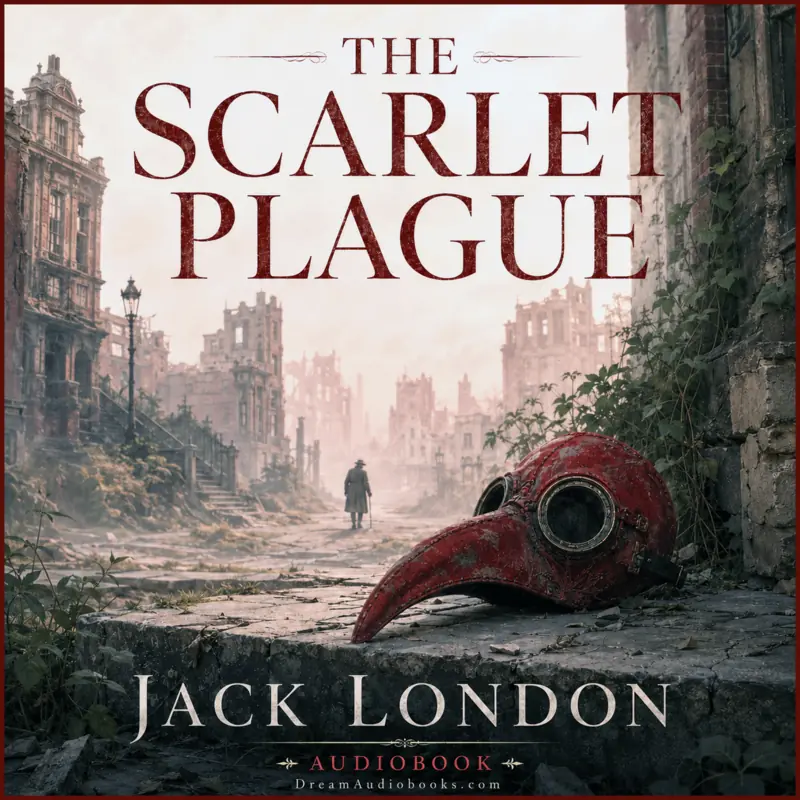
The Scarlet Plague Audiobook (Unabridged) – Listen Free
The Scarlet Plague audiobook brings Jack London’s unsettling post-apocalyptic classic to life in a complete, unabridged listening experience. First published in 1912, this short novel imagines a world in which a fast-moving epidemic destroys modern civilization and leaves only scattered groups of survivors. Decades later, an elderly man walks through the reclaimed landscape of California with three boys who have never known cities, schools, books, or organized society. His memories become the only bridge between the sophisticated world that disappeared and the primitive culture growing in its place.
London is best known for adventure stories such as The Call of the Wild and White Fang, but The Scarlet Plague reveals another side of his imagination. It combines speculative fiction, survival, social criticism, and philosophical reflection in a remarkably compact narrative. The catastrophe matters, yet the deeper subject is what happens to language, knowledge, status, and human identity when the institutions supporting them suddenly vanish.
Use the listening links below to hear the story on your preferred platform. You can then explore this guide for a spoiler-light introduction, a detailed account of the setting and characters, an examination of the novel’s major themes, and recommendations for related free classic audiobooks available through DreamAudiobooks.
Listen to The Scarlet Plague Audiobook Online
Choose any of the platforms below to start listening to The Scarlet Plague. Availability and playback features may differ by platform, so select the service that works best on your phone, tablet, computer, smart speaker, or connected audio system.
Listen on Spotify
Listen on Amazon Music / Audible
Listen on Podchaser
Listen on Deezer
This is an unabridged presentation of London’s text rather than a modern retelling. The story is concise enough for focused listening, yet rich enough to reward a second visit. Headphones can make the contrast between the quiet ruined landscape and the narrator’s memories of panic, crowds, and social collapse especially vivid.
The Scarlet Plague: Book Overview
| Title | The Scarlet Plague |
|---|---|
| Author | Jack London |
| First published | 1912 |
| Genre | Post-apocalyptic fiction, science fiction, dystopian literature |
| Setting | A future California decades after a global epidemic |
| Audiobook edition | Complete and unabridged |
The Scarlet Plague belongs to the early history of modern catastrophe fiction. Its premise is immediately recognizable today: a prosperous, technologically advanced society believes itself secure, only to discover that its complex systems can fail with terrifying speed. London does not spend hundreds of pages explaining scientific mechanisms or political responses. Instead, he looks backward from the aftermath. The reader sees civilization as a lost age remembered by one aging witness and misunderstood by children born long after its fall.
That framing device gives the novel its distinctive power. The ruined world is not presented as a temporary emergency waiting to be repaired. For the boys, it is normal life. They hunt, tend animals, make fires, and measure value through immediate physical needs. The old man, however, still remembers universities, transportation, crowded cities, money, law, and the enormous network of specialized labor that once supported daily existence. Every conversation between the generations exposes how much has been forgotten.
What Is The Scarlet Plague About?
The narrative is set in the San Francisco Bay Area many decades after an epidemic known as the Scarlet Death swept across the world. An old man commonly called Granser travels with his grandsons Edwin, Hoo-Hoo, and Hare-Lip. The boys possess practical survival skills, but their vocabulary is limited and their understanding of the former world is almost nonexistent. When Granser uses words associated with education or social organization, they interrupt, laugh, or demand explanations.
As the group moves through a landscape where wild animals roam and vegetation covers the traces of human construction, Granser tells them about his youth. Before the catastrophe, he was James Howard Smith, a professor of English literature. He lived within a society that appeared powerful, wealthy, and permanent. Then reports of a mysterious disease began to arrive. Those infected developed the sign that gave the plague its name, and death followed with extraordinary speed. Fear spread faster than institutions could respond.
Granser remembers the breakdown of public order, the desperate attempts to escape populated areas, and the growing realization that familiar systems no longer offered protection. The catastrophe erased distinctions that had seemed fundamental. Academic prestige, financial wealth, and professional rank lost their practical meaning when food, water, shelter, and distance from infection became the only urgent concerns. Survivors were forced into a world governed by physical necessity.
The novel’s central tension does not depend on whether civilization will be restored during the story. Instead, it comes from Granser’s effort to communicate the meaning of civilization to listeners who lack the concepts required to understand him. His grandsons know that ruins exist, but they cannot emotionally grasp the scale of the population, knowledge, and coordinated activity that produced them. To the boys, the old man’s memories often sound exaggerated or absurd.
This structure allows London to tell two stories at once. One is the direct account of the epidemic and the narrator’s survival. The other is the quieter tragedy of cultural memory disappearing. Granser has preserved fragments of the past, but he cannot preserve them indefinitely by himself. Unless knowledge is taught, recorded, and valued by a new generation, the old world will vanish a second time—first materially, then intellectually.
Main Characters in The Scarlet Plague
James Howard Smith, or Granser
Granser is the narrator within the story and its emotional center. Once a university professor, he is now an elderly survivor whose appearance and circumstances contrast sharply with his former identity. His education lets him describe the lost world precisely, but it also isolates him. He carries a vocabulary, a historical memory, and a set of cultural assumptions that the boys do not share.
He is not simply a heroic guardian of perfect knowledge. Granser can be proud, impatient, sentimental, and painfully aware that his listeners do not fully respect him. His memories reveal both admiration for civilization’s achievements and recognition of its inequalities. Because he has lived in two radically different social orders, he becomes London’s instrument for comparing them.
Edwin
Edwin is generally the most receptive of the boys. He shows curiosity about Granser’s account and occasionally tries to understand ideas beyond his immediate experience. His interest suggests that knowledge may not disappear completely. Even so, the distance between hearing a story and rebuilding a culture remains enormous.
Hoo-Hoo and Hare-Lip
Hoo-Hoo and Hare-Lip often respond with impatience, mockery, or practical questions. Their reactions can be humorous, but the humor has a serious function. They demonstrate how quickly language and social meaning change when the world that produced them is gone. A word that once identified a profession, institution, or class becomes useless when no living experience corresponds to it.
The boys should not be dismissed as unintelligent. They possess knowledge suited to their environment: animals, weather, movement, food, danger, and tribal relationships. The contrast is not simply between educated and ignorant people. It is between two forms of knowledge shaped by completely different conditions. London asks readers to consider which skills endure when the systems surrounding formal education collapse.
A Civilization Reclaimed by Nature
One of the most memorable elements of The Scarlet Plague is its vision of nature returning after human populations disappear. Roads no longer carry traffic. Buildings lose their intended purposes. Domestic animals change, wild creatures expand their territory, and plants gradually cover spaces once controlled by engineering and constant maintenance. The landscape becomes both beautiful and unsettling.
London does not present nature as malicious. The natural world simply continues. Human civilization, which once appeared dominant, is revealed as a temporary arrangement requiring uninterrupted labor. A city is not only its stone, wood, and metal. It is also the millions of repeated actions that maintain water systems, transportation, food distribution, communication, security, and repair. When those actions stop, physical structures remain for a time, but the living city has already vanished.
This aspect of the book connects with London’s broader interest in survival and the pressure of environment. In The Sea-Wolf audiobook, human beings confront danger, power, and moral conflict at sea. In Before Adam, London imagines humanity through a much earlier stage of development. The Scarlet Plague reverses the usual story of progress: a complex society moves backward, and knowledge that took centuries to accumulate becomes inaccessible within a few generations.
Major Themes in The Scarlet Plague Audiobook
The fragility of civilization
The novel’s most direct idea is that civilization is less permanent than its inhabitants assume. Before the epidemic, people depend on institutions so completely that those systems feel like natural facts. London strips them away and reveals the cooperation beneath ordinary life. Electricity, food, law, education, medicine, and communication exist because large numbers of people maintain them. When coordination fails, individual wealth cannot easily replace collective infrastructure.
This is not an argument that social collapse is inevitable. It is a warning against confusing complexity with invulnerability. The more specialized a society becomes, the more each person depends on work performed by strangers. London’s future world dramatizes the consequences of that network breaking faster than people can adapt.
Knowledge, language, and memory
Granser’s difficulty speaking with his grandsons is more than a generational disagreement. Language preserves distinctions, histories, and ways of thinking. When institutions disappear, the words describing them may also fade. The boys simplify unfamiliar terms because those terms have no practical place in their lives. Their reduced vocabulary reflects a reduced cultural inheritance, not a biological decline in intelligence.
The audiobook format makes this theme particularly noticeable. Listeners hear an educated voice trying to explain a vanished reality through speech alone. Granser’s story resembles an oral history told at the edge of forgetting. The act of narration becomes a form of resistance: if someone listens and remembers, part of the old world may survive.
Social class and the instability of status
London repeatedly questions the permanence of social hierarchy. Before the plague, status depends on money, occupation, education, and institutional recognition. Afterward, physical strength, access to resources, and membership in a protective group become more important. People who once possessed little formal authority may gain power, while respected professionals discover that their credentials cannot secure food or safety.
Yet the disappearance of one hierarchy does not produce equality. New forms of dominance appear. Strength, aggression, and control over scarce resources can create harsh social orders of their own. The novel therefore avoids a simple fantasy in which catastrophe cleanses society and makes everyone free. Collapse removes certain injustices while creating new opportunities for coercion.
Progress and regression
The boys’ world seems primitive compared with Granser’s memories, but London complicates the language of progress. Modern society possesses advanced technology and enormous stores of knowledge, yet it is unable to prevent its destruction. The survivors are materially poorer, but they are adapted to their environment. The book asks whether progress is secure when most individuals cannot reproduce or even explain the systems on which they depend.
Granser hopes that humanity may eventually rebuild. History, however, may not repeat in a straight upward line. Knowledge can be recovered, distorted, or lost again. That uncertainty makes the novel more provocative than a straightforward disaster adventure. The future remains open, but restoration requires curiosity, teaching, cooperation, and time.
Survival versus culture
Immediate survival rightly dominates the post-plague world. The boys need food, shelter, and protection. Granser wants them to value ideas that do not always offer an immediate physical benefit. This conflict raises a difficult question: when resources are scarce, how much effort can a community devote to literature, history, science, or abstract learning?
London does not treat culture as decoration. Granser’s identity depends on memory and language. Without culture, humanity may survive biologically while losing much of what connects generations. At the same time, knowledge survives only when living people possess the security and motivation to preserve it. The novel shows that physical survival and cultural survival are different achievements, but a durable civilization needs both.
Jack London’s Writing Style
London writes with the directness associated with his adventure fiction, but the structure of The Scarlet Plague gives him room for satire and reflection. The physical journey through California provides a clear narrative frame, while Granser’s memories supply urgency and scale. This movement between quiet aftermath and remembered catastrophe prevents the philosophical ideas from becoming detached from the story.
The contrast in speech is especially important. Granser uses the language of the educated world; the boys speak in a simplified form shaped by their new culture. Their interruptions break the solemnity of his account and remind readers that his audience does not share their assumptions. What seems tragic to Granser can seem irrelevant to children concerned with hunting or teasing one another.
London’s imagery is economical. Ruins, animals, vegetation, abandoned routes, and scattered remnants of technology allow listeners to imagine the scale of the loss without lengthy architectural description. The most effective scenes often place evidence of the former civilization beside ordinary activities of the new one. That juxtaposition turns the landscape into a silent argument about time.
Readers who appreciate London’s attention to ambition, education, and social position may also enjoy Martin Eden. Although its setting is not apocalyptic, it explores the relationship between knowledge, class, individual striving, and the society that assigns value to them. Together, the two books show how widely London’s fiction ranges beyond wilderness adventure.
Why The Scarlet Plague Still Matters
The Scarlet Plague appeared before post-apocalyptic fiction became a familiar category in books, films, television, and games. Many later catastrophe stories would use similar images: empty cities, nature reclaiming constructed spaces, scattered survivors, and children who know the old world only through stories. London helped demonstrate how these elements could support not only adventure, but also social and philosophical criticism.
The book’s continued relevance does not depend on treating it as a literal prediction. Some imagined details reflect the assumptions of London’s era, and the narrative is not a scientific model of epidemic response. Its strength lies elsewhere. It recognizes that civilization is a system of relationships, habits, institutions, and shared knowledge. Destroying buildings is not the only way to destroy a world; breaking continuity between people can be equally decisive.
At the same time, the novella should not be reduced to a warning about disease. It is equally concerned with inequality, institutional dependence, historical memory, and the recurring human desire for power. Reading it only as an epidemic story would miss much of London’s argument. The plague is the event that exposes the structure of society; the aftermath is where the deeper examination begins.
Why Listen to The Scarlet Plague Audiobook?
An audiobook is especially well suited to a story built around one person recounting the past. Granser is not writing a formal history. He is speaking to an impatient audience while traveling through the remains of the world he remembers. Listening restores that oral quality. Pauses, changes of pace, and differences between reflective and urgent passages help distinguish the old man’s present journey from his memories of the outbreak.
For language learners, following the audio alongside a legally available text can help with pronunciation, rhythm, and comprehension. Some of the vocabulary reflects the period in which London wrote, but the central action remains clear. Listeners may find it useful to pause after major sections and summarize the contrast between Granser’s memories and the boys’ reactions.
The complete, unabridged edition preserves the author’s structure and language. That matters because the philosophical passages are not optional additions to an adventure plot; they are central to the book’s purpose. An abridged version could communicate the catastrophe while weakening the discussion of class, memory, and cultural loss.
Who Will Enjoy This Audiobook?
The Scarlet Plague is a strong choice for listeners who enjoy classic science fiction, dystopian and post-apocalyptic stories, survival narratives, social criticism, or speculative accounts of lost civilization. It is also suitable for readers who know Jack London mainly through animal and wilderness fiction and want to discover a different part of his work.
The book may appeal to fans of The Lost World audiobook, where adventure meets speculation about a world beyond ordinary experience, or The Island of Doctor Moreau, which uses science fiction to examine disturbing questions about humanity and social boundaries. Listeners who prefer darker atmosphere may also explore At the Mountains of Madness.
However, anyone expecting a detailed medical thriller or a modern technical account of pandemic management should adjust those expectations. London’s interest is primarily social and symbolic. The disease moves rapidly because it must clear the stage for his investigation of what remains afterward. The novella is most rewarding when approached as an imaginative thought experiment rather than a realistic procedural narrative.
Related Free Classic Audiobooks
Continue exploring Jack London and classic speculative fiction with these selections from DreamAudiobooks:
- The Call of the Wild — A powerful story of instinct, adaptation, and survival in the Yukon.
- White Fang — London follows a wild animal’s difficult movement toward human companionship.
- The Sea-Wolf — A tense maritime novel about survival, power, intellect, and morality.
- Martin Eden — An ambitious young man pursues education and literary success while confronting class divisions.
- Before Adam — A speculative journey into humanity’s distant prehistoric past.
- The Lost World — Explorers enter an isolated land where prehistoric creatures survive.
- The Island of Doctor Moreau — H. G. Wells combines scientific imagination with moral horror.
- Frankenstein — Mary Shelley’s foundational novel about creation, responsibility, and isolation.
Frequently Asked Questions
Is The Scarlet Plague audiobook unabridged?
Yes. The listening edition linked on this page presents Jack London’s complete novella rather than a shortened summary or modern adaptation.
Where can I listen to The Scarlet Plague audiobook?
You can use the buttons near the top of this page to listen through Apple Podcasts, Spotify, Amazon Music / Audible, Podchaser, or Deezer. Platform availability can vary by country and device.
Is The Scarlet Plague a science-fiction novel?
Yes. It is commonly classified as science fiction and post-apocalyptic fiction. London imagines a future epidemic and uses the resulting collapse to explore society, technology, class, language, and survival.
When was The Scarlet Plague written?
The story was first published in 1912. Its early date is important because London developed many images and questions that later became familiar features of post-apocalyptic storytelling.
Is The Scarlet Plague connected to The Call of the Wild?
No. They are separate works with different characters and settings. Both, however, reflect London’s interest in adaptation, environment, instinct, and the pressure extreme conditions place on individuals.
Is this audiobook suitable for new readers of Jack London?
Yes. Its manageable length, clear central premise, and memorable themes make it a useful introduction to London beyond his best-known wilderness stories. Readers can then continue with The Call of the Wild, White Fang, The Sea-Wolf, or Martin Eden.
Why is the book called The Scarlet Plague?
The title refers to the visible scarlet sign associated with the fictional disease. The color also becomes a symbol of fear, rapid mortality, and the catastrophe that separates the old civilization from the survivors’ world.
Does the story focus mainly on the outbreak?
The outbreak is crucial, but much of the novel’s meaning comes from the aftermath. Granser’s memories are framed by his conversations with descendants who cannot understand the institutions, language, or values of the vanished society.
Start Listening Today
The Scarlet Plague remains memorable because it looks beyond the immediate terror of catastrophe. Jack London asks what happens to knowledge after teachers, schools, and readers disappear; what wealth means after markets collapse; and how quickly the achievements of one era can become incomprehensible legends to the next.
Listen to The Scarlet Plague audiobook through your preferred platform and experience a foundational work of post-apocalyptic fiction. Then continue your journey through Jack London’s adventurous and socially observant writing with the related audiobooks above. DreamAudiobooks brings classic literature together in one growing collection, making it easier to discover, compare, and enjoy remarkable works wherever you listen.