
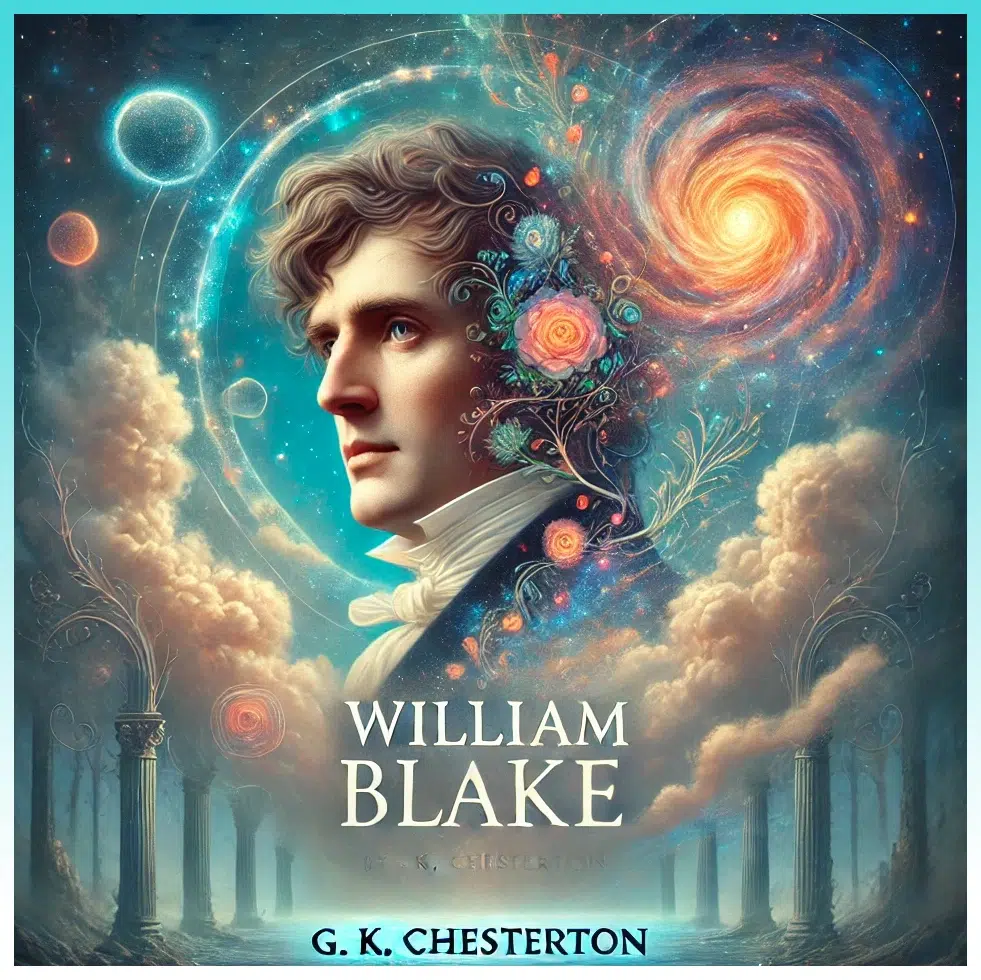
William Blake Audiobook by G. K. Chesterton
William Blake (1757–1827) is one of the most imaginative and unconventional figures in English literature and art. Though he lived a modest life and was largely unrecognized by his contemporaries, Blake is now celebrated as a visionary poet, engraver, painter, and mystic whose works reshaped the boundaries of creativity. His poetry blends myth, symbolism, and spirituality; his art challenges conventional forms; and together, his works form a universe of imagination unmatched in English culture.
Biography and early life of William Blake
William Blake was born in London to a family of modest means. From a young age, he displayed strong artistic talent and a deep sensitivity to spiritual experience. According to his own accounts, he saw angels, prophets, and celestial beings throughout his childhood. His parents, though puzzled, supported his artistic gifts and allowed him to apprentice as an engraver at the age of fourteen. Engraving became Blake’s primary profession and the foundation for his later artistic innovations. While many viewed engraving as a purely technical craft, Blake transformed it into a spiritual and imaginative process.
Imagination and spiritual vision
For William Blake, imagination was not mere fantasy but the deepest form of reality. He believed the senses limit human perception and that true vision comes from inner revelation. This conviction shapes nearly all his works, from his early poems to his later illuminated books. Blake rejected the cold rationalism of the Enlightenment and the rigid morality of institutional religion. Instead, he embraced a personal spirituality rooted in intuition, freedom, and visionary experience—an outlook that resonates with readers who also love reflective works such as “Walden” or the wisdom of the “Daodejing”.
Songs of Innocence and Songs of Experience
Blake’s earliest published collection, Poetical Sketches (1783), gained little attention but already hinted at his unique voice and rebellious spirit. His true breakthrough came with Songs of Innocence (1789), a series of illustrated poems that explore childhood, nature, purity, and divine love. These poems present a world untouched by corruption, where children sing, lambs symbolize innocence, and God appears as a nurturing presence. Blake personally engraved the poems and illustrations on copper plates using a technique he later called “illuminated printing,” which allowed him to fuse text and image into a single work of art.
Five years later, he published Songs of Experience (1794), a darker and more mature counterpart. Here, the world is seen through the eyes of suffering, oppression, and disillusionment. Famous poems like “The Tyger” and “London” reveal the harsh realities of society: poverty, child labor, moral hypocrisy, and the loss of innocence. The contrast between innocence and experience became one of Blake’s central themes. He believed the human soul moves through both states and that true wisdom comes from uniting them, rather than idealizing innocence or condemning experience.
Mythology and prophetic books
William Blake’s religious ideas were complex and fiercely independent. He believed institutional religion restricted human freedom and imagination. His works frequently criticize the Church for promoting guilt, repression, and blind obedience. In poems such as “The Garden of Love,” he shows how rigid doctrines destroy natural joy and creativity.
To express his beliefs, Blake created an elaborate personal mythology. Figures such as Urizen, Los, Orc, and Enitharmon represent cosmic forces, psychological states, and moral principles. Through these symbolic characters he explored creation, oppression, rebellion, and the struggle for human liberation. His ambitious prophetic books—among them Jerusalem, Milton, and The Book of Urizen—blend biblical language with his own mythological system, examining the human condition on a cosmic scale.
William Blake as artist and illustrator
Blake’s genius extended far beyond poetry. He was also an extraordinary painter and engraver. His illustrations for the Bible, Dante’s Divine Comedy, Milton’s Paradise Lost, and his own poems are celebrated for their expressive power and daring originality. His figures often appear weightless, suspended between the material and spiritual worlds. Through visual art, Blake sought to reveal what he called the “eternal world”—a reality invisible to ordinary perception but accessible through imagination.
Readers who enjoy the atmospheric intensity of works like “Wuthering Heights” or the rich symbolism of “The Picture of Dorian Gray” often find Blake’s images and verse particularly compelling, as they share the same fascination with inner vision and moral conflict.
Reception, influence, and legacy
Despite his immense creativity, William Blake lived most of his life in relative poverty. His unconventional ideas and artistic style made him difficult for the public of his time to understand, and some critics dismissed him as eccentric or even mad. Yet Blake remained devoted to his vision, supported by a small circle of loyal friends and by his wife, Catherine Blake, who helped him print and hand-color his illuminated books.
Today, William Blake is recognized as a central figure of the Romantic movement. His works influenced generations of writers, artists, and thinkers. Romantic poets such as Wordsworth, Coleridge, and Shelley admired his celebration of imagination and emotion. In the twentieth century, Blake became an icon for modern artists, musicians, and philosophers who found inspiration in his rebellion against conformity. His poem “Jerusalem,” set to music, became one of the most famous hymns in Britain. Lines like “To see a world in a grain of sand” remain among the most quoted in English literature and sit comfortably beside other classics on Dream Audiobooks, from “Pride and Prejudice” to “The Great Gatsby”.
Why William Blake still matters today
Blake’s enduring legacy lies in his unwavering belief in imagination as a source of truth and liberation. At a time when society celebrated reason, order, and industrial progress, William Blake insisted that human beings must look inward to find meaning. He saw imagination not as an escape from reality but as the essence of reality itself. His works challenge us to question our assumptions, reject injustice, and cultivate a more profound spiritual awareness.
To read—or listen to—William Blake is to enter a universe of passion, myth, and luminous symbolism. It is a world where angels appear over city rooftops, tigers burn bright in the forests of the night, and humanity’s deepest truths are revealed through vision. His poetry and art remind us that the human spirit is boundless and that imagination has the power to transform both the individual and the world.