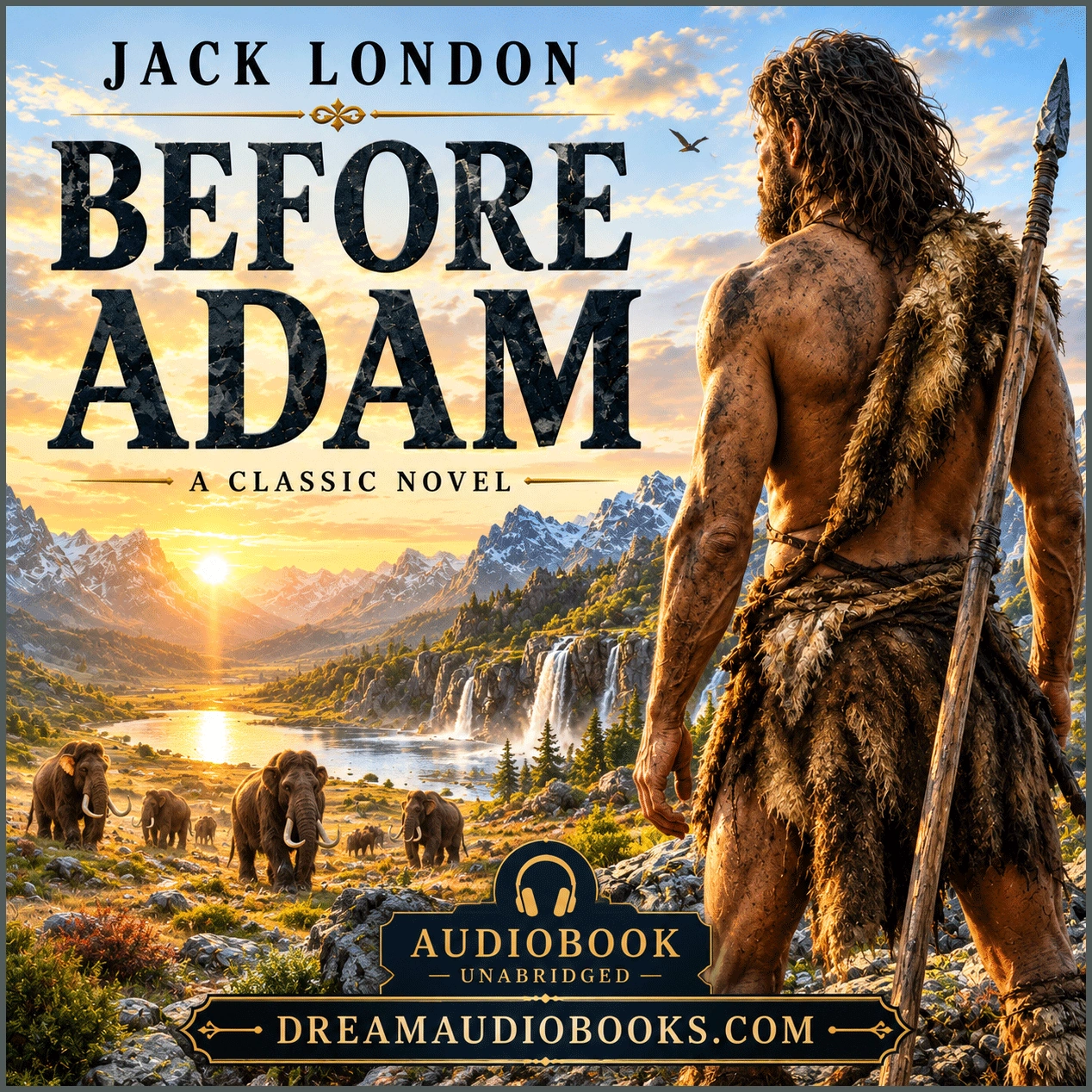
Before Adam Audiobook (Unabridged) – Listen Free
Listen to Before Adam Audiobook Free
Before Adam Audiobook by Jack London is available as a complete unabridged listening experience on several major audiobook and podcast platforms. Choose your preferred service below and enter an imaginative prehistoric world of danger, evolution, survival, and ancestral memory.
Introduction to Before Adam by Jack London
Before Adam is one of Jack London’s most imaginative and unusual novels. First published in 1907, it moves far beyond the familiar ships, frozen wildernesses, and industrial cities associated with much of London’s fiction. Instead, it carries listeners into a distant prehistoric age, long before written history, agriculture, cities, or modern civilization.
The story is told by a modern narrator who experiences recurring dreams of a primitive ancestor called Big-Tooth. These dreams do not feel like ordinary fantasies. They possess continuity, emotional intensity, and detailed memories of a vanished world. Through them, the narrator relives the struggles of an early human-like creature living among trees, caves, predators, rival tribes, and more advanced competitors.
This unusual structure allows Jack London to combine prehistoric adventure with speculative ideas about evolution, inherited memory, instinct, and the development of humanity. The result is neither a conventional historical novel nor a purely scientific account. It is a work of fiction shaped by the evolutionary theories and anthropological interests of the early twentieth century.
At the center of the novel is survival. Big-Tooth belongs to a vulnerable group known as the Folk. They are intelligent enough to use simple tools, organize limited social relationships, and recognize danger, yet they lack the technological and cultural advantages of more advanced human groups.
Every day presents a threat. Predators move through the forest. Rival creatures attack without warning. Food must be found, shelter protected, and fire understood from a distance before it can be controlled. The prehistoric world is beautiful, but it is never safe.
Jack London uses this setting to explore questions that appear throughout his writing. What allows one being to survive while another disappears? How do strength, intelligence, cooperation, and adaptation shape life? What separates instinct from thought? What does civilization gain, and what does it leave behind?
Listeners familiar with The Call of the Wild and White Fang will recognize London’s fascination with inherited instinct and the pressure of environment. In those novels, animals are transformed by wilderness and human influence. In Before Adam, London imagines the much earlier transformation of human life itself.
What Is Before Adam About?
The novel begins with an unnamed modern narrator reflecting on strange dreams that have followed him since childhood. These dreams are vivid, repeated, and connected. He does not merely observe a prehistoric world; he experiences it through the senses of another being.
That being is Big-Tooth, a young member of the Folk. Big-Tooth lives during a remote stage of human evolution when several human-like groups occupy the same landscape. The Folk are relatively small, timid, and partly adapted to life in trees. They possess limited language and simple social customs but remain highly vulnerable.
Big-Tooth grows up among caves, branches, rivers, and open country. He learns through fear, imitation, and direct experience. There are no formal lessons, written rules, or organized institutions. Knowledge is preserved through behavior and instinct.
One of Big-Tooth’s closest companions is Lop-Ear. Together, they explore the environment, seek food, escape predators, and observe the strange behavior of other creatures. Their friendship introduces cooperation into a world otherwise dominated by immediate survival.
The Folk are not alone. They encounter more primitive tree-dwelling creatures whose behavior remains closer to that of animals. They also fear a more advanced group known as the Fire People. These rivals possess stronger social organization, better weapons, and control of fire.
The contrast between the groups becomes central to the novel. The Folk survive through familiarity with their environment, agility, and cautious behavior. The Fire People possess a technological advantage that changes the balance of power.
Big-Tooth is fascinated by fire even before he fully understands it. Fire provides warmth, protection, light, and the ability to alter food and landscape. Yet it also becomes a weapon in the hands of a more powerful group.
As Big-Tooth matures, he forms a bond with a young female called Swift One. Their relationship introduces affection, jealousy, loyalty, and the early beginnings of more stable partnership. However, personal bonds remain fragile in a world where violence can destroy an entire community.
The greatest human threat comes from Red-Eye, a brutal and physically powerful member of the Folk. Red-Eye represents uncontrolled aggression within the community. He dominates through fear rather than cooperation and threatens those around him, including women and weaker males.
The Folk therefore face danger from both outside and within. Predators attack from the forest. The Fire People possess superior technology. Red-Eye uses violence against his own group. These pressures reveal how social survival requires more than individual strength.
The novel follows Big-Tooth through episodes of exploration, fear, conflict, companionship, migration, and loss. Jack London does not present prehistoric life as a peaceful natural paradise. It is governed by hunger, competition, territorial behavior, and constant uncertainty.
At the same time, Big-Tooth experiences curiosity, playfulness, affection, memory, and imagination. These qualities suggest the emotional and intellectual foundations from which later humanity may emerge.
The narrator’s dreams eventually form a complete prehistoric narrative. He comes to believe that they may represent inherited memories from an ancestral life. Whether taken literally or symbolically, this idea connects modern consciousness to a much older struggle for survival.
Like The Lost World Audiobook, the novel transports its audience into a vanished environment filled with ancient danger. However, while Arthur Conan Doyle imagines prehistoric creatures surviving into modern times, Jack London sends the modern mind backward into humanity’s evolutionary past.
Main Characters in Before Adam
Big-Tooth
Big-Tooth is the prehistoric ancestor whose life is experienced through the narrator’s dreams. He is curious, cautious, observant, and more imaginative than many members of the Folk.
He is not a modern human placed inside a prehistoric body. His understanding is limited by the stage of development of his group. He cannot explain natural events scientifically, and his language remains basic. Nevertheless, he can remember, plan, recognize patterns, and form emotional bonds.
Big-Tooth survives partly because he learns. He watches other beings, remembers dangerous places, experiments with objects, and adapts his behavior. His curiosity sometimes exposes him to danger, but it also represents an evolutionary advantage.
The Modern Narrator
The unnamed narrator lives in the modern world but carries the dreams of Big-Tooth. He attempts to understand why these memories feel so real and why they continue in sequence.
His role creates a bridge between civilization and prehistory. Modern humans may appear completely separated from early ancestors, yet the narrator suggests that traces of primitive fear, instinct, and memory remain within the mind.
Lop-Ear
Lop-Ear is Big-Tooth’s closest companion. Their friendship is one of the novel’s most human and emotionally engaging elements.
Together, they play, explore, search for food, and face danger. Lop-Ear is sometimes more impulsive, while Big-Tooth may be more cautious. Their partnership demonstrates that cooperation can improve survival.
Their bond also shows that companionship existed long before formal society. Loyalty, trust, and shared experience become powerful forces even in a primitive world.
Swift One
Swift One is a young female member of the Folk who becomes important to Big-Tooth. She is agile, alert, and capable of acting independently.
Big-Tooth’s feelings toward her reflect attraction, attachment, protectiveness, and jealousy. Their relationship suggests the beginnings of stable emotional partnership beyond immediate instinct.
Red-Eye
Red-Eye is the most frightening individual among the Folk. He is larger, stronger, and more violent than those around him. He uses physical power to dominate the community.
He represents brutality without restraint. Unlike predators that kill for food, Red-Eye often acts through anger, possession, and aggression.
His behavior reveals that danger does not always come from another species or rival group. A community can also be threatened by members who exploit their strength without concern for others.
The Fire People
The Fire People are a more advanced human group. They control fire, use better weapons, and possess stronger social organization.
They represent evolutionary and technological change. Their advantages allow them to dominate groups that have not developed the same skills.
However, progress does not automatically mean kindness. The Fire People use their abilities to attack and displace the Folk. Technology increases power, but not necessarily morality.
Ancestral Dreams and Racial Memory
The central literary device in Before Adam is the narrator’s experience of ancestral memory. He dreams events that appear to belong to an early predecessor rather than to his own life.
Jack London presents these dreams as connected memories rather than random images. Places remain consistent. Characters reappear. Events develop over time. The narrator experiences childhood, maturity, danger, and loss through Big-Tooth.
The concept reflects speculative ideas that circulated during London’s period. Some thinkers wondered whether inherited instincts might contain traces of ancestral experience.
Modern genetics does not support the idea that detailed autobiographical memories are inherited in the way the novel imagines. A person does not genetically remember the specific experiences of a prehistoric ancestor.
However, inherited biological tendencies, reflexes, and behavioral predispositions are real. Fear responses, attachment patterns, and survival instincts have evolutionary foundations. London transforms this general truth into a dramatic fictional possibility.
The ancestral dream therefore works symbolically even when it is not accepted scientifically. It suggests that modern civilization rests upon an extremely long history of fear, hunger, adaptation, and competition.
The narrator’s modern mind may use language, science, and reflection, but the emotional force of Big-Tooth’s world remains recognizable. Darkness, isolation, sudden movement, heights, predators, and violence still affect the human nervous system.
This connection between the modern and primitive mind gives the novel psychological depth. The past is not completely dead. It survives through the body, instinct, imagination, and the structures of fear.
Listeners interested in introspection and the relationship between individual consciousness and nature may also appreciate Walden Audiobook. Thoreau examines a modern person’s deliberate return to simplicity, while London imagines a consciousness returning involuntarily to humanity’s distant beginnings.
The Prehistoric World of Before Adam
Jack London creates a vivid environment of forests, caves, rivers, open plains, cliffs, and dangerous pathways. The landscape is not simply a background. It determines how every character moves, sleeps, searches for food, and avoids death.
The Folk depend heavily on trees and elevated shelter. Height provides protection from some predators, while caves offer security and communal space. Yet both forms of shelter have risks.
Waterways shape movement and create natural barriers. Open ground may offer food or visibility but exposes individuals to attack. Dense vegetation provides hiding places for both prey and predators.
Animals occupy an important place in the story. The prehistoric world contains large predators, dangerous reptiles, and other creatures capable of killing vulnerable members of the Folk.
London emphasizes the importance of attention. A moment of carelessness can be fatal. Survival requires listening, watching, smelling, remembering, and responding quickly.
The environment also shapes social development. Groups form around secure shelter and access to food. Rival communities compete for territory. The ability to use weapons or fire alters who can occupy a particular region.
The world is violent, but it also contains beauty. Big-Tooth experiences sunlight, movement, water, companionship, and curiosity. Play and exploration exist beside hunger and fear.
This balance prevents the prehistoric setting from becoming merely grotesque. London imagines early life as emotionally limited compared with modern humanity, but not empty.
Readers who enjoy dangerous natural environments may also explore The Jungle Book, where law, survival, belonging, and animal behavior shape life within a very different wilderness.
Major Themes in Before Adam
Survival and Adaptation
The most important theme is survival through adaptation. Big-Tooth cannot control the environment, but he can observe it and adjust his behavior.
Individuals who fail to recognize danger are removed quickly. Those who remember, cooperate, and experiment gain an advantage.
Evolution
The novel imagines humanity as part of a long biological process rather than a separate creation appearing fully developed.
The Folk, Tree People, and Fire People represent different levels of physical, intellectual, and social development. Their coexistence dramatizes competition between related groups.
Technology and Power
Control of fire and better weapons gives the Fire People enormous power. Technology changes the relationship between individuals, communities, and nature.
However, London does not present technology as morally neutral in its consequences. It can protect, warm, and feed, but it can also destroy weaker populations.
Cooperation
Friendship between Big-Tooth and Lop-Ear demonstrates the value of cooperation. Two individuals can watch for danger, share experience, and support one another.
The Folk remain vulnerable partly because their social organization is weak. More advanced groups succeed through coordinated action.
Violence Within the Community
Red-Eye represents destructive power inside the Folk. His violence weakens those who should be cooperating against external threats.
The novel suggests that physical strength without social restraint can damage the survival of an entire group.
Curiosity and Intelligence
Big-Tooth’s curiosity separates him from less adaptable individuals. He investigates objects, observes other groups, and forms memories that influence future behavior.
Curiosity is dangerous because exploration creates exposure. Yet it is also essential to learning and innovation.
Fear and Memory
Fear is not presented simply as weakness. It is an adaptive response that keeps vulnerable beings alive.
Memory transforms fear into knowledge. A dangerous event becomes useful when it changes later behavior.
Displacement
The advance of the Fire People threatens the existence of the Folk. A technologically superior group can take territory and resources from a weaker population.
This theme gives the novel a tragic historical dimension. Evolutionary success for one group may mean extinction for another.
The Primitive Mind in Modern Humanity
The narrator’s dreams imply that modern people still contain ancient emotional structures. Civilization changes behavior, but it does not completely erase instinct.
Fear of darkness, sudden violence, isolation, and predators may be connected symbolically to countless generations of survival.
Evolution and Early Humanity
Before Adam was written during a period of intense public interest in evolutionary theory. Scientific discoveries were changing the way people understood human origins, geological time, and the relationship between humans and other animals.
Jack London was strongly influenced by ideas of evolution, competition, adaptation, and environmental pressure. These ideas appear throughout his fiction.
In The Call of the Wild, Buck reconnects with inherited instincts under the pressure of the northern wilderness. In White Fang, environment and experience shape the development of a wolf-dog moving between wilderness and human society.
In Before Adam, London applies similar ideas to humanity’s distant ancestors. The characters are shaped by natural selection, competition, climate, predators, social organization, and technology.
The scientific details should not be treated as an accurate modern reconstruction of human evolution. Anthropology and paleoanthropology have advanced enormously since 1907.
Human evolution was not a simple straight line from primitive tree creatures to modern civilization. Multiple human species and populations existed, interacted, migrated, and sometimes interbred across long periods.
The novel’s value lies in imaginative speculation rather than scientific precision. It helped readers picture humanity as a product of deep time and biological history.
London also understood that intelligence alone does not determine survival. Physical adaptation, group cooperation, technology, and environment all matter.
The Fire People succeed because several advantages work together. They possess fire, weapons, organization, and the ability to coordinate attacks. The Folk cannot overcome these combined strengths through individual bravery alone.
This idea connects with The Art of War, where organization, preparation, knowledge, and strategic advantage matter more than raw courage.
Jack London’s Imaginative Vision
Jack London is best known for stories of wilderness, maritime danger, social struggle, and personal transformation. Before Adam brings all these interests together in an unusual prehistoric setting.
The wilderness is more absolute than in his other works. There are no towns, laws, hospitals, ships, or written records. Survival depends directly on physical ability, instinct, memory, and community.
The social conflict is also fundamental. Red-Eye dominates weaker members of the Folk, while the Fire People dominate the Folk as a group. Power appears at both personal and collective levels.
London’s writing style is direct, visual, and energetic. He describes movement, danger, and physical sensation with clarity. The listener can easily imagine climbing branches, entering caves, crossing open ground, and freezing when a predator appears.
The dream structure gives the narrative additional mystery. The modern narrator understands more than Big-Tooth, yet he cannot alter the ancestral events. He must experience them as memories.
This creates emotional tension. The narrator knows that Big-Tooth belongs to a fragile population facing displacement, but the prehistoric character cannot understand the larger evolutionary process.
Compared with Martin Eden Audiobook, this novel moves from intellectual self-creation to biological inheritance. Martin attempts to transform himself through books and discipline. Big-Tooth survives through inherited ability, observation, and adaptation.
Compared with The Sea-Wolf Audiobook, both novels examine strength and domination. Wolf Larsen controls a ship through physical and intellectual power. Red-Eye controls weaker individuals through violence, while the Fire People dominate through superior organization and technology.
London’s works repeatedly ask whether strength alone creates value. Before Adam suggests that strength matters, but cooperation, intelligence, memory, and adaptability may matter more.
Why Listen to Before Adam Audiobook?
Before Adam works especially well as an audiobook because the novel is structured like a remembered oral story. The narrator guides the listener through recurring visions of a lost world.
The prehistoric episodes are highly visual and physical. Forest sounds, animal movement, sudden attacks, hiding places, caves, rivers, and fire create an immersive listening experience.
The audiobook is ideal for listeners interested in Jack London, prehistoric fiction, evolution, survival, anthropology, ancestral memory, wilderness adventure, and speculative science fiction.
It is also accessible to listeners who may find London’s more philosophical novels demanding. The story contains ideas about evolution and memory, but much of the narrative is driven by action, danger, friendship, and exploration.
The complete unabridged edition preserves Big-Tooth’s gradual development and the narrator’s reflections. A short summary cannot reproduce the emotional force of returning repeatedly to the same prehistoric life.
Listening also makes the contrast between the modern narrator and primitive experience more noticeable. The narrator can interpret the dreams using modern language, while Big-Tooth experiences the world through instinct and limited concepts.
The book may interest younger listeners, although adults should consider the frequent violence, predation, death, conflict, and evolutionary themes.
For adventure lovers, the novel offers a world without maps or safe routes. For readers of science fiction, it presents a speculative connection between memory and ancestry. For Jack London fans, it reveals a different side of the author’s imagination.
Frequently Asked Questions
Who wrote Before Adam?
Before Adam was written by American author Jack London and first published in 1907.
What is Before Adam about?
The novel follows a modern narrator who experiences dreams and memories belonging to a prehistoric ancestor called Big-Tooth. Through these dreams, he relives a primitive struggle for survival.
Is Before Adam a prehistoric novel?
Yes. The main narrative takes place in an imagined prehistoric period before modern human civilization, agriculture, cities, and written language.
Is Before Adam science fiction?
It can be classified as speculative fiction or early science fiction because it combines evolutionary ideas with the fictional concept of inherited ancestral memory.
Who is Big-Tooth?
Big-Tooth is the narrator’s prehistoric ancestor and the central character of the dream narrative. He belongs to a vulnerable human-like group called the Folk.
Who is Lop-Ear?
Lop-Ear is Big-Tooth’s closest friend and companion. They explore, play, search for food, and face danger together.
Who is Red-Eye?
Red-Eye is a powerful and violent member of the Folk. He dominates weaker members of the community through fear and physical aggression.
Who are the Fire People?
The Fire People are a more advanced group with fire, stronger weapons, and greater social organization. Their advantages threaten the survival of the Folk.
Are ancestral memories scientifically possible?
Detailed personal memories are not inherited genetically in the way the novel imagines. However, inherited instincts and biological tendencies have evolutionary foundations.
Is Before Adam based on real prehistoric history?
No. The characters and events are fictional, and the scientific understanding reflects Jack London’s period. The book should be read as imaginative literature rather than modern anthropology.
What are the main themes?
The main themes include survival, evolution, adaptation, cooperation, technology, violence, inherited instinct, social development, displacement, and the relationship between primitive and modern humanity.
Is the audiobook unabridged?
This DreamAudiobooks presentation is intended as a complete unabridged audiobook, preserving Jack London’s full narrative, prehistoric episodes, characters, and reflections on ancestral memory.
Where can I listen to Before Adam Audiobook?
You can listen on Spotify, Apple Podcasts, Amazon Music / Audible, Deezer, Podchaser, or Podcast Addict using the buttons at the beginning of this page.
Is Before Adam suitable for younger listeners?
Older children and teenagers interested in adventure may enjoy it, but the novel contains violence, death, predators, conflict, primitive relationships, and outdated scientific ideas.
Why is Before Adam worth listening to?
The novel offers a rare combination of prehistoric adventure, evolutionary speculation, wilderness survival, friendship, and psychological mystery. It also shows a distinctive side of Jack London’s imagination.
Begin Before Adam Audiobook
Before Adam Audiobook invites listeners into a world older than history, where every sound may signal danger and every new discovery may change the future of a species.
Through Big-Tooth’s experiences, Jack London imagines the fragile beginnings of memory, friendship, cooperation, technology, and human intelligence. The Folk are vulnerable, but they are not without curiosity or emotion.
The novel reminds us that modern civilization rests upon an immense history of adaptation. Long before books, cities, machines, and laws, survival depended on observing the environment, remembering danger, building relationships, and responding to change.
Choose your preferred listening platform above and experience this complete unabridged prehistoric classic by Jack London.
Presented by DreamAudiobooks — listen to timeless public-domain audiobooks and discover the greatest works of classic literature online.