Books Like Far From the Madding Crowd: 7 Classics
If you are looking for books like Far From the Madding Crowd, the best place to continue is not simply with another Victorian love story. Thomas Hardy’s novel combines romance with independence, work, social expectations, rural life and the consequences of difficult personal choices. That mixture is what makes the book memorable long after the complicated relationships between Bathsheba Everdene, Gabriel Oak, William Boldwood and Sergeant Troy have reached their conclusion.
First published in 1874, Far From the Madding Crowd by Thomas Hardy follows Bathsheba Everdene as she unexpectedly becomes the owner of a farm in rural Wessex. She is young, proud, intelligent and determined to manage the property herself. At a time when women had far fewer opportunities for economic independence, Bathsheba’s position immediately makes her unusual.
Her independence does not make her immune to emotional mistakes. Gabriel Oak offers loyalty, patience and practical understanding. William Boldwood represents stability but gradually becomes dangerously obsessive. Sergeant Troy brings excitement, charm and unpredictability. Through these three relationships, Hardy explores several very different forms of attraction and love.
Yet the novel is about far more than choosing the right man. Bathsheba must learn how to run a farm, command respect, deal with financial responsibility and live with decisions that affect other people. Gabriel, meanwhile, shows the value of patience, competence and quiet loyalty. The surrounding farming community observes everything, turning private mistakes into public events.
The countryside is equally important. Weather, harvests, animals, seasons and agricultural work constantly influence the characters’ lives. Hardy’s rural world is beautiful but never sentimental. A storm can destroy months of work. An animal can change someone’s fortune. Economic security depends on knowledge, labor and luck.
That combination of romance, work, social judgment and landscape gives us several useful directions when searching for similar novels.
Some readers are most interested in Bathsheba’s independence. Others want another story about a tightly connected nineteenth-century community. Some want more complicated romance, while others are drawn to Hardy’s countryside and his belief that seemingly small decisions can have enormous consequences.
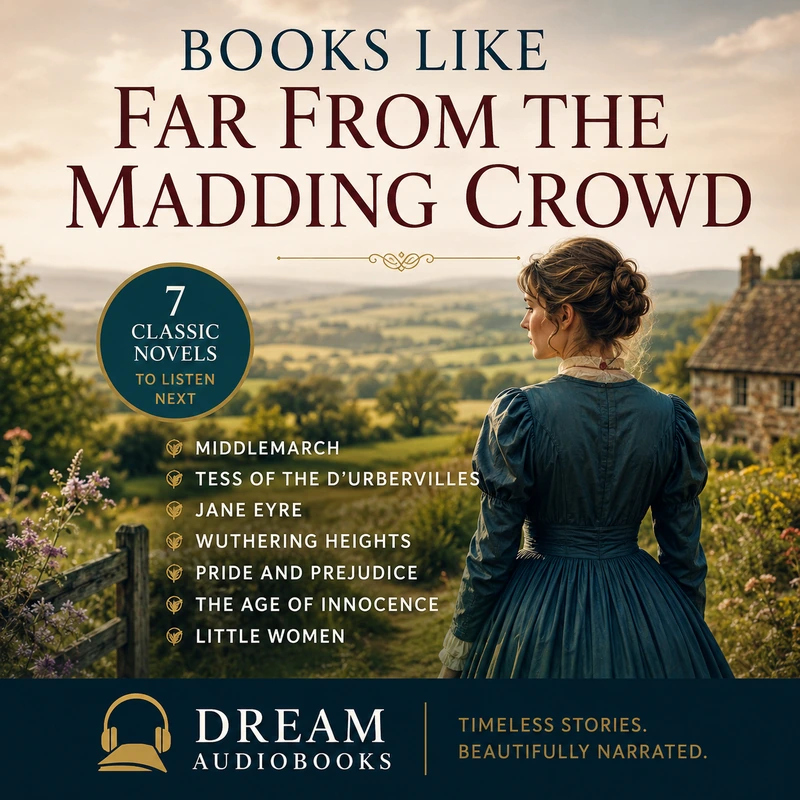
The seven novels below share different parts of that experience.
Middlemarch expands the social world and shows how marriages, careers and ambitions become connected across an entire community. Tess of the d’Urbervilles returns directly to Thomas Hardy’s rural England but moves into much darker territory. Jane Eyre offers another heroine determined not to sacrifice her independence for love. Wuthering Heights explores passion, obsession and landscape with far greater violence.
Pride and Prejudice provides a lighter, more ironic examination of romantic judgment. The Age of Innocence replaces the English countryside with wealthy New York society but keeps the tension between personal desire and social expectations. Finally, Little Women broadens the subject beyond romance and asks how women can build meaningful lives around family, work, ambition and personal freedom.
These are not seven copies of Hardy’s novel. They are better understood as seven different paths leading away from it. If one particular element of Far From the Madding Crowd stayed with you, one of these classics should be a natural next listen.
Why These Books Are Like Far From the Madding Crowd
Finding genuinely good books like Far From the Madding Crowd requires looking beyond the obvious category of Victorian romance. Hardy’s novel works because several themes operate at the same time.
The first is independence. Bathsheba does not begin the novel waiting for marriage to give her a place in the world. When she inherits Weatherbury Farm, she becomes an employer and landowner. She makes decisions, negotiates with workers and takes responsibility for the success or failure of the farm.
The second theme is judgment. Bathsheba is intelligent, but intelligence does not prevent her from misreading people. Gabriel’s reliability initially appears less exciting than Troy’s charm. Boldwood’s respectable position hides an increasingly unhealthy fixation. Hardy repeatedly shows the difference between first impressions and character revealed over time.
The third theme is community. Nobody lives completely privately in Weatherbury. Workers gossip. Neighbors notice changes. Reputation matters. Personal choices ripple outward into a social world where people depend on one another.
The fourth is work. Farming is not merely background decoration. Gabriel’s skill repeatedly matters because he understands sheep, crops, storms and practical danger. Bathsheba’s authority is meaningful because it comes with responsibility.
Finally, there is Hardy’s treatment of chance. A message, an impulsive decision, a badly timed encounter or a natural disaster can change an entire life. Characters attempt to control their futures, but Hardy continually reminds us that human plans exist inside a world that is never completely predictable.
The books on this list share at least one of these qualities. Some share several.
1. Middlemarch by George Eliot
Middlemarch by George Eliot is one of the strongest choices for listeners who enjoyed the social world surrounding Bathsheba Everdene as much as the central romance.
George Eliot’s novel moves through the lives of several people in the fictional English town of Middlemarch. Dorothea Brooke wants to live a serious and useful life. She hopes for intellectual purpose and believes marriage may help her achieve it. Tertius Lydgate arrives with ambitious ideas about medicine and reform. Around them are families, businessmen, landowners, clergy, creditors and neighbors whose decisions constantly intersect.
Where Hardy concentrates much of his novel around Bathsheba and three men, Eliot creates a much wider web. Marriage is still important, but so are professional ambition, money, inheritance, debt, political reform and social reputation.
Dorothea makes Middlemarch particularly relevant for readers interested in Bathsheba. Both women are intelligent and strong-minded, yet both must discover that independence is more complicated than simply refusing to follow convention.
Dorothea begins with idealistic ideas about marriage. She wants intellectual companionship and believes she has found it in Edward Casaubon. Reality proves painfully different. Like Bathsheba, she learns through experience rather than through simple moral lessons.
The novels also share a strong sense that private decisions are never completely private. In a small community, money, marriage, work and reputation connect people whether they want those connections or not.
George Eliot is more analytical than Hardy. She frequently examines why characters misunderstand themselves and one another. Hardy tends to give landscape and circumstance a larger role, while Eliot is especially interested in psychology and social relationships.
That difference makes Middlemarch an excellent companion rather than a duplicate. If Weatherbury felt alive to you because farmers, servants, landowners and workers formed one interconnected world, Middlemarch offers an even larger version of that experience.
It is also ideal for listeners who want a long audiobook they can settle into slowly. Its pleasures come from accumulating detail and from watching seemingly separate lives become increasingly connected.
Best for: social realism, marriage, ambition, community life and complex characters.
Listen to Middlemarch on DreamAudiobooks →
2. Tess of the d’Urbervilles by Thomas Hardy
If you want the most direct continuation possible, choose Tess of the d’Urbervilles by Thomas Hardy.
Hardy’s later novel returns to the countryside of Wessex, but its emotional atmosphere is considerably darker. Tess Durbeyfield comes from a poor rural family whose fortunes appear to change when her father learns that they may be descended from the ancient d’Urberville family.
What follows is a story shaped by class, poverty, gender, desire, social judgment and circumstances that Tess cannot fully control.
Anyone who loved the rural environment of Far From the Madding Crowd will recognize Hardy immediately. Fields, farms, roads, weather and seasons shape the rhythm of the story. Agricultural work has physical weight. The landscape can be beautiful, but beauty never guarantees safety.
The most revealing comparison, however, is between Bathsheba and Tess.
Bathsheba inherits property. That economic independence gives her choices that many women around her do not possess. She can employ workers, make business decisions and resist marriage when she wants to.
Tess lives in almost the opposite position. Her family’s financial vulnerability repeatedly limits her choices. Hardy uses her story to show how dramatically class and money influence personal freedom.
Both women are judged by their communities, but the consequences are much harsher for Tess. This makes the two novels fascinating to experience together. They reveal two different sides of Hardy’s treatment of women in nineteenth-century rural society.
The love stories are also very different. Far From the Madding Crowd contains tragedy and serious mistakes, but it ultimately leaves space for recognition and mature companionship. Tess of the d’Urbervilles steadily removes such possibilities.
There is another connection through work. Tess is often shown performing agricultural labor, and those scenes are not simply decorative descriptions of country life. Physical work reveals class, vulnerability and the changing rural economy.
If Gabriel Oak’s practical world, Hardy’s landscapes and the moral complexity of Bathsheba’s choices were the strongest parts of Far From the Madding Crowd for you, Tess is the most natural next audiobook.
Just be prepared for a much more tragic story.
Best for: Hardy readers, rural England, tragedy, social judgment and emotional depth.
Listen to Tess of the d’Urbervilles on DreamAudiobooks →
3. Jane Eyre by Charlotte Brontë
Readers who admired Bathsheba’s determination to remain independent should continue with Jane Eyre by Charlotte Brontë.
Jane’s circumstances could hardly be more different from Bathsheba’s. She begins life without wealth, property or influential family connections. Orphaned and dependent on others, she grows up learning how little social power she possesses.
Yet Jane develops a powerful sense of self-respect.
When she becomes governess at Thornfield Hall and meets Edward Rochester, the novel develops into one of literature’s most famous love stories. But Charlotte Brontë refuses to make romance more important than Jane’s moral independence.
Jane loves deeply, yet she will not accept happiness at the cost of her own principles.
That makes her an excellent literary companion to Bathsheba Everdene. Bathsheba owns land and Jane owns almost nothing, but both women resist being defined entirely through a man’s position.
There is also an important similarity in the way both heroines learn. Neither begins as a perfectly mature character. Pride, emotion and mistaken judgment matter. Growth comes through experience.
The atmosphere of Jane Eyre is dramatically different from Hardy’s novel. Thornfield Hall introduces secrecy, gothic tension and mystery. The open farmland of Weatherbury becomes an enclosed house filled with unanswered questions.
Yet both stories ask whether love can coexist with independence.
That question is especially important because nineteenth-century marriage often involved enormous differences in economic and social power. Both Hardy and Brontë understand that romantic happiness is not meaningful if one person must disappear inside the other person’s life.
Jane’s voice also gives the novel a more intimate quality. Because she tells her own story, listeners experience her changing emotions and judgments directly.
If you finished Far From the Madding Crowd thinking mainly about Bathsheba—her pride, mistakes, strength and refusal to be passive—then Jane Eyre may be the strongest recommendation on this list.
Best for: independent heroines, gothic atmosphere, moral conflict and intense romance.
Listen to Jane Eyre on DreamAudiobooks →
4. Wuthering Heights by Emily Brontë
Wuthering Heights by Emily Brontë is for listeners who want to explore the darker side of passion, pride and emotional obsession.
The novel centers on the destructive relationship between Catherine Earnshaw and Heathcliff. Their bond is powerful, but Emily Brontë refuses to present intensity as evidence of healthy love.
Class, resentment, revenge and wounded pride transform personal unhappiness into damage that continues across generations.
This makes the book an interesting comparison with the romantic triangle in Far From the Madding Crowd.
Sergeant Troy attracts Bathsheba because he is exciting and confident. His charisma temporarily overwhelms her better judgment. Boldwood shows another dangerous possibility: affection becoming possession and obsession.
Wuthering Heights takes those destructive possibilities much further.
The landscape provides another powerful connection. Hardy’s Wessex and Brontë’s Yorkshire moors are very different places, yet both writers make nature part of the emotional atmosphere.
Weather matters. Isolation matters. Distance matters. The physical environment seems to absorb something from the characters who live within it.
Where Gabriel Oak understands nature practically, the characters in Wuthering Heights often seem emotionally fused with the wild landscape around them.
This is not the book to choose if you want another relatively balanced rural romance. The characters can be cruel, self-destructive and difficult to admire.
But if the scenes involving Troy or Boldwood made you interested in the dangerous difference between love and obsession, Wuthering Heights offers one of the most uncompromising explorations of that subject.
It is also a useful reminder that many classic romances are not instructions for how love should work. Sometimes they are warnings about what happens when desire becomes stronger than empathy, judgment and responsibility.
Best for: dark romance, obsession, dramatic landscapes, family conflict and psychological intensity.
Listen to Wuthering Heights on DreamAudiobooks →
5. Pride and Prejudice by Jane Austen
For something lighter without abandoning questions of judgment, courtship and social position, choose Pride and Prejudice by Jane Austen.
Elizabeth Bennet and Fitzwilliam Darcy form opinions about one another very quickly. Those judgments are influenced by pride, embarrassment, incomplete information and the behavior of the people around them.
The novel’s central pleasure comes from watching both characters gradually understand how unreliable those early assumptions were.
That idea should feel familiar after Far From the Madding Crowd.
Bathsheba’s choices are also affected by appearances. Gabriel’s value is not immediately obvious because reliability is less dramatic than charm. Troy knows how to create excitement. Boldwood’s respectable social position initially gives no clear warning of what his feelings may become.
Both Austen and Hardy therefore ask readers to look beyond first impressions.
Their tones, however, are completely different.
Austen uses wit, conversation and social comedy. Hardy uses weather, work, accident and tragedy. Elizabeth moves through drawing rooms, visits, dinners and dances; Bathsheba moves through farmyards, markets and fields.
But money matters in both worlds.
The Bennet family’s financial situation means marriage cannot be treated as purely romantic. Property and inheritance influence everyone’s future. Hardy similarly understands that Bathsheba’s position as a landowner fundamentally changes the choices available to her.
Both novels also reward characters who learn humility. Elizabeth must reconsider Darcy. Darcy must recognize his own arrogance. Bathsheba gradually understands the difference between excitement and dependable character.
If you enjoyed the romantic misunderstandings in Hardy but would prefer less tragedy and more humor, Pride and Prejudice is the easiest recommendation on this list.
It also works particularly well as an audiobook because so much of Austen’s humor emerges through dialogue and social interaction.
Best for: romantic misunderstanding, witty dialogue, social observation and character growth.
Listen to Pride and Prejudice on DreamAudiobooks →
6. The Age of Innocence by Edith Wharton
The Age of Innocence by Edith Wharton moves away from the farms of Wessex and into the drawing rooms of wealthy nineteenth-century New York.
At first, that may seem far removed from Far From the Madding Crowd. Yet both novels are deeply concerned with the relationship between individual desire and social expectation.
Newland Archer is preparing to marry May Welland when May’s cousin Ellen Olenska returns to New York after separating from her husband.
Ellen does not easily fit the rules of the society around her. Her independence attracts Newland, but pursuing that attraction would threaten relationships, reputations and the social order that has shaped his entire life.
Wharton’s society appears elegant and controlled, but its rules can be severe. Characters often know exactly what they are expected to do even when nobody openly explains those expectations.
This provides an interesting contrast with Weatherbury.
Bathsheba is watched by farm workers, neighbors and other landowners. Her choices become subjects of conversation. Ellen and Newland are similarly surrounded by observers, but Wharton’s characters live inside an even more formal system of manners.
What both novels understand is that society can influence intimate decisions without using physical force.
Reputation, money, family expectations and fear of scandal can be powerful enough on their own.
The emotional tone is also different. Hardy allows dramatic events to erupt into the open. Wharton frequently builds tension from restraint. Some of the novel’s most important moments concern what characters cannot say or what they decide not to do.
If you enjoyed the social pressure surrounding Bathsheba’s romantic choices and want to see the same theme examined in a more sophisticated urban setting, The Age of Innocence is an excellent next step.
Best for: social pressure, forbidden love, marriage, reputation and restrained emotional drama.
Listen to The Age of Innocence on DreamAudiobooks →
7. Little Women by Louisa May Alcott
The final recommendation, Little Women by Louisa May Alcott, moves further away from Hardy’s central love triangle but comes surprisingly close to one of his most important themes: how a woman can build a life without allowing marriage to become her only identity.
The novel follows the March sisters—Meg, Jo, Beth and Amy—as they grow from girls into young women.
Each sister imagines adulthood differently. Meg values home and family. Amy has artistic ambitions and strong ideas about social advancement. Beth is quiet and domestic. Jo wants to write and resists many conventional expectations surrounding femininity and marriage.
Jo provides the clearest connection with Bathsheba Everdene.
Both characters want meaningful work. Both value freedom. Both can be stubborn. Both must learn that independence does not necessarily require rejecting affection, family or partnership.
The specific form of their work differs. Bathsheba manages a farm; Jo wants to become a writer. Yet their ambitions give them identities beyond romance.
This is important because many nineteenth-century novels focus so heavily on marriage that a heroine’s wedding can seem like the final definition of her life. Hardy and Alcott both create women whose personal development cannot be reduced to finding a husband.
Little Women is warmer and more domestic than Far From the Madding Crowd. Family relationships replace much of Hardy’s agricultural world, and the overall tone contains more comfort and optimism.
Yet money and work remain important. The March family does not have unlimited resources. The sisters learn practical responsibility and repeatedly discover that ambition must coexist with obligations to other people.
Like Bathsheba, Jo also makes mistakes. She is not admirable because she is perfect. She is memorable because she develops without losing the energy and independence that make her distinctive.
If Bathsheba’s determination to manage her own future was your favorite part of Hardy’s story, Little Women offers a very different but rewarding continuation.
Best for: female independence, family, ambition, personal growth and a warmer emotional tone.
Listen to Little Women on DreamAudiobooks →
Which Book Is Most Like Far From the Madding Crowd?
Tess of the d’Urbervilles is the closest overall match because it comes from Thomas Hardy himself and returns to many of the same elements: Wessex, agriculture, rural communities, class, social judgment and complicated relationships.
It is not identical in tone. Tess is considerably darker and more tragic.
If you want the closest match specifically for Bathsheba’s independence rather than Hardy’s style, choose Jane Eyre.
If you want another novel built around an entire community and the consequences of marriage and ambition, choose Middlemarch.
For romantic misjudgment, Pride and Prejudice is the best alternative. For destructive passion, choose Wuthering Heights.
There is therefore no single perfect replacement. The best choice depends on which part of Hardy’s novel you want to experience again.
Which Book Should You Start With?
Use the following guide to choose your next audiobook:
- Want more Thomas Hardy? Start with Tess of the d’Urbervilles.
- Want another independent heroine? Choose Jane Eyre.
- Want a large Victorian community? Listen to Middlemarch.
- Want darker and more obsessive romance? Try Wuthering Heights.
- Want romance with humor? Choose Pride and Prejudice.
- Want love versus social expectations? Try The Age of Innocence.
- Want female ambition and family life? Choose Little Women.
If you have no strong preference and simply want the most natural next step, start with Tess of the d’Urbervilles. Moving from one Hardy novel to another allows you to recognize familiar themes while discovering a much darker side of his fiction.
After that, Middlemarch and Jane Eyre provide two very different directions: one toward a broader social world and the other toward a more intimate story of independence and love.
Readers especially interested in Victorian social fiction can also explore Books Like Middlemarch for another selection of classics centered on marriage, ambition, society and personal choice.
Frequently Asked Questions
What books are similar to Far From the Madding Crowd?
Good choices include Tess of the d’Urbervilles, Middlemarch, Jane Eyre, Wuthering Heights, Pride and Prejudice, The Age of Innocence and Little Women. Each shares themes such as love, independence, social expectations, reputation or difficult personal choices.
What should I read after Far From the Madding Crowd?
Start with Tess of the d’Urbervilles if you want another Thomas Hardy novel with a strong rural setting. Choose Jane Eyre if Bathsheba’s independence interested you most, or Middlemarch if you enjoyed the social world surrounding the characters.
Which Thomas Hardy book is most like Far From the Madding Crowd?
Tess of the d’Urbervilles is one of the best next choices. It returns to rural Wessex and explores work, class, relationships and social judgment. However, it is much more tragic than Far From the Madding Crowd.
Is Far From the Madding Crowd mainly a romance?
Romance is central to the plot, but the novel also explores independence, farming, responsibility, social status and personal growth. Bathsheba’s relationships with Gabriel Oak, William Boldwood and Sergeant Troy allow Hardy to compare loyalty, obsession and attraction.
Which heroine is most similar to Bathsheba Everdene?
Jane Eyre is one of the strongest comparisons because she values love without sacrificing her independence or self-respect. Jo March in Little Women is another good match because she wants a meaningful life built around her own ambitions.
What should I read if I liked Gabriel Oak?
Readers who admired Gabriel’s patience, competence and reliability may especially enjoy Middlemarch, where George Eliot frequently contrasts genuine character with social appearance. Pride and Prejudice also explores how initial impressions can hide a person’s real qualities.
What should I read if I liked the rural setting?
Choose Tess of the d’Urbervilles. Thomas Hardy again makes the countryside central to the story, using farms, seasons, physical labor and changing landscapes as important parts of the characters’ lives.
What should I read if I liked the love triangle?
Jane Eyre is a strong choice for romantic conflict and independence, while Wuthering Heights offers a much darker exploration of passion and obsession. Pride and Prejudice is better if you want romantic misunderstanding with a lighter tone.
Is Middlemarch similar to Far From the Madding Crowd?
Yes, particularly in its attention to community, marriage, money and the consequences of personal choices. Middlemarch contains a much larger cast and a broader social world, while Hardy gives rural landscape and agricultural life a more central role.
Is Jane Eyre similar to Far From the Madding Crowd?
The settings are very different, but Bathsheba Everdene and Jane Eyre share a strong desire for independence. Both novels ask whether romantic love can coexist with self-respect and personal freedom.
Final Thoughts
The best books like Far From the Madding Crowd do not need to reproduce Thomas Hardy’s story exactly. What matters is finding another novel that develops the element you loved most.
If that element was Hardy’s rural England, continue with Tess of the d’Urbervilles. If it was Bathsheba’s independence, choose Jane Eyre or Little Women. If the social world of Weatherbury interested you, Middlemarch provides an even broader community filled with intersecting lives.
For dangerous passion, Wuthering Heights takes the emotions surrounding Troy and Boldwood into much darker territory. Pride and Prejudice turns romantic misjudgment into comedy, while The Age of Innocence shows how society can quietly prevent people from following their desires.
Together, these seven novels demonstrate why Far From the Madding Crowd continues to lead readers toward so many other classics. Hardy’s story sits at the meeting point of romance, social realism, rural life and the struggle for personal independence.
Choose the theme that mattered most to you, then follow that path into your next audiobook.