
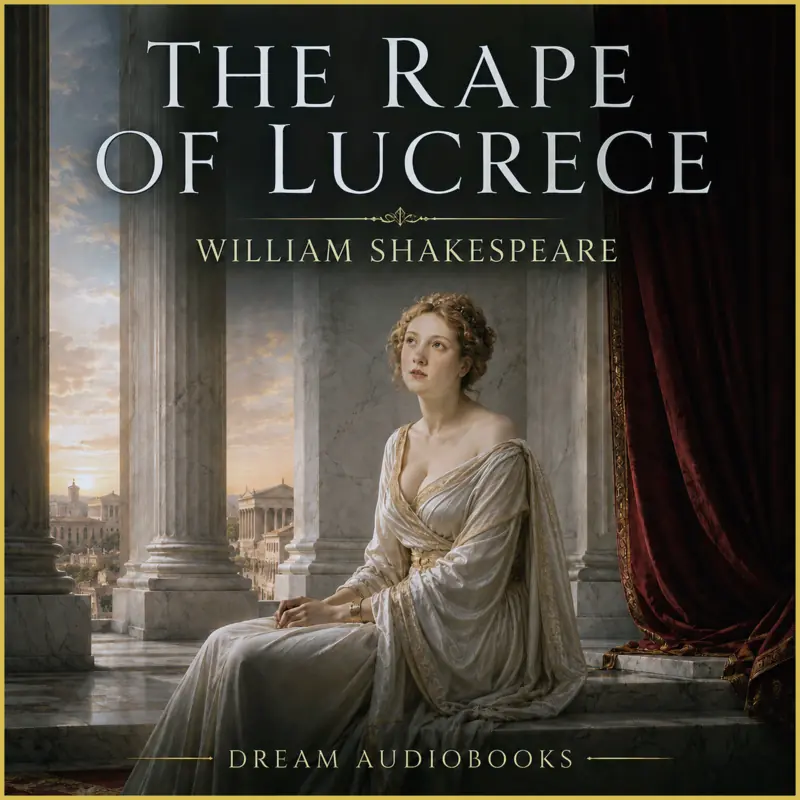
The Rape of Lucrece Audiobook – Listen Free
The Rape of Lucrece audiobook brings William Shakespeare’s grave and psychologically searching narrative poem into the form for which its language is especially suited: a voice speaking directly to a listener. First published in 1594, the poem retells the ancient Roman story of Lucrece, whose assault by Sextus Tarquinius becomes both a personal catastrophe and the spark for political revolt. Shakespeare does not present the event as spectacle. He concentrates on coercive power, violated trust, the language of self-blame, the limits of sympathy and the difficult movement from private suffering to public action.
This complete audio edition runs for approximately two hours and ten minutes. It rewards close listening, but no specialist knowledge of Shakespeare or Roman history is required. The guide below introduces the story, principal figures, verse form and major themes before helping you choose the most useful way to hear the poem.
Listen to The Rape of Lucrece Audiobook
You can hear the full poem below or open it on your preferred listening platform. The Spreaker recording lasts approximately 2 hours 9 minutes. Platform availability can vary by country.
Listen on Spotify
Listen on Apple Podcasts
Listen on Spreaker
Listen on iHeartRadio
Listen on Podcast Addict
Listen on Podchaser
About The Rape of Lucrece
The Rape of Lucrece is a long narrative poem rather than a stage play. Shakespeare published it early in his career, one year after Venus and Adonis and before most of the tragedies for which he is now best known. The title uses the older sense of “rape” derived from abduction or seizure, although the poem unmistakably concerns sexual assault. Modern editions sometimes shorten the title to Lucrece, but The Rape of Lucrece remains the familiar full title.
The poem begins with a dedication to Henry Wriothesley, the Earl of Southampton, followed by a prose “Argument” that gives the historical background. The verse then enters the minds of Tarquin and Lucrece with unusual intensity. Tarquin debates the crime before committing it; Lucrece searches for words after surviving it. Shakespeare makes their experiences radically unequal. Tarquin’s internal conflict reveals knowledge, choice and responsibility. Lucrece’s extended lament reveals the damage caused when a victim is forced to carry shame that properly belongs to the perpetrator.
Although the story ends in political revolution, the poem never allows the public consequence to erase the individual suffering that precedes it. This double scale—one violated person and a transformed state—gives the work its enduring force. It is at once a study of conscience, a tragedy of power and a poem about how private testimony enters history.
Quick Facts
| Author | William Shakespeare |
|---|---|
| First published | 1594 |
| Literary form | Narrative poem |
| Length | 1,855 lines in 265 stanzas |
| Verse pattern | Rhyme royal: seven-line stanzas with an ABABBCC rhyme scheme |
| Setting | Ardea and Collatium, before the foundation of the Roman Republic |
| Central figures | Lucrece, Tarquin, Collatine and Junius Brutus |
| Audio duration | Approximately 2 hours 10 minutes |
The Rape of Lucrece: Plot Summary
The poem opens during the Roman siege of Ardea. A group of noble soldiers discuss their wives, and Collatine praises the beauty and chastity of Lucrece. His description provokes Tarquin, son of the ruling king, to travel secretly to Collatium. Lucrece receives him with the hospitality owed to her husband’s companion and to a prince. The welcome makes Tarquin’s betrayal more serious: he abuses both political rank and the trust of a household that has admitted him as a guest.
During the night, Tarquin argues with himself. He understands the moral, personal and political reasons to stop. Collatine is his friend; Lucrece has done him no wrong; the act will damage honour and may expose the ruling family to hatred. These thoughts do not excuse him. On the contrary, Shakespeare uses the debate to establish that the crime is deliberate. Tarquin repeatedly recognises the good and chooses against it.
He enters Lucrece’s chamber and threatens her with death and manufactured disgrace. If she resists, he says he will kill both her and a servant, place their bodies together and claim he found them in adultery. The threat targets more than physical survival. It exploits a social order in which a woman’s reputation can be destroyed by a man’s account of events. Lucrece attempts to reason with him by appealing to honour, friendship, kinship, religion and the responsibilities of a ruler. Tarquin refuses every appeal and assaults her.
Afterward, he leaves in fear and disgrace. The poem remains with Lucrece. She experiences anger, grief, isolation and a painful division between what she knows and what her society may believe. Much of the middle section follows her attempts to name what has happened. She addresses Night, Time and Opportunity as though the conditions surrounding the crime could answer her. The rhetorical movement is not indecision for its own sake. It shows a mind trying to restore order after another person has deliberately shattered it.
Lucrece also looks at a painting of the fall of Troy. She studies figures associated with war, betrayal and mourning, then identifies especially with Hecuba, the grieving Trojan queen. The painted scene allows her to approach suffering indirectly before she can speak publicly about her own. Shakespeare makes visual art a temporary companion: the image cannot answer, but it gives grief a form outside the self.
Lucrece sends a messenger to Collatine and asks him to return. When he arrives with Lucretius and other Roman nobles, she tells them that Tarquin assaulted her and demands that they swear to punish him. They affirm her innocence, yet their assurances cannot immediately undo the codes of honour she has internalised. After naming Tarquin, Lucrece takes her own life.
Junius Brutus then draws the knife from her wound and transforms mourning into a public oath. He calls on the Romans to expel Tarquin’s family. Lucrece’s body is carried through Rome, public anger grows and the monarchy falls. The traditional legend therefore connects her death with the birth of the Roman Republic. Shakespeare closes on this political outcome, but the poem leaves a difficult question: what is lost when a woman’s suffering becomes useful to a public cause?
Main Characters
Lucrece
Lucrece is the poem’s moral and emotional centre. She is neither a distant emblem nor a passive device for Roman history. Shakespeare gives her the longest and most complex voice in the work. Her speeches move through grief, argument, anger, memory and judgment. They also reveal how deeply social ideas about female honour have entered her own understanding of herself.
Modern listeners may reject the belief that an assaulted woman is dishonoured; responsibility belongs entirely to the assailant. The poem contains important support for that view. Lucrece distinguishes the innocent mind from the violated body, and the men who hear her testimony declare her blameless. Yet she cannot escape the harsher values of her culture. That conflict between innocence and internalised shame is central to the tragedy.
Sextus Tarquinius, or Tarquin
Tarquin is the son of Rome’s king and the man who assaults Lucrece. His rank gives him access, credibility and power, all of which he turns into weapons. Shakespeare’s extensive account of his hesitation does not soften his guilt. Tarquin anticipates the consequences, understands the wrong and continues. His private corruption mirrors the political corruption of a royal family that treats power as possession.
Collatine
Collatine is Lucrece’s husband. His praise of her prompts Tarquin’s desire, but the poem does not make praise morally equivalent to assault. Collatine’s error is more subtle: he speaks of Lucrece’s virtue as a treasure that raises his own status. After her death, his grief is sincere, yet it struggles to become action until Brutus gives the group a political direction.
Junius Brutus
Brutus initially appears quiet and underestimated. At the end, he reveals political purpose. He converts the private oath of vengeance into a movement against the Tarquin monarchy. His intervention gives the story its republican conclusion, but it also creates interpretive unease. Lucrece finally controls the disclosure of Tarquin’s name, while Brutus controls what her death will mean in public.
Lucretius and the Roman nobles
Lucretius, Lucrece’s father, and the assembled men form the first audience for her testimony. They believe her and deny that guilt can pass from an attacker to a victim. Nevertheless, their society has helped create the honour code that makes her fear permanent disgrace. The gap between their compassionate words and the culture surrounding them is one of the poem’s sharpest tensions.
Major Themes in The Rape of Lucrece
Power, consent and coercion
The crime depends on unequal power. Tarquin is male, royal, armed and welcomed as a trusted guest. His threat uses both violence and reputation. Lucrece’s refusal is clear, but he designs a false story intended to make refusal appear socially ruinous. Shakespeare therefore presents coercion as a system of pressures rather than a single physical act.
This is one reason the poem still demands attention. It recognises how authority can manipulate the anticipated judgment of other people. Tarquin assumes that his status will make a lie believable and that Lucrece’s fear of shame will silence resistance. The later revolt answers that abuse politically: a ruler who cannot govern desire cannot be trusted to govern Rome.
Guilt, shame and victim-blaming
Lucrece repeatedly asks whether the body can stain the mind. Her reasoning often approaches the conclusion that it cannot: unwilling suffering is not consent, and force does not transfer moral guilt. Yet emotional knowledge does not immediately submit to logical proof. She continues to feel the shame her culture has taught her to fear.
The poem becomes especially powerful when heard because a narrator can distinguish these layers. An argument may sound firm for one line and collapse into grief in the next. Listeners hear not a simple moral lesson but the exhausting effort required to resist a false accusation that has been absorbed from the surrounding world.
Speech, silence and testimony
Before the assault, Lucrece speaks directly to Tarquin and deploys every persuasive resource available to her. Afterward, she speaks first to absent forces, then to an image, a messenger and finally the men she has summoned. The sequence matters. Testimony is not produced instantly; it is prepared through private attempts to make language adequate to experience.
Tarquin also uses language, but to threaten and falsify. The contrast is ethical as well as rhetorical. He makes words conceal responsibility. Lucrece uses words to identify it. Naming Tarquin before witnesses is her decisive public act, even though the poem’s tragic conclusion prevents that act from opening into recovery.
Private trauma and public revolution
The Roman tradition treats Lucrece’s death as the event that awakens opposition to monarchy. Shakespeare preserves that link but does not make it comfortable. Political change gives the narrative a large historical consequence, yet no revolution restores the life at its centre.
Brutus’s oath can be read as justice, appropriation or both. He ensures that Tarquin’s rank will not protect him. At the same time, the men rapidly turn Lucrece into a symbol. The poem asks listeners to hold together two truths: public action against abusive power is necessary, and a person should never disappear behind the cause built around her suffering.
Art, grief and imperfect sympathy
The Troy painting is one of the poem’s most remarkable episodes. Lucrece searches the painted faces for an image equal to sorrow. When she encounters Hecuba, she imagines lending the figure her voice. The scene shows how art can help a person recognise emotion across time while remaining unable to share the full reality of another life.
Shakespeare does not present the artwork as a cure. Lucrece even attacks the image of Sinon, whose deception enabled Troy’s destruction. Her response reveals both the usefulness and limit of representation: an image can organise feeling, but it cannot answer, intervene or undo harm.
Beauty, possession and dangerous praise
The poem repeatedly uses the language of treasure, ownership, siege and conquest. Lucrece’s beauty is described as wealth; her body becomes a fortress in Tarquin’s imagination. These metaphors expose a destructive habit of turning a person into property. Collatine’s admiration is not violent, but his boast introduces Lucrece through the value she gives him. Tarquin then converts that social language of possession into predatory intent.
Listening closely to the imagery makes this pattern easier to notice. Words associated with war migrate from the siege of Ardea into a domestic chamber. Political aggression and sexual violence begin to share a vocabulary, revealing that Tarquin carries the logic of domination wherever he goes.
Poetic Form and Language
The Rape of Lucrece contains 1,855 lines arranged in 265 seven-line stanzas. Each stanza follows the rhyme scheme ABABBCC, a form known as rhyme royal. Most lines use iambic pentameter, the five-beat rhythm strongly associated with English Renaissance verse.
The form combines movement with delay. The interlocking middle rhymes carry an argument forward, while the final couplet can close, reverse or sharpen it. Because the poem frequently enters a character’s debate with the self, this structure is ideal. A stanza may begin with an image, complicate it through several comparisons and finish with a judgment that still does not settle the emotion.
Shakespeare’s language is highly figurative. Night becomes an accomplice, Time a destroyer, Opportunity a servant of crime and the body a contested fortress. The abundance can feel difficult on the page because a reader must process syntax, rhyme and metaphor simultaneously. In a careful performance, vocal stress clarifies the sentence beneath the ornament. Rhyme marks the stanza without turning every line into a sing-song pattern.
The poem also anticipates Shakespeare’s later drama. Tarquin’s self-division points toward characters who know the moral argument and act against it. Lucrece’s sustained soliloquies show Shakespeare learning how thought changes while it is spoken. Readers who know the plays will hear early forms of the psychological pressure found in his mature tragedies.
Roman History and Shakespeare’s Sources
The story is set near the end of the Roman monarchy, traditionally dated to 509 BCE. Roman accounts describe Sextus Tarquinius as the son of Lucius Tarquinius Superbus, or Tarquin the Proud, the final king of Rome. After Lucretia’s death, Lucius Junius Brutus leads a revolt, the royal family is expelled and republican government begins.
Shakespeare inherited the story through classical and later retellings, especially accounts associated with Livy and Ovid. These traditions do not function like modern documentary evidence. They combine history, moral example and political origin story. Lucretia becomes a figure through whom Roman writers explain why kingship failed and why republican liberty appeared necessary.
Shakespeare keeps the political framework but greatly expands the psychological action. The external plot is simple enough to summarise briefly; the poem’s length comes from interior speech, metaphor and ethical argument. This shift matters. Instead of treating Lucrece only as the trigger for a change of government, Shakespeare spends hundreds of lines with her attempt to understand what has happened.
Modern audiences should still read critically. The work emerges from cultures that linked a woman’s value too closely to sexual chastity and often treated suicide as proof of innocence. Those assumptions should not be repeated as moral truths. The poem is most useful when its compassionate insights and historical limitations are examined together.
Why Listen to The Rape of Lucrece Audiobook?
The verse was built for the ear
Rhyme royal becomes clearer when spoken. A capable reader can preserve the sentence while allowing the rhyme to provide quiet structure. The listener hears recurring sounds, balanced clauses and the closing force of each couplet without needing to mark the page.
Performance clarifies long sentences
Shakespeare often delays the grammatical completion of a thought. On the page, unfamiliar spelling or punctuation can make the route difficult to follow. Vocal phrasing identifies the main verb, distinguishes an aside from a new statement and shows where an image changes direction.
The inner debates gain dramatic shape
This is a narrative poem with the psychological energy of a play. Tarquin and Lucrece both speak at length, but their voices serve opposite moral purposes. A performance can reveal Tarquin’s evasion and Lucrece’s movement between analysis, grief and resolve without requiring a full theatrical production.
The duration is approachable
At roughly two hours and ten minutes, the recording is shorter than most Shakespeare plays and far shorter than a classic novel. It can be heard in one concentrated sitting, though the emotional subject makes two or three sessions a reasonable choice.
Audio supports reading rather than replacing it
Students may gain the most by listening while following the text. Hearing a stanza first can establish meaning; reading it afterward can reveal imagery and verbal pattern. The process also reduces the temptation to stop at every unfamiliar word before the sentence has had a chance to make sense.
How to Listen: A Practical Study Guide
Before listening
Read the prose Argument if your edition includes it. Remember four relationships: Lucrece is married to Collatine; Tarquin is Collatine’s fellow soldier and the king’s son; Brutus belongs to the group summoned at the end; the Tarquin family rules Rome. That is enough context to begin.
During the first listening
Follow the emotional movement rather than trying to decode every metaphor. Notice the major stages: Collatine’s praise, Tarquin’s journey, his internal debate, Lucrece’s resistance, the aftermath, the Troy painting, her testimony and Brutus’s oath. If a passage becomes dense, continue until the end of the stanza; the final couplet often clarifies its direction.
During a second listening
Track a repeated image or idea. Useful choices include light and darkness, stains and purity, siege and conquest, treasure and ownership, speaking and silence, or the contrast between hand, body and mind. Repetition shows how Shakespeare links personal violation to political tyranny.
Questions for discussion
- Why does Shakespeare give Tarquin a long moral debate before the crime?
- Where does the poem clearly separate involuntary suffering from guilt?
- How does the painting of Troy help Lucrece speak about grief?
- Does Brutus honour Lucrece’s final demand, use her death for politics, or do both?
- How does the language of ownership affect the way male characters describe her?
- What changes when the poem is heard rather than silently read?
A note for teachers and reading groups
Discuss the work with precise, non-sensational language. Do not present Lucrece’s suicide as a necessary proof of virtue or an appropriate response to assault. It belongs to the tragic logic and honour culture represented by the poem, not to a responsible modern judgment of survivors. It is also worth giving participants advance notice of the subject and allowing them to step away from the discussion.
William Shakespeare Beyond the Stage
Listeners who know Shakespeare mainly through plays may be surprised by the sustained narrative voice of The Rape of Lucrece. The poem was designed for publication and close reading rather than for performance by a company of actors. It therefore gives Shakespeare room to extend a metaphor, pause the plot and enter a single consciousness for many stanzas.
Yet the dramatic writer is already present. Arguments arrive through imagined voices, abstract forces become characters and thought behaves like action. Tarquin attempts to rename desire as necessity. Lucrece interrogates the meanings attached to body and reputation. Brutus changes role in an instant, moving from apparently private observer to public leader.
For a direct contrast, listen next to A Midsummer Night’s Dream. Its enchanted comedy treats unstable desire through mistaken identities and eventual reconciliation. The Rape of Lucrece examines desire without consent and refuses comic restoration. The comparison shows the extraordinary moral and tonal range of Shakespeare’s early writing.
Related Audiobooks on DreamAudiobooks
Continue with these existing DreamAudiobooks pages. Each link develops a genuine literary connection rather than sending you to an unrelated general category.
Romeo and Juliet
Shakespeare’s tragedy also joins private catastrophe to a violent public order. Family identity, reputation and failed mediation restrict the choices available to its young protagonists. Choose it when you want dramatic dialogue and a faster plot shaped by secrecy, inherited conflict and grief.
A Midsummer Night’s Dream
This comedy offers the clearest tonal contrast within Shakespeare. Both works explore desire and transformations of perception, but the enchanted forest allows confusion to end in recognition and restored relationships. The difference makes the ethical seriousness of Lucrece even more apparent.
Amoretti: A Sonnet Sequence
Edmund Spenser’s sonnets provide another route into English Renaissance poetry. Their movement toward mutual love and marriage is much gentler, while the formal patterning helps listeners develop an ear for early modern verse.
The Iliad
Homer’s epic is essential for listeners interested in honour, war, grief and the public meaning attached to private loss. Like Shakespeare’s poem, it repeatedly asks what heroic reputation costs the vulnerable people surrounding powerful men.
Andromache
Racine’s classical tragedy centres a woman whose life has been shaped by war, captivity and dynastic power. It is an especially relevant companion for examining how inherited violence enters households and intimate relationships.
Books Like The Iliad: 7 Epic and Tragic Classics
This guide expands the classical cluster through stories of war, fate, loyalty and political change. Use it when the Roman and legendary background of The Rape of Lucrece interests you as much as Shakespeare’s language.
Books Like Romeo and Juliet: 7 Tragic Romances
This selection focuses on private feeling under public pressure. Its recommendations include works about unequal standards, social judgment, secrecy and the consequences of violent family or political systems.
Frequently Asked Questions
Is The Rape of Lucrece a play?
No. It is a narrative poem published in 1594. Shakespeare tells the story through a narrator, extended speeches and 265 seven-line stanzas rather than through acts and scenes written for a theatre company.
How long is The Rape of Lucrece audiobook?
The audio edition linked on this page lasts approximately two hours and ten minutes. Exact display times may differ slightly between platforms.
What is The Rape of Lucrece about?
The poem recounts the assault of the Roman noblewoman Lucrece by Sextus Tarquinius, her testimony and death, and the revolt that expels the Tarquin monarchy. Its central concerns include coercive power, guilt, shame, testimony, political corruption and the transformation of private suffering into public history.
Is Lucrece the same person as Lucretia?
Yes. Lucrece is the English form Shakespeare uses for Lucretia, the legendary Roman woman associated with the fall of the monarchy and the foundation of the Roman Republic.
What verse form does Shakespeare use?
Shakespeare uses rhyme royal. Each stanza contains seven lines, usually in iambic pentameter, with the rhyme scheme ABABBCC. The final couplet often completes or challenges the thought developed in the first five lines.
Is this audiobook suitable for beginners?
It can be, especially for a listener willing to follow the plot summary first and hear the poem in sections. The language is denser than modern prose, but the recording’s moderate length and clear stanza pattern make it more approachable than many long classics.
Does the poem contain disturbing material?
Yes. It deals with sexual assault, threats, trauma and suicide. Shakespeare’s treatment is serious rather than celebratory, but the emotional detail can still be difficult. Listeners should use their own judgment and may prefer to pause or skip the work.
Why is the poem historically important?
It is one of Shakespeare’s major early publications and an important stage in the development of his psychological writing. It also retells a foundational Roman legend in which resistance to personal abuse becomes resistance to tyrannical government.
Where can I listen to The Rape of Lucrece?
You can play the recording directly on this page or open the listening links above for Spotify, Apple Podcasts, Spreaker, iHeartRadio, Podcast Addict and Podchaser. Availability may vary by region and can change when a platform updates its catalogue.
Final Reflection
The Rape of Lucrece is not an easy poem, either linguistically or emotionally. Its value lies in the seriousness with which it studies responsibility. Tarquin knows what he is doing; rank and desire do not diminish his choice. Lucrece’s suffering reveals the cruelty of a culture that can make an innocent person fear the judgment properly owed to an attacker. Brutus’s revolt exposes the political danger of power without restraint.
The audiobook restores the pressure and musical structure of Shakespeare’s verse. It lets the arguments unfold in time, gives the recurring imagery audible force and brings the poem’s uneasy movement from private voice to public history into focus. Listen closely, pause when necessary and allow the final political action to remain complicated by the life it cannot restore.
Begin the full The Rape of Lucrece audiobook by William Shakespeare with the player above, or continue through DreamAudiobooks with Romeo and Juliet and The Iliad.