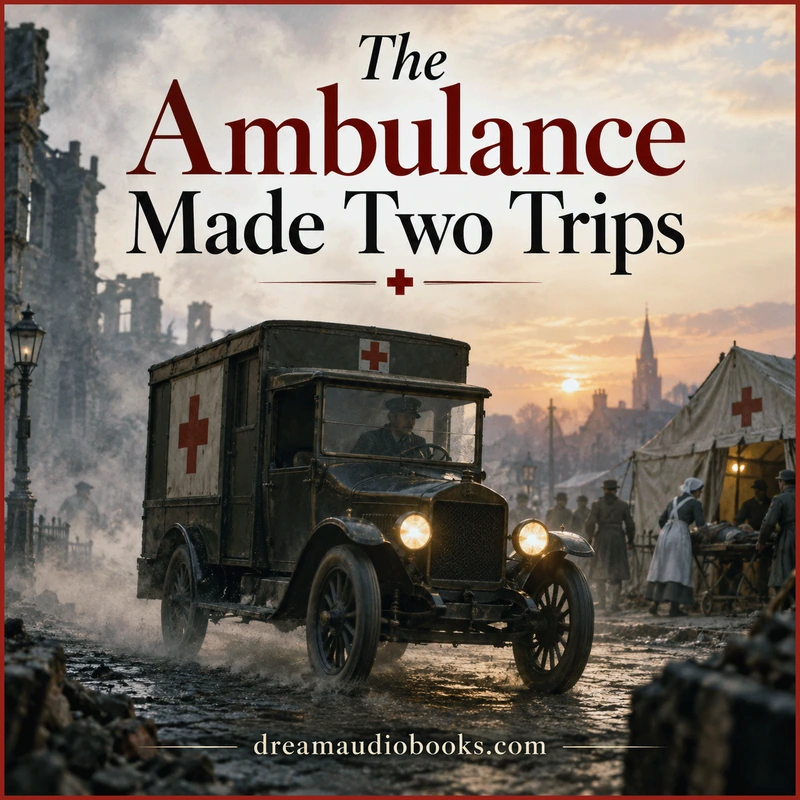
The Ambulance Made Two Trips Audiobook
The Ambulance Made Two Trips audiobook by Murray Leinster is a clever blend of classic science fiction, crime, mystery, and dark comedy. Instead of taking listeners to another planet or a distant future, Leinster begins with something much more familiar: a town where organized crime appears to have become almost impossible to stop.
Detective Sergeant Fitzgerald knows exactly who is responsible. Big Jake Connors has built his influence through intimidation, corruption, and violence, while honest businesses struggle to resist him. The problem is not identifying the criminal. The problem is finding a way to stop him.
Then the pattern suddenly changes. When Connors and his men target the wrong business, their carefully planned acts of intimidation begin failing in increasingly improbable ways. Accidents occur at exactly the right moment. Violent intentions seem to trigger unexpected consequences. Fitzgerald soon discovers that ordinary luck may have very little to do with what is happening.
Short, imaginative, and unusually playful, The Ambulance Made Two Trips turns a gangster story into an ingenious speculative question about probability itself. You can listen to this classic Murray Leinster story below on Apple Podcasts, Spotify, Amazon Music, or Podcast Addict.
Listen to The Ambulance Made Two Trips Audiobook
Choose your preferred listening platform below. Each link opens the dedicated audiobook page for The Ambulance Made Two Trips.
This compact audiobook is particularly suitable for listeners who want a complete classic story without beginning a long novel. Leinster quickly establishes the criminal problem, introduces the speculative idea, and lets the consequences develop with increasing momentum.
About The Ambulance Made Two Trips
The Ambulance Made Two Trips is a science-fiction short story by American writer Murray Leinster. Its unusual strength comes from combining two genres that initially seem unrelated.
On one side, the story resembles a classic crime narrative. There is a powerful racketeer, frightened businesses, frustrated police officers, intimidation, and the constant threat of violence.
On the other side is a speculative scientific idea that completely changes the rules of the conflict.
Leinster does not need spaceships, extraterrestrials, or enormous futuristic cities to create science fiction. Instead, he asks a deceptively simple question: what might happen if someone found a way to influence probability?
From that idea comes nearly everything that makes the story memorable.
The characters intending to cause harm discover that the world no longer seems willing to cooperate with them. Ordinary actions become unexpectedly dangerous. Plans collapse because of unlikely accidents. The more determined the criminals become, the stranger the consequences appear.
The result is part detective story, part speculative experiment, and part comic revenge fantasy.
Story Summary
Detective Sergeant Fitzgerald lives in a town where law enforcement faces an increasingly difficult problem. Big Jake Connors has developed a criminal organization powerful enough to influence businesses and intimidate the people who might otherwise oppose him.
Everyone understands what is happening, yet knowing the truth is not enough.
Connors has created an environment in which witnesses are reluctant to cooperate, business owners know that resistance can have consequences, and conventional police work rarely produces the decisive evidence Fitzgerald needs.
For an experienced detective, that situation is especially frustrating. Fitzgerald understands crime. He understands intimidation. But he cannot simply arrest a man because everyone knows he is dangerous.
When the Pattern Changes
The balance begins to shift when a small business refuses to accept Connors’ control.
Normally, such defiance would be answered predictably. Someone might damage property, intimidate an employee, arrange an accident, or make an example of the owner so that other businesses understand the cost of resistance.
This time, however, something goes wrong.
Then something else goes wrong.
The criminals discover that actions intended to harm other people have an extraordinary tendency to fail. The failures are not merely inconvenient. They happen with such remarkable timing that coincidence becomes increasingly difficult to accept.
Fitzgerald starts investigating.
His search eventually brings him into contact with Brink, a man connected to the business that has unexpectedly resisted Big Jake’s pressure.
Brink knows considerably more than an ordinary shop owner should know about the bizarre accidents surrounding Connors’ men.
Gradually, Fitzgerald is introduced to an astonishing possibility: the improbable events may not be random at all.
A Different Kind of Weapon
The remarkable element in the story is not a conventional weapon. It does not need bullets, explosives, or physical force.
Instead, the idea depends on influencing probability.
When someone seriously intends to commit violence, circumstances begin arranging themselves against that intention. Something slips. Something breaks. An apparently harmless detail suddenly matters. An action that should have succeeded becomes an embarrassing or painful failure.
Leinster develops this premise with humor, but beneath the comedy is a serious speculative idea.
If probability could be manipulated, how could anyone defend against it?
A person understands how to protect himself against a gun. A criminal understands police procedure. But how do you fight an apparently ordinary universe in which every violent decision seems to produce the wrong result?
That question gives the story its distinctive energy.
Detective Sergeant Fitzgerald
Detective Sergeant Fitzgerald is an important reason the story works so well.
Leinster could have centered the entire narrative on the strange scientific device. Instead, he gives listeners a practical police officer who initially experiences the situation from the perspective of ordinary law enforcement.
Fitzgerald’s frustration is understandable. He knows that Big Jake Connors is responsible for intimidation and corruption, yet the legal system requires more than suspicion.
His position creates a tension familiar to crime fiction: the difference between knowing who committed a crime and being able to prove it.
When improbable accidents begin affecting Connors’ organization, Fitzgerald therefore has an unusual reaction. He is suspicious, but he is also fascinated.
What he discovers challenges the normal categories of police investigation. The events surrounding Brink cannot easily be treated as conventional crimes because many of them appear to be accidents.
Fitzgerald becomes the listener’s bridge between the familiar world and Leinster’s speculative concept. He asks the practical questions that naturally arise and recognizes the possibilities of a force that changes probability rather than directly attacking an enemy.
Big Jake Connors and Organized Crime
Big Jake Connors represents a very different form of power.
His authority does not come from scientific knowledge. It comes from fear.
Businesses cooperate because resisting him can be expensive or dangerous. People hesitate to interfere because they understand what his organization is capable of doing.
This kind of criminal power depends on predictability.
A racketeer makes a threat because the victim believes that refusing the demand will produce a worse outcome than accepting it. The entire system works because violence and intimidation reliably create fear.
Leinster’s probability concept attacks exactly that assumption.
What happens to intimidation when violence itself becomes unreliable?
Big Jake’s traditional advantage begins disappearing because his men can no longer assume that an attack will work as intended.
The harder they try to impose control, the greater the opportunity for events to turn against them.
This reversal gives the story much of its humor. People accustomed to frightening others suddenly find themselves unable to trust their own actions.
The Strange Power of Probability
The most memorable concept in The Ambulance Made Two Trips is the manipulation of probability.
Science fiction often begins by taking something familiar and changing one rule.
Time normally moves forward, so a writer invents a time machine. Human beings are visible, so a writer imagines invisibility. Other planets are unreachable, so writers create technologies capable of crossing space.
Leinster applies the same imaginative method to chance.
Every day contains countless small probabilities. A driver reaches an intersection at a particular second. An object sits near the edge of a table. A mechanical component functions correctly—or does not. A person takes one step instead of another.
Most of these possibilities mean nothing.
But what if they could be influenced?
In Leinster’s fictional world, a tiny shift in probability can produce enormous consequences because one unlikely event can trigger another.
The idea is effective because it does not require spectacular visual effects. The strange power often looks like coincidence.
That makes it both amusing and unsettling.
If something impossible happens openly, everyone knows that a mysterious force is involved. But when an unlikely accident occurs, there is always another possible explanation: perhaps it was simply bad luck.
After enough unlikely accidents, however, the distinction becomes harder to maintain.
Major Themes in The Ambulance Made Two Trips
Crime and Corruption
The story begins with a familiar social problem: criminals can sometimes gain influence faster than institutions can respond.
Fitzgerald’s frustration does not come from ignorance. He knows where the problem originates. What he lacks is an effective legal path to remove it.
This gives the speculative element a practical purpose. The strange technology enters a world where conventional methods have already failed to produce satisfactory results.
Violence Turning Against Itself
One of Leinster’s cleverest ideas is making hostile intention part of the problem.
The criminals’ instinct is always escalation. If a warning fails, they threaten. If a threat fails, they use force. If force fails, they prepare something even more dangerous.
Normally that escalation would increase their power.
Here it increases their exposure to increasingly disastrous probability.
Chance and Control
Human beings like to believe they control the results of their actions.
We plan because we expect causes to produce reasonably predictable effects.
Leinster disrupts that relationship. A criminal can still decide to attack someone, but he cannot reliably determine what follows.
The story therefore asks an interesting question about power: are you truly powerful if you can make decisions but cannot control their consequences?
Justice Outside Conventional Rules
The story also plays with the difference between legal justice and poetic justice.
Fitzgerald operates within a system of evidence and procedure. The probability effect operates according to a completely different logic.
It does not arrest criminals, prosecute them, or present evidence to a court.
Instead, harmful intentions simply become increasingly difficult to execute successfully.
The concept is deliberately playful, but it creates a moral complication. A technology capable of changing probability could be useful against violent criminals—but what might happen if someone less responsible controlled it?
Why This Story Works as Classic Science Fiction
The Ambulance Made Two Trips demonstrates that science fiction does not require enormous scale.
Some classics explore alien invasion, distant planets, prehistoric worlds, or catastrophic experiments. Leinster takes a much smaller setting and introduces one extraordinary variable.
That approach is part of a long tradition of speculative fiction built around a strong “what if?” question.
Instead of spending most of the story explaining machinery, Leinster focuses on consequences.
What would criminals do when their normal methods stopped working?
What would a detective think when probability became part of an investigation?
Would people recognize the effect immediately, or continue assuming that each new disaster was merely another coincidence?
These questions keep the story accessible even for listeners who do not normally choose science fiction.
If this kind of speculative idea appeals to you, explore DreamAudiobooks’ guide to the best science fiction audiobooks of all time. It includes classic stories built around dangerous inventions, strange discoveries, hidden worlds, and ideas that changed the genre.
Why Listen to The Ambulance Made Two Trips Audiobook?
A Complete Story in a Compact Format
One of the advantages of this audiobook is its short-story structure.
You do not need to commit to a novel lasting ten or twenty hours. The story introduces its conflict quickly and keeps moving toward its unusual conclusion.
That makes it an excellent choice for a commute, evening listening session, or anyone exploring classic science fiction for the first time.
Dialogue Works Naturally in Audio
Much of the entertainment comes from the contrast between practical characters discussing increasingly improbable events.
Hearing these exchanges aloud helps emphasize Fitzgerald’s reactions, the criminals’ frustration, and the dry humor behind Leinster’s premise.
Crime and Science Fiction in One Story
Listeners who normally prefer mysteries or gangster stories can approach the audiobook as crime fiction, while science-fiction fans can focus on the probability concept.
Neither element completely overwhelms the other.
This hybrid structure makes The Ambulance Made Two Trips particularly easy to recommend to listeners who want something different from conventional space adventure.
A Classic “What If?” Premise
The best speculative fiction often leaves the listener thinking after the story ends.
Leinster’s idea naturally produces additional questions.
Could probability manipulation prevent accidents?
Could it be used defensively?
How could anyone prove that it existed?
Could a legal system regulate something whose effects looked like coincidence?
The story does not need to answer every possibility. The strength of the premise is that it encourages listeners to continue imagining consequences themselves.
About Murray Leinster
Murray Leinster was one of the important American writers associated with twentieth-century speculative fiction.
His stories frequently begin with an unusual scientific or technological possibility and then concentrate on how ordinary people react when familiar rules stop working.
That approach is clearly visible in The Ambulance Made Two Trips.
The central invention matters, but Leinster is equally interested in human behavior. Fitzgerald behaves like a detective. Big Jake behaves like a racketeer. Brink understands something neither side initially possesses.
Once probability enters the conflict, each character responds according to his existing personality.
This makes the speculative element feel connected to the story rather than added simply for decoration.
Leinster’s direct pacing also works particularly well in audio. He establishes a problem, complicates it with an imaginative idea, and lets cause and effect carry the listener toward the conclusion.
More Science Fiction Audiobooks on DreamAudiobooks
If you enjoyed the combination of dangerous ideas and human consequences in The Ambulance Made Two Trips, continue with these related classics available on DreamAudiobooks.
The Island of Doctor Moreau
For a much darker examination of science and responsibility, listen to The Island of Doctor Moreau audiobook by H. G. Wells.
Where Leinster treats unusual science with wit and criminal suspense, Wells asks what happens when scientific ambition loses its ethical limits.
The Lost World
If you prefer speculative science mixed with adventure, explore The Lost World audiobook by Arthur Conan Doyle.
A scientific expedition travels into unknown territory where discoveries challenge accepted ideas about the natural world.
A Princess of Mars
For a faster and more expansive pulp adventure, continue with A Princess of Mars by Edgar Rice Burroughs.
Its scale is very different from Leinster’s urban crime story, but both works show why early speculative fiction remains so entertaining: each begins by changing what seems possible.
Best Science Fiction Audiobooks
You can also browse the complete Best Science Fiction Audiobooks of All Time collection for stories involving time travel, scientific experiments, alien life, hidden worlds, and extraordinary inventions.
Frequently Asked Questions
What is The Ambulance Made Two Trips about?
The Ambulance Made Two Trips follows Detective Sergeant Fitzgerald as he deals with the criminal influence of racketeer Big Jake Connors. When Connors’ men begin suffering a remarkable series of failures and accidents, Fitzgerald discovers that an unusual method of influencing probability may be involved.
Who wrote The Ambulance Made Two Trips?
The story was written by Murray Leinster, an American writer known for imaginative science-fiction stories built around unusual scientific and technological concepts.
Is The Ambulance Made Two Trips science fiction?
Yes. It is science fiction, although it also contains strong elements of crime fiction, mystery, gangster stories, and comedy. Its central speculative idea involves influencing probability.
Is this a war story about an ambulance?
No. Despite the title, the central story is not primarily about battlefield medicine or military ambulances. It is a science-fiction crime story involving Detective Sergeant Fitzgerald, Big Jake Connors, Brink, organized crime, and unusual probability effects.
Why is the story called The Ambulance Made Two Trips?
The title points toward the consequences of the escalating confrontation. Its full significance becomes clearer near the end of the story, so new listeners may prefer discovering the exact circumstances without spoilers.
Is The Ambulance Made Two Trips a novel?
No. It is a short story rather than a full-length novel. That makes the audiobook a good choice for listeners who want a complete science-fiction story in a relatively short listening session.
What genres does the audiobook combine?
The story combines science fiction, crime, mystery, humor, pulp storytelling, and speculative ideas about probability.
Where can I listen to The Ambulance Made Two Trips audiobook?
You can use the listening links near the top of this page to open the audiobook on Apple Podcasts, Spotify, Amazon Music / Audible, or Podcast Addict.
Who should listen to this audiobook?
It is particularly suitable for fans of vintage science fiction, short stories, unusual inventions, crime fiction, clever speculative concepts, and stories where an apparently simple idea creates unexpected consequences.
What should I listen to after The Ambulance Made Two Trips?
For more classic speculative fiction, explore DreamAudiobooks’ science fiction collection. If you want darker science, try The Island of Doctor Moreau. For adventure, try The Lost World or A Princess of Mars.
Final Thoughts
The Ambulance Made Two Trips audiobook stands out because Murray Leinster takes a familiar conflict and solves it with a wonderfully unfamiliar idea.
Big Jake Connors understands intimidation. Detective Sergeant Fitzgerald understands police work. Both operate according to rules they have learned through experience.
Then probability itself becomes part of the conflict.
From that moment, violence becomes unpredictable, criminal confidence begins to collapse, and what initially resembles a straightforward gangster story turns into a playful piece of speculative science fiction.
The audiobook is short enough to enjoy in one sitting but imaginative enough to leave behind a much larger question: if human beings could influence chance, how would that change crime, justice, responsibility, and everyday life?
Choose your preferred platform above and listen to The Ambulance Made Two Trips by Murray Leinster.
Then continue exploring more classic science fiction audiobooks on DreamAudiobooks.