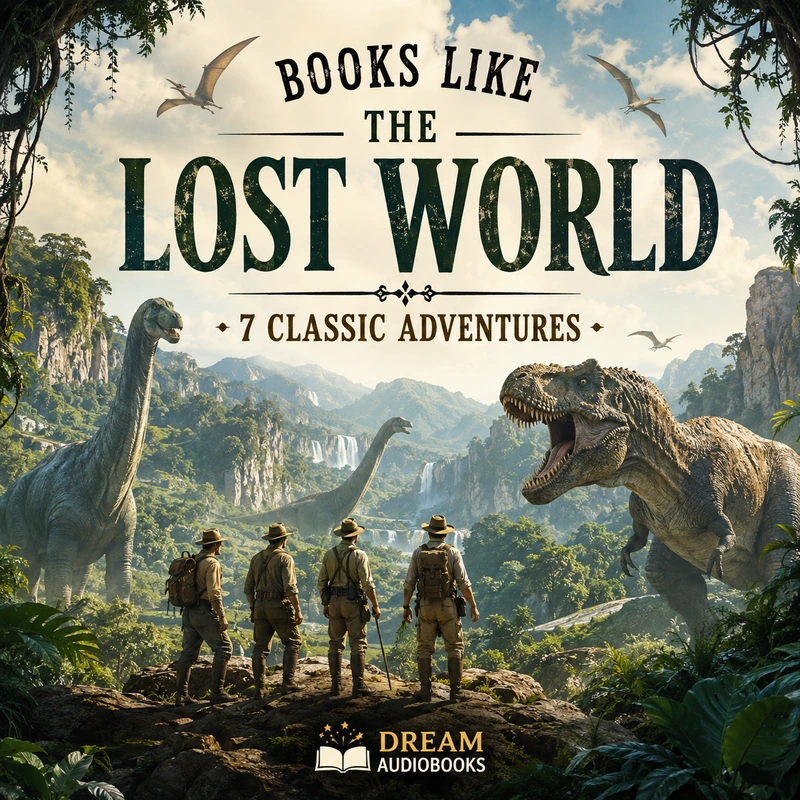
Books Like The Lost World: 7 Classic Adventures
If you are looking for books like The Lost World, the best recommendations should offer more than dinosaurs. Arthur Conan Doyle’s adventure works because it combines scientific curiosity, an expedition into unknown territory, dangerous wildlife, rivalry, survival and the extraordinary possibility that an isolated place may have preserved a world modern civilization knows nothing about.
First published in 1912, The Lost World follows journalist Edward Malone as he joins Professor Challenger, Professor Summerlee and Lord John Roxton on an expedition to a remote South American plateau. Challenger claims prehistoric creatures still survive there. What begins as an attempt to prove a controversial scientific theory quickly becomes an adventure in which discovery and danger are almost impossible to separate.
The seven audiobooks below continue different parts of that experience. Some lead into hidden civilizations or impossible landscapes. Others place travelers among strange creatures, isolated islands or hostile wilderness. A few move farther from realism into early science fiction, but all preserve the sense that crossing one geographical or intellectual boundary can reveal an entirely different world.
If dinosaurs and prehistoric life were what interested you most, begin with At the Earth’s Core or Before Adam. For expeditions and lost civilizations, choose King Solomon’s Mines. If you want imaginative world-building, A Princess of Mars is the strongest change of setting. The Island of Doctor Moreau offers a darker scientific adventure, while Treasure Island and White Fang preserve the danger, wilderness and survival that make Conan Doyle’s novel such an enjoyable adventure.
What Makes a Book Like The Lost World?
The most obvious answer is exploration. Conan Doyle sends his characters away from familiar institutions and into a place where maps, reputation and accepted scientific knowledge suddenly become unreliable. Professor Challenger has evidence, but evidence means little until other people can enter the plateau and see what he has seen.
That structure gives The Lost World two kinds of adventure at once. There is the physical journey through difficult terrain, but there is also an intellectual journey from disbelief to discovery. Summerlee begins as a skeptic. Malone wants excitement and personal achievement. Challenger wants vindication. Roxton understands danger better than the scientists do. Each man therefore enters the same landscape for a different reason.
The best books like The Lost World create a similar collision between expectation and reality. Their characters enter underground kingdoms, remote territories, alien worlds, islands or wilderness believing that experience has prepared them for what they will find. Usually it has not.
Creatures are important, but they are not enough. Dinosaurs make Conan Doyle’s plateau memorable because they destroy the comfortable assumption that the explorers understand the history of life around them. Edgar Rice Burroughs uses prehistoric animals in Pellucidar for a similar purpose. Jack London reaches prehistory from an entirely different direction in Before Adam. H. G. Wells creates organisms altered by human intervention rather than preserved by isolation.
Survival provides another connection. The explorers cannot simply observe their discoveries from a safe distance. Knowledge puts them inside the danger. That is why adventure novels such as Treasure Island and White Fang still belong in this listening path even though they contain no lost civilization. Both force characters to read unfamiliar environments quickly, distinguish threats from allies and adapt before circumstances overwhelm them.
Finally, these books share a powerful sense of distance. A remote plateau, underground world, Martian civilization, hidden kingdom or isolated island creates temporary separation from ordinary rules. That separation allows the author to ask what happens when familiar assumptions no longer provide protection.
Seven Classic Adventures at a Glance
| Audiobook | Closest connection to The Lost World | Best for |
|---|---|---|
| At the Earth’s Core | Prehistoric creatures and a hidden world | The closest lost-world adventure |
| King Solomon’s Mines | Expedition and hidden civilization | Classic exploration |
| A Princess of Mars | Discovery of an unfamiliar civilization | Planetary adventure |
| Before Adam | Prehistoric life and human origins | Readers fascinated by prehistory |
| The Island of Doctor Moreau | Science, isolation and dangerous creatures | Darker science fiction |
| Treasure Island | Expedition, remote territory and survival | Fast adventure |
| White Fang | Dangerous wilderness and adaptation | Nature and survival |
Best Books Like The Lost World
1. At the Earth’s Core by Edgar Rice Burroughs
At the Earth’s Core is the strongest first recommendation for anyone who wants another genuine lost-world adventure. Edgar Rice Burroughs takes the basic thrill of entering an unknown ecosystem and makes the concept even more extreme: instead of climbing onto an isolated plateau, his explorers travel beneath the surface of the Earth.
David Innes and inventor Abner Perry test an enormous drilling machine called the Iron Mole. The experiment does not go according to plan. Their machine carries them deep into the planet until they emerge in Pellucidar, an enormous inner world illuminated by a central sun.
The first similarity to The Lost World is immediate. The explorers discover creatures that should not exist beside human civilization. Prehistoric animals move through unfamiliar landscapes, while intelligent species and human communities have developed beyond the knowledge of the surface world.
Burroughs pushes the idea farther into fantasy than Conan Doyle. Challenger wants scientific recognition and attempts to prove that surviving dinosaurs are real. Pellucidar follows its own speculative geography and biological history. The result is less scientifically restrained but even more committed to wonder.
Both novels also understand that discovery quickly creates practical problems. Seeing an extraordinary creature is exciting from a distance. Being trapped in the same environment changes the question from “Does it exist?” to “How do we survive it?” David and Perry must understand local power, find allies and adapt to a world whose rules they did not know before arriving.
Choose this first if the isolated plateau was your favorite element of Conan Doyle’s story. Of every audiobook in this list, At the Earth’s Core most directly preserves the combination of prehistoric creatures, inaccessible geography and human exploration.
Best for: lost worlds, prehistoric creatures, underground exploration, pulp science fiction and fast adventure.
Listen to At the Earth’s Core on Spotify
2. King Solomon’s Mines by H. Rider Haggard
King Solomon’s Mines is essential for understanding the literary tradition from which The Lost World emerged. H. Rider Haggard’s novel predates Conan Doyle’s adventure and helped establish many of the conventions later associated with lost-world fiction.
Allan Quatermain joins Sir Henry Curtis and Captain Good on an expedition connected to the disappearance of Sir Henry’s brother and a mysterious map. Their journey leads across severe landscapes toward Kukuanaland and the legendary mines associated with immense treasure.
There are no dinosaurs, but the narrative structure will feel immediately familiar. A small group leaves the known world, follows uncertain evidence, crosses increasingly dangerous terrain and eventually discovers a society largely separated from their ordinary experience.
Quatermain also provides an interesting contrast with Professor Challenger. Challenger enters danger partly because confidence in his own theory makes retreat almost impossible. Quatermain is more cautious. He understands that adventure stories can sound attractive from a comfortable room but become physically exhausting when food, weather, distance and survival enter the calculation.
Modern listeners should also approach King Solomon’s Mines critically. It was written during the British imperial era, and its representation of Africa carries assumptions about race, empire, territory and European exploration that belong to that historical context. Those elements should not be hidden when recommending the novel today.
Recognizing them also makes comparison with The Lost World more useful. Both novels belong to a period fascinated by supposedly unknown territories and by the idea that European explorers could enter them, classify what they found and return with knowledge or objects. The adventure remains influential, but its worldview deserves examination alongside its narrative excitement.
Choose this audiobook if you enjoyed the expedition itself as much as the dinosaurs.
Best for: expeditions, lost civilizations, maps, hidden treasure and classic adventure history.
Listen to King Solomon’s Mines on Spotify
3. A Princess of Mars by Edgar Rice Burroughs
A Princess of Mars replaces Conan Doyle’s hidden plateau with an entire planet. John Carter mysteriously leaves Earth and finds himself on Mars, known to its inhabitants as Barsoom. The landscape, creatures, cultures and physical conditions are all unfamiliar, so Carter must learn how this new world works while already being drawn into its conflicts.
The connection to The Lost World is therefore less about dinosaurs than about discovery. Malone enters Challenger’s plateau without knowing what exists beyond its cliffs. Carter enters Barsoom with almost no reliable framework for interpreting what he sees.
Burroughs continually introduces new civilizations, creatures, political rivalries and technologies. The pleasure comes partly from following Carter as his understanding expands. Each discovery makes the world larger rather than simply solving the previous mystery.
The novel also moves much faster than many nineteenth- and early twentieth-century classics. Duels, escapes, battles, alliances and romantic conflict arrive quickly. Readers who enjoyed The Lost World because it felt more like an adventure than a demanding literary exercise may find A Princess of Mars particularly accessible.
Its scientific ideas are very different from modern knowledge of Mars. That is part of the historical experience. Burroughs was not describing the Mars explored by modern spacecraft; he was creating a planetary romance from the imaginative possibilities available to writers of his period.
The result became enormously influential. Barsoom helped establish a tradition of planetary adventure in which the hero enters an alien environment, learns its rules and becomes involved in conflicts much larger than the original journey.
Choose this audiobook when you want to preserve the wonder and exploration of The Lost World while moving fully into imaginative science fiction.
Best for: strange worlds, alien civilizations, action, heroic adventure and early science fiction.
Listen to A Princess of Mars on Spotify
4. Before Adam by Jack London
Before Adam approaches prehistory in a way completely different from Conan Doyle. Instead of sending modern explorers into a region where prehistoric life has survived, Jack London imagines a modern narrator experiencing ancestral memories from a much earlier stage of human development.
The novel moves into a brutal prehistoric environment populated by primitive human ancestors and dangerous animals. Everyday existence revolves around food, shelter, fear, competition and the constant need to understand threats before they become fatal.
For readers fascinated by the dinosaurs and ancient ecosystem of The Lost World, this creates an unusual companion. Conan Doyle allows twentieth-century explorers to remain themselves while walking through prehistory. London removes most of that protection. His prehistoric figures belong to their environment and must survive according to its rules.
The two novels also share an early twentieth-century fascination with evolution. Their scientific assumptions should not be treated as current anthropology or paleontology. They are works of fiction shaped by the scientific debates and popular theories available when they were written.
That historical distance is part of what makes listening to them together interesting. Conan Doyle asks what might happen if supposedly extinct creatures survived somewhere beyond modern knowledge. London imagines traces of the distant evolutionary past surviving inside the modern mind.
Before Adam is shorter and stranger than most books in this list. It lacks the formal expedition structure of Challenger’s journey, but its prehistoric atmosphere provides one of the strongest thematic connections.
Choose it if the ancient world itself interested you more than Professor Challenger’s personality or the expedition politics.
Best for: prehistory, evolution, primitive survival, dangerous animals and shorter speculative fiction.
Listen to Before Adam on Spotify
5. The Island of Doctor Moreau by H. G. Wells
The Island of Doctor Moreau takes several familiar ingredients—an isolated location, strange creatures, scientific ambition and a visitor who does not understand what he has entered—and turns them into something much darker.
Edward Prendick survives a shipwreck and eventually reaches an isolated island occupied by Doctor Moreau and his assistant Montgomery. Strange sounds and disturbing inhabitants gradually reveal that Moreau has been conducting experiments on animals, attempting to transform them into humanlike beings.
The contrast with The Lost World is important. Challenger discovers a place where nature has preserved forms of life thought to have disappeared. Moreau deliberately interferes with nature and creates his own unstable population. One scientist wants evidence of what already exists; the other uses knowledge to force living bodies into forms he has chosen.
Both stories nevertheless depend on isolation. Challenger’s plateau protects prehistoric life from the outside world. Moreau’s island protects the scientist from outside judgment. Distance makes the extraordinary possible because ordinary institutions cannot easily interfere.
Wells is also much less optimistic about scientific authority. Intelligence does not make Moreau wise or compassionate. His technical ability increases the harm he can inflict because nothing inside his private domain meaningfully limits him.
The creatures therefore produce fear for a very different reason than Conan Doyle’s dinosaurs. A dinosaur is dangerous because it belongs to another age and follows its own nature. Moreau’s Beast Folk are disturbing because suffering and human intention are responsible for what they have become.
Choose this when you want the scientific and creature elements of The Lost World but prefer horror, ethics and psychological unease to straightforward expedition adventure.
Best for: dark science fiction, isolated islands, dangerous experiments, creatures and moral questions.
Listen to The Island of Doctor Moreau on Spotify
6. Treasure Island by Robert Louis Stevenson
Treasure Island contains no prehistoric animals or speculative science, but it preserves one of the qualities that makes The Lost World enjoyable: the excitement of travelling toward a place that exists first as an idea, a story and a set of uncertain clues.
Jim Hawkins becomes involved in an expedition after discovering a treasure map. A voyage aboard the Hispaniola carries him toward a remote island, but the journey becomes dangerous long before the destination is reached. Some members of the crew are not what they appear to be, and Long John Silver makes trust almost as important as navigation.
Malone undergoes a comparable transition in The Lost World. At the beginning, adventure is something he wants in the abstract. Once the expedition reaches genuinely dangerous territory, courage becomes less romantic. Decisions have consequences, experienced adults can be wrong and survival requires attention rather than enthusiasm alone.
Stevenson’s island also works as an enclosed environment. Once competing groups occupy the same limited territory, geography becomes part of the conflict. Paths, supplies, shelter, ships and information matter because nobody can simply return to ordinary society when the situation becomes uncomfortable.
The book moves quickly and remains one of the easiest classic adventures to recommend to listeners who dislike slow openings. Dialogue and changing alliances keep the story active, while Jim provides a clear viewpoint through which the listener experiences uncertainty.
If you enjoy this direction, DreamAudiobooks also has a dedicated guide to books like Treasure Island, which expands the adventure and exploration cluster further.
Choose this audiobook when what you loved most about The Lost World was the expedition, danger and feeling of being cut off from safety rather than the science-fiction element itself.
Best for: islands, expeditions, maps, danger, betrayal and fast classic adventure.
Listen to Treasure Island on Spotify
7. White Fang by Jack London
White Fang seems at first to be the least obvious recommendation on this list. There is no hidden civilization, scientific expedition or impossible geography. Yet it preserves another important part of The Lost World: human vulnerability inside an environment that does not care about human confidence.
London places much of the story in the harsh northern wilderness and follows a wolfdog whose behavior is shaped by hunger, violence, other animals and changing encounters with humans. Instead of allowing explorers to observe dangerous nature, London partly shifts the viewpoint toward the animal itself.
This makes White Fang an interesting book to read after Conan Doyle. Professor Challenger’s group enters the plateau believing they are observers and discover that they can easily become prey. In London’s world, that balance between hunter and hunted is present from the beginning.
Adaptation is therefore central. White Fang learns through experience. Environments and relationships teach him what is safe, what is dangerous and what forms of behavior allow survival. Intelligence appears not as abstract scientific knowledge but as the ability to read immediate circumstances correctly.
London also questions easy distinctions between wilderness and civilization. The natural world can be brutal, but human beings are capable of deliberate cruelty that animals do not need philosophical excuses to justify. The story gradually becomes not only about survival but about the effects of treatment, trust and environment on character.
Listeners interested in the wilderness side of The Lost World will appreciate the physical atmosphere. Cold, hunger, distance and danger never feel decorative. They shape every decision.
Choose White Fang as the final audiobook when you want to leave speculative lost worlds behind while keeping the intensity of humans and animals confronting a powerful natural environment.
Best for: wilderness, animals, survival, adaptation, nature and Jack London fans.
Listen to White Fang on Spotify
How to Choose Your Next Audiobook
For the closest book to The Lost World
Start with At the Earth’s Core. Pellucidar gives you prehistoric creatures, an inaccessible environment, lost civilizations and explorers trying to understand a world that should not exist according to ordinary geography.
For another classic expedition
Choose King Solomon’s Mines. It removes the dinosaurs but preserves maps, dangerous travel, a small expedition and entry into territory imagined as remote from the explorers’ familiar world.
For more imaginative science fiction
Listen to A Princess of Mars. The scale expands from a hidden plateau to an entire planet, with strange species, civilizations, technologies and conflicts.
For prehistoric atmosphere
Choose Before Adam. It is the most direct option for listeners whose curiosity centers on ancient forms of human and animal life.
For something darker
The Island of Doctor Moreau is the strongest choice. It combines isolation and unusual creatures with a disturbing examination of scientific power and responsibility.
For pure adventure
Choose Treasure Island. It offers the most accessible combination of travel, danger, suspense, changing alliances and remote geography.
For wilderness survival
Finish with White Fang. The setting is realistic, but the struggle to understand and survive an unforgiving environment remains intense.
Lost Worlds, Science and Exploration
The Lost World belongs to a period when large areas of the planet were still presented to many European and American readers as mysterious or unexplored. Adventure writers transformed that limited public knowledge into stories about hidden kingdoms, surviving species and geographical barriers separating modern civilization from extraordinary discoveries.
Modern readers know that territories described as “unknown” in imperial adventure fiction were often already known perfectly well to the people who lived there. That historical fact matters. The idea of an explorer discovering a territory can reveal more about the explorer’s worldview than about the place itself.
Reading these novels critically does not require removing their adventure. It means recognizing both what made them exciting and the assumptions that shaped that excitement.
Conan Doyle’s great contribution was to connect the lost-world tradition with paleontology and public fascination with prehistoric life. Professor Challenger does not merely search for treasure. He wants to prove a scientific claim. Dinosaurs become evidence as well as danger.
Burroughs expands the concept until geography becomes fantasy. Haggard builds expeditions around hidden civilizations and treasure. Wells turns scientific isolation into horror. London looks backward toward human origins. Stevenson strips away speculative science and demonstrates that a remote island, uncertain companions and limited resources are enough to create a complete world of danger.
Together, these books show why the lost-world idea survived far beyond its original historical context. The essential fantasy is not simply that dinosaurs might remain alive somewhere. It is the possibility that one journey could reveal that the world is larger, stranger and less completely understood than the traveler believed.
For another route through classic survival and exploration, see Books Like Robinson Crusoe. Readers interested in the scientific side of Conan Doyle’s novel can also explore Books Like The Invisible Man.
Frequently Asked Questions
What should I read after The Lost World?
At the Earth’s Core by Edgar Rice Burroughs is the closest recommendation if you want another adventure involving prehistoric creatures and a hidden world. King Solomon’s Mines is better if the expedition and lost-civilization elements interested you most.
What books are similar to The Lost World because of dinosaurs or prehistory?
At the Earth’s Core is the strongest lost-world alternative because Pellucidar contains prehistoric creatures. Before Adam also explores prehistoric life, although Jack London approaches the subject through ancestral memory rather than a modern expedition.
Is The Lost World science fiction or adventure?
It is both. Arthur Conan Doyle uses an adventure-expedition structure but builds the central mystery around a scientific claim: prehistoric animals may have survived in an isolated ecosystem. This combination helped make the novel an important early work of science-fiction adventure.
Is The Lost World connected to Jurassic Park?
They are separate works by different authors and from very different periods. However, the broader concept of modern people entering an environment inhabited by prehistoric creatures makes Conan Doyle’s novel an important ancestor of later dinosaur adventure fiction.
Which book on this list has the most similar hidden-world setting?
At the Earth’s Core is the closest. Its characters enter Pellucidar, a vast world beneath the Earth populated by prehistoric creatures and unfamiliar civilizations. The speculative geography is different, but the sense of discovering an isolated ecosystem is extremely similar.
Which recommendation is easiest to start with?
Treasure Island, At the Earth’s Core and A Princess of Mars are strong starting points for listeners who prefer fast-moving adventure. The Island of Doctor Moreau is better for someone who wants a darker and more philosophical story.
Are these audiobooks available on Spotify?
Yes. Each selection above includes a direct Spotify link to its specific audiobook or podcast listing. Availability can vary by country and may change when streaming platforms or distributors update their catalogs.
Final Recommendation
Start with At the Earth’s Core if you want the closest continuation of The Lost World. Its prehistoric creatures, inaccessible environment and hidden civilization recreate the sense that a single expedition can overturn everything its travelers thought they knew about the planet.
Move next to King Solomon’s Mines for the expedition tradition that helped shape lost-world fiction, then to A Princess of Mars when you are ready to take the same spirit of discovery beyond Earth.
The remaining books explore different pieces of Conan Doyle’s formula: Before Adam for prehistory, The Island of Doctor Moreau for dangerous science, Treasure Island for remote adventure and White Fang for survival in a landscape where nature sets the rules.
These seven books like The Lost World demonstrate why the adventure still works more than a century after its publication. The dinosaurs are unforgettable, but the deeper attraction is discovery: crossing a boundary, entering the unknown and realizing that the world may contain far more than anyone expected.