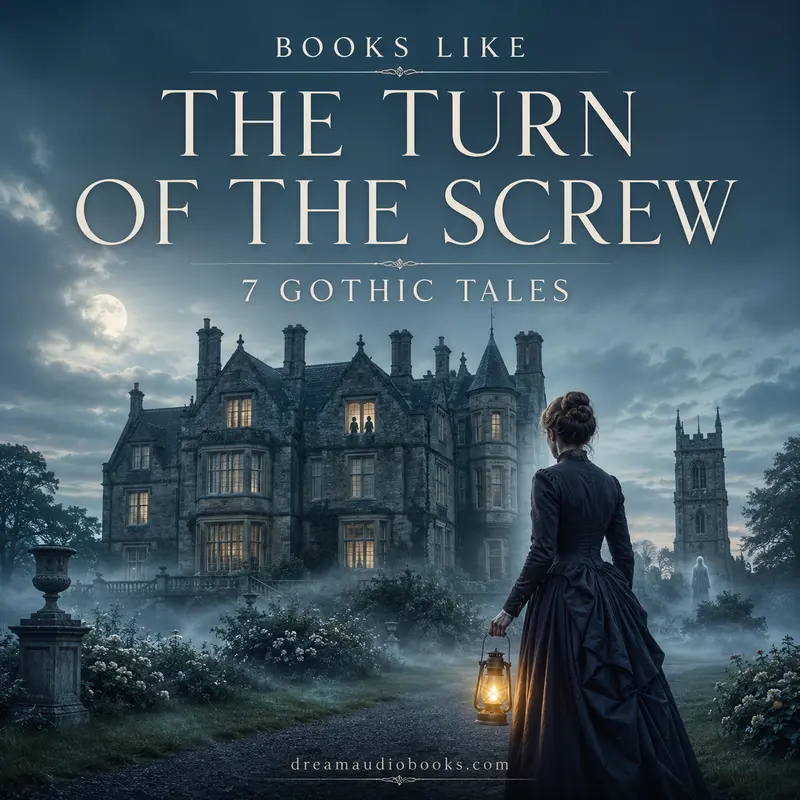
Books Like The Turn of the Screw: 7 Gothic Tales
Gothic fiction · Psychological horror · Haunted places · Free audiobooks
Books like The Turn of the Screw do more than place ghosts inside an old house. Henry James makes every event depend on a question that the story refuses to settle: is the governess protecting the children from a supernatural danger, or is her certainty creating a danger of its own? The apparitions at Bly may be real, Miles and Flora may be concealing what they know, and the governess may be a trustworthy witness. Yet each of those explanations leaves something unresolved.
That uncertainty is the novella’s most enduring source of fear. A conventional ghost story can tell us what the spirit wants and how it may be defeated. James gives the listener testimony rather than proof. We hear the governess describe Peter Quint and Miss Jessel, but no independent witness confirms her interpretation. Her devotion, fear and growing conviction become inseparable, making it impossible to examine the haunting without also examining the person who reports it.
The seven Gothic tales below preserve different parts of that experience. The White People uses a young girl’s private manuscript to suggest forbidden knowledge without explaining it. Olalla places a rational visitor inside a decaying household where heredity and supernatural corruption cannot be separated. Carmilla brings an intimate and dangerous visitor into an isolated home, while The Castle of Otranto shows the earlier Gothic tradition of family secrets and unmistakable apparitions.
The Ghost Pirates replaces the country estate with a ship that its crew cannot escape. Tales of Terror and Mystery moves between rational investigation and uncanny possibility, and 30 Ghost Stories offers shorter encounters with haunted places, unexplained figures and unfinished histories.
If you have not yet listened to Henry James’s novella, begin with The Turn of the Screw audiobook. Then use this guide to choose the quality you want to encounter again: an unreliable testimony, an isolated household, a threatened young narrator, a family secret, a confined setting or a haunting that resists a final explanation.
Why The Turn of the Screw Still Endures
The plot begins with a familiar Gothic arrangement. A young and inexperienced governess accepts responsibility for two orphaned children at Bly, a remote country estate. Their uncle, who employs her, insists that she must solve every problem herself and never trouble him. The apparent freedom of the position is therefore also a form of abandonment. She has authority inside the house, but no experienced person with whom she can test her conclusions.
Miles and Flora initially appear beautiful, affectionate and unusually well behaved. The governess’s first sightings of an unknown man and woman gradually alter that impression. After the housekeeper identifies the figures as the dead Peter Quint and Miss Jessel, the governess becomes convinced that the children know more than they admit. Ordinary silence begins to look like conspiracy, and every display of innocence can be interpreted as evidence of corruption.
James limits the narrative so carefully that sincerity never becomes certainty. The governess may honestly believe everything she says while still misunderstanding what she sees. Mrs Grose confirms the identities from the descriptions, but she does not see the ghosts herself. The children’s behaviour can support several incompatible interpretations. Even the manuscript frame places the events at a distance, reminding us that we are receiving a written account passed from one person to another.
The best books like The Turn of the Screw preserve that pressure between evidence and interpretation. They place characters where ordinary assistance is difficult to reach, allow the setting to intensify fear and make the act of telling the story part of the mystery. The reader or listener must decide not only what happened, but also how much confidence to place in the voice describing it.
What to Look for in Books Like The Turn of the Screw
A useful companion does not need another governess, two children and an English country house. Repeating the surface plot would miss what makes James’s novella distinctive. Strong comparisons usually share several deeper features:
- Restricted testimony: events reach us through a diary, manuscript, witness or narrator whose knowledge is incomplete.
- Isolation: a house, castle, ship or remote landscape separates the characters from reliable outside help.
- Uncertain danger: the threat may be supernatural, psychological, hereditary or a combination of several explanations.
- Vulnerable relationships: trust between a guardian, guest, child, patient or companion becomes part of the suspense.
- A meaningful setting: the building or landscape does more than provide scenery; it controls what can be seen, known and escaped.
- Suggestion over spectacle: silence, absence and implication create more fear than explicit violence.
Not every recommendation below contains all six qualities. Together, however, they offer a listening path from quiet psychological ambiguity to direct supernatural terror without collapsing every Gothic story into the same formula.
Seven Gothic Audiobooks at a Glance
| Audiobook | Closest connection | Mood | Best for |
|---|---|---|---|
| The White People | A young voice and forbidden knowledge | Dreamlike and unsettling | The closest psychological match |
| Olalla | An isolated estate and uncertain corruption | Romantic and oppressive | Family secrets |
| Carmilla | Intimacy becoming supernatural danger | Elegant and threatening | Gothic vampire fiction |
| The Castle of Otranto | A haunted building and a buried family history | Dramatic and supernatural | The origins of Gothic fiction |
| The Ghost Pirates | Confined witnesses facing an unexplained presence | Claustrophobic and maritime | Slow-building supernatural fear |
| Tales of Terror and Mystery | Reason confronting uncanny evidence | Varied and suspenseful | Short mysteries and horror |
| 30 Ghost Stories | Haunted places and restless presences | Eerie and accessible | Short listening sessions |
Seven Books Like The Turn of the Screw
1. The White People by Arthur Machen
The White People audiobook is the closest recommendation for listeners fascinated by the uncertain relationship between childhood, testimony and supernatural knowledge. Much of Arthur Machen’s story consists of a private manuscript written by a young girl. She records strange games, invented words, secret rituals and journeys through a landscape that seems to conceal an older reality.
The girl does not explain her experiences in adult terms. That limitation makes the manuscript both innocent and disturbing. She may be describing imagination, folklore, manipulation or contact with forces she cannot understand. Like the children at Bly, she stands at the centre of a mystery that adults interpret from outside. The reader must decide how much danger exists in the events themselves and how much enters through the language used to frame them.
Machen’s horror is even less direct than James’s. There is no simple confrontation in which the supernatural becomes fully visible and classified. Beauty and menace remain close together: hills, woods and childhood discoveries acquire an occult significance without losing their surface charm. Choose this first if ambiguity, rather than the traditional ghost story, was what stayed with you after The Turn of the Screw.
Listen to The White People on Spotify
2. Olalla by Robert Louis Stevenson
Olalla begins when a wounded soldier is sent to recover at an isolated estate in the Spanish mountains. The household he enters appears diminished by its own history. The mother behaves with an unnerving passivity that can suddenly become animal aggression, her son Felipe seems ruled by instinct, and the refined Olalla believes that her family carries a destructive inheritance.
The narrator tries to understand whether the danger is medical, hereditary, moral or supernatural. Stevenson refuses to turn those possibilities into a single clean answer. Blood, degeneration and forbidden desire create a Gothic vocabulary through which nineteenth-century fears about inheritance become almost vampiric. The estate, like Bly, separates the outsider from ordinary reference points and makes every encounter feel more significant.
The emotional relationship is also important. The soldier is attracted to Olalla, while she believes that love cannot free her from the burden of her family. Care and danger therefore occupy the same relationship, as they do in the governess’s attachment to Miles and Flora. Choose Olalla if you want another compact Gothic work in which a visitor becomes emotionally committed before understanding the household’s secret.
3. Carmilla by Joseph Sheridan Le Fanu
The Carmilla audiobook is narrated by Laura, a young woman whose secluded life changes after a mysterious carriage accident brings Carmilla into her home. The visitor is affectionate, secretive and increasingly difficult to separate from Laura’s dreams, physical weakness and fear. Their intimacy makes the danger harder to name because attraction and alarm develop together.
Unlike The Turn of the Screw, Le Fanu eventually provides a clearer supernatural explanation. The route to that explanation, however, depends on testimony, delayed recognition and adults assembling evidence that Laura could not interpret when events occurred. The remote castle and surrounding forest create a protected world that also leaves its inhabitants vulnerable. Help exists, but it arrives only after the pattern of illness has repeated.
Carmilla herself is more intimate than Peter Quint or Miss Jessel. She enters the household as a companion rather than appearing at a distance. This turns hospitality into exposure and makes trust one of the story’s most dangerous conditions. Choose this audiobook if you want Gothic uncertainty with a stronger plot, a memorable supernatural antagonist and an important place in the development of vampire fiction.
4. The Castle of Otranto by Horace Walpole
The Castle of Otranto audiobook shows the Gothic tradition before Henry James turned so much of its fear inward. Horace Walpole gives the supernatural a physical and theatrical presence: a gigantic helmet kills Conrad on his wedding day, ancient prophecy challenges Manfred’s authority, and the castle produces signs that cannot easily be dismissed as private hallucinations.
The comparison lies in the building’s relationship with its hidden past. Bly appears peaceful, but the history of Quint and Miss Jessel changes how every room and window is understood. Otranto is even more openly governed by inheritance, illegitimate power and a truth that the ruling family has tried to contain. Corridors, chambers and secret passages do not merely hold the action; they materialise the family’s fear of exposure.
Walpole’s pace and melodrama feel very different from James’s controlled ambiguity. That difference makes the novel useful. It allows listeners to hear how later psychological ghost stories developed from an earlier form filled with prophecy, persecuted heroines, ancestral crime and visible supernatural intervention. Choose Otranto when you want a shorter, more direct haunting and a foundational work in the history of Gothic fiction.
Listen to The Castle of Otranto on Spotify
5. The Ghost Pirates by William Hope Hodgson
The Ghost Pirates audiobook transfers supernatural isolation from a country estate to the merchant ship Mortzestus. Jessop joins a crew already burdened by the vessel’s sinister reputation. At first he notices uncertain shapes, unusual sounds and movements that might be explained by darkness or the difficult conditions of life at sea. The evidence then becomes increasingly physical and dangerous.
Like the governess’s manuscript, Jessop’s account is a survivor’s testimony. His voice gives the impossible events a practical frame. Ropes, rigging, watches and the routines of sailors make the ship credible before ghostly figures begin to intrude upon it. The listener is encouraged to trust his observations, yet he cannot explain what the attackers are, where they come from or why the vessel has become accessible to them.
The sea makes this story especially claustrophobic. Bly is remote, but its characters could theoretically leave. The crew of the Mortzestus is enclosed by distance, weather and duty. There is no safe neighbouring house and no authority to consult. Choose this novel if you want the slow accumulation of unexplained sightings, but prefer physical danger, maritime detail and a supernatural threat that eventually moves from the edge of vision onto the ship itself.
Listen to The Ghost Pirates on Spotify
6. Tales of Terror and Mystery by Arthur Conan Doyle
Tales of Terror and Mystery reveals a darker side of Arthur Conan Doyle’s fiction. The collection moves between physical danger, strange experiments, apparently impossible events and mysteries that invite rational reconstruction. This mixture is valuable after Henry James because it repeatedly tests the boundary between evidence and fear.
Doyle’s narrators often begin with confidence in observation, science or ordinary causation. An unexplained sound, a sealed space or a disturbing discovery then forces them to reconsider what their knowledge can account for. Some stories ultimately favour an ingenious solution; others allow the uncanny atmosphere to survive. The listener is placed in the productive position of looking for clues without knowing whether the case belongs to detection or horror.
The collection also offers a change of rhythm. Instead of remaining inside one ambiguous situation for an entire novella, you can hear a complete suspense narrative in a shorter session and then begin again with a new voice and setting. Choose Doyle if you enjoyed interpreting small details in The Turn of the Screw, but want clearer plots, more variety and the intellectual pleasure of stories that place reason under pressure.
Listen to Tales of Terror and Mystery on Spotify
7. 30 Ghost Stories
30 Ghost Stories is the most flexible recommendation on this list. Rather than following one narrator through a long psychological crisis, the collection offers multiple haunted spaces, apparitions and encounters with the unresolved past. One tale may emphasise an empty room or abandoned house, while another may centre on a voice, object or figure that appears only briefly.
The connection to Henry James lies in atmosphere and suggestion. A successful ghost story does not always need to explain who the spirit was or provide a mechanical rule for the haunting. Footsteps, silence, interrupted routines and the sense that a familiar place is being observed can be enough. Short form makes those details especially important because the story must establish trust and disturb it within a limited time.
This is the best choice for listeners who want Gothic audio in small portions. You can hear a complete story during an evening walk or before bed without carrying the characters and plot of a longer novel across several days. It is also a useful introduction for someone who found James’s prose demanding but enjoyed the mood of Bly. Begin here for variety, then return to The White People or Olalla when you want a more sustained ambiguity.
Listen to 30 Ghost Stories on Spotify
How to Choose Your Next Gothic Audiobook
For the closest psychological uncertainty
Begin with The White People. Its young manuscript writer describes experiences without possessing the adult categories needed to explain them. As with the children and governess at Bly, innocence, knowledge and interpretation remain unstable.
For another isolated household
Choose Olalla when the remote estate and hidden family history mattered most. Choose Carmilla when you want the threat to enter through companionship, intimacy and the rules of hospitality.
For unmistakable supernatural events
Listen to The Castle of Otranto. Walpole offers prophecy, apparitions and impossible physical signs rather than asking the listener to decide whether one witness imagined everything.
For an inescapable setting
Select The Ghost Pirates. A haunted ship intensifies the isolation of Bly because the characters cannot walk away or seek ordinary help. Practical maritime routines make the intrusion of impossible figures more convincing.
For shorter listening
Tales of Terror and Mystery is best when you want compact plots that mix detection and fear. 30 Ghost Stories is the more direct choice for apparitions, haunted locations and a different supernatural encounter in each session.
Why These Gothic Stories Work So Well in Audio
Ambiguous fiction depends on voice. On the page, a reader controls speed and may return immediately to a suspicious sentence. In an audiobook, the narrator carries the listener forward while tone supplies another layer of interpretation. A pause may suggest doubt; a calm description can make an impossible event feel credible; sudden certainty may sound reassuring or obsessive.
This is particularly important in first-person and manuscript narratives. The governess, Machen’s young diarist, Laura, Stevenson’s soldier and Hodgson’s sailor do not simply report plots. Their manner of speaking shapes how much we trust them. A strong performance should communicate fear and conviction without deciding every ambiguity for the audience.
Setting also becomes more immediate through rhythm. Long sentences can slow a listener inside an old house, while short reports reproduce the urgency of a shipboard emergency. The absence of visual images leaves Bly, Otranto and the Mortzestus to the imagination. That can make the unseen presence more effective because no fixed picture limits what may be waiting beyond a doorway, window or stretch of dark water.
For the best experience, listen when you can follow changes in voice and perspective without constant interruption. These stories do not require darkness, headphones or theatrical sound effects, but quiet attention helps. Their most important clues are often not loud events. They are small contradictions, delayed explanations and moments when a familiar voice becomes difficult to read.
Related Gothic Audiobook Guides
Continue with Best Weird Fiction Audiobooks if uncertainty about reality is your main interest. That guide moves from Henry James and Arthur Machen toward cosmic and speculative horror.
For a broader historical overview, explore the best Gothic audiobooks. Vampire listeners can compare the more intimate threat in Books Like Carmilla with the larger conflict found in Books Like Dracula.
If the shipboard isolation of Hodgson’s novel appeals to you, visit Best Maritime Horror Audiobooks. Listeners who prefer shorter dark fiction can also explore the best Edgar Allan Poe audiobooks.
Frequently Asked Questions
What is the best book to listen to after The Turn of the Screw?
The White People is the closest choice for listeners who value ambiguity, a young perspective and forbidden supernatural knowledge. Choose Olalla instead for another isolated estate and a visitor trying to interpret a troubled household.
Which recommendation is the most traditional ghost story?
30 Ghost Stories provides the widest selection of apparitions and haunted places. The Castle of Otranto offers the clearest supernatural events within a single influential Gothic novel.
Which book has the most psychological ambiguity?
The White People leaves its central experiences deliberately difficult to classify. Olalla also preserves uncertainty between heredity, illness, moral corruption and supernatural danger.
Are these books suitable for listeners new to Gothic fiction?
Yes, but their styles differ. Carmilla, The Castle of Otranto and the two story collections are relatively accessible starting points. The White People and Olalla reward listeners who enjoy implication and older literary prose.
Do all seven recommendations have free audiobook links?
Yes. Each selection has its own DreamAudiobooks page and a dedicated Spotify button in this guide. Availability may vary by country and can change when a platform updates its catalogue.
Is The Turn of the Screw definitely a supernatural story?
The novella can be read as a genuine ghost story, but Henry James leaves enough uncertainty for psychological interpretations. The governess may see real spirits, misunderstand the children or combine accurate observations with conclusions shaped by fear and isolation.
Final Recommendation
Start with The White People for the closest return to uncertain testimony and childhood knowledge. Continue with Olalla when you want an isolated household whose danger may be hereditary or supernatural, or choose Carmilla for a clearer plot built around trust and intimate intrusion.
Move to The Castle of Otranto to hear the Gothic tradition in a more dramatic early form. Select The Ghost Pirates when confinement and slow supernatural escalation matter more than the country-house setting. Use Tales of Terror and Mystery and 30 Ghost Stories when you prefer complete shorter experiences.
The best books like The Turn of the Screw do not solve Henry James’s mystery or repeat the figures standing at Bly. They recreate the more disturbing experience of hearing a witness speak with conviction while the evidence remains incomplete. The ghost may be real, the narrator may be mistaken, and the listener must remain inside both possibilities until the final words.