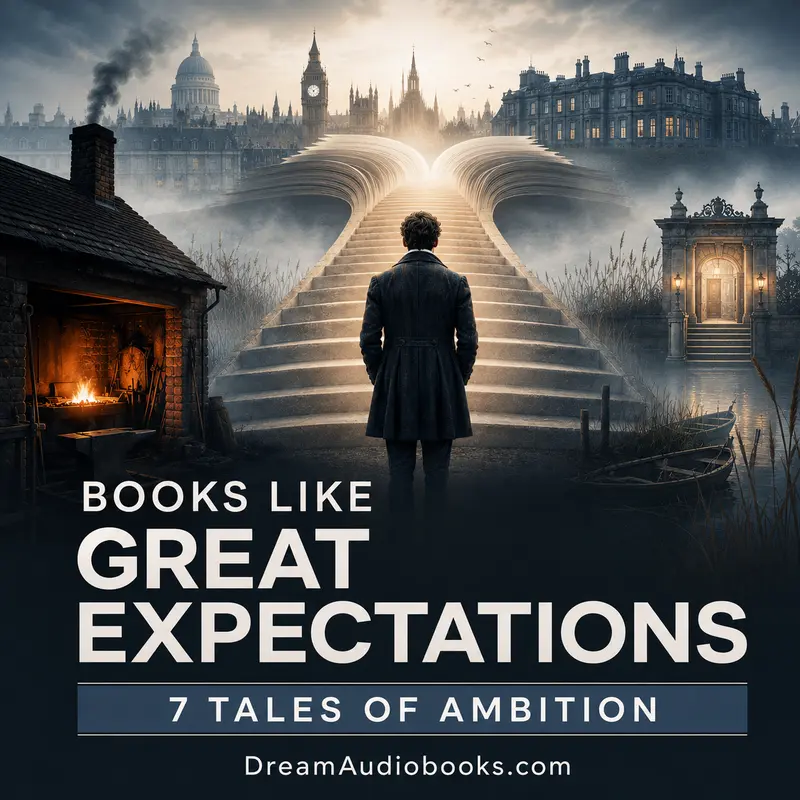
Books Like Great Expectations: 7 Tales of Ambition
Books Like Great Expectations tend to begin with a young person looking beyond the life that seems to have been assigned to them. Charles Dickens gives that desire an unforgettable shape in Pip, an orphan raised beside the Kent marshes who dreams of leaving the forge and becoming a gentleman. When money arrives from an unknown benefactor, Pip assumes that his imagined future has finally chosen him. He acquires clothes, rooms, debts and social confidence, but the education he receives is not the one he expected. His rise reveals how easily ambition can become embarrassment, how class can distort affection, and how a person may mistake status for worth.
That is why Great Expectations is much richer than a simple rags-to-riches story. Pip’s material transformation matters, but Dickens is more interested in the transformation of his judgment. As a boy, Pip knows the warmth of Joe Gargery and the terror of the escaped convict Magwitch. At Satis House, he encounters Miss Havisham’s frozen grief and Estella’s cultivated coldness. Later, London allows him to imitate the manners of a gentleman without first understanding what gentleness demands. His greatest errors come not from wanting a larger life, but from treating the people connected to his humble past as obstacles to that life.
The best companion books therefore do not merely feature orphans, inheritances or grand houses. They ask the same harder questions. What does ambition cost? Can wealth create identity? Why do people become ashamed of those who first loved them? Is social advancement a form of freedom, or simply another role to perform? What happens when a dream is built on a false assumption? Each title in this guide explores at least one of those questions through a distinct character, setting and literary voice.
If you have just finished the Great Expectations audiobook, the next book you choose may depend on which part of Pip’s journey stayed with you. For another orphan who must protect an inner sense of dignity, begin with Jane Eyre. For ambition sharpened by education and social exclusion, choose Martin Eden. If the glitter of wealth and self-invention fascinated you, The Great Gatsby is the clearest twentieth-century echo. If you want another boyhood shaped by adventure, conscience and social rules, turn to The Adventures of Tom Sawyer.
The remaining recommendations widen the social and emotional world around Dickens’s novel. Little Women follows young people whose ambitions develop within family life rather than through a mysterious fortune. Bleak House returns to Dickens’s London and shows how money, inheritance and institutions entangle many lives at once. The Count of Monte Cristo offers the most dramatic transformation: a wronged man acquires wealth, education and a new identity, then uses them to shape the fate of everyone connected to his past.
Together, these seven books create a useful spectrum. At one end are characters such as Jane Eyre and Jo March, who try to build lives without surrendering their principles. At the other are figures such as Martin Eden, Jay Gatsby and Edmond Dantès, whose extraordinary powers of self-reinvention place their humanity under pressure. Tom Sawyer gives ambition a playful childhood form, while Bleak House reveals the larger systems of class and money that individual dreams cannot easily escape.
The audiobook format suits these stories especially well because so much of their meaning depends on voice. Pip narrates from adulthood, allowing regret and affection to colour memories that his younger self did not fully understand. Jane Eyre speaks with fierce inward clarity. Martin Eden’s changing language reflects his education and estrangement. Nick Carraway’s admiration for Gatsby is inseparable from his unease. Dickens’s crowded London becomes easier to navigate when narrators give each character a recognisable rhythm and tone.
Listening also allows long social novels to unfold without haste. A book such as Bleak House builds its effect through recurring names, places, secrets and relationships. Audio makes those patterns easier to absorb over daily walks, commutes or quiet evenings. Shorter, faster works such as Tom Sawyer provide a lighter alternative, while The Count of Monte Cristo rewards listeners who want a large, immersive commitment.
This list is ranked by thematic usefulness rather than by literary importance. Jane Eyre comes first because it shares Pip’s orphanhood and social vulnerability while offering a morally stronger model of self-respect. Martin Eden follows because its treatment of ambition, education and class comes closest to Pip’s desire to remake himself. The other five titles develop specific parts of the same conversation: wealth, family, conscience, inheritance, revenge and the difference between becoming impressive and becoming good.
Every entry includes a dedicated DreamAudiobooks page and its own Spotify link. You can explore the background of each title, compare its connection to Dickens’s novel and then begin the correct audiobook directly. Whether you want another Victorian coming-of-age story, an American novel about invented identity or an epic tale of transformation, these seven classics provide meaningful paths beyond the final pages of Pip’s story.
Why Books Like Great Expectations Still Matter
Great Expectations endures because Pip’s mistake is painfully recognisable. He does not simply want money. He wants money to settle the question of who he is. Once he believes that wealth and Estella belong to the same secret plan, every coincidence seems to confirm the story. Dickens lets the reader see how expectation edits reality: Pip notices evidence that supports his hopes and overlooks the loyalty already present in his life.
The seven books below all examine identities shaped by desire. Their characters want education, independence, artistic recognition, romance, family security, justice or admission to a higher social world. Some grow through the pursuit. Others discover that achieving the dream does not heal the need beneath it. Like Pip, they must eventually distinguish a life chosen with honesty from a performance designed to impress an imagined audience.
Class is equally important. In these novels, society does not merely divide rich people from poor people; it teaches characters what to admire and what to hide. Accent, clothing, work, education and family history become signs that others read. The finest protagonists learn that social judgment is real without allowing it to become the final measure of human value.
Seven Classic Audiobooks at a Glance
| Audiobook | Closest connection | Best for listeners who want |
|---|---|---|
| Jane Eyre | Orphanhood, class and moral growth | A strong first-person heroine |
| Martin Eden | Education and self-made ambition | An intense rise-and-fall story |
| The Great Gatsby | Wealth, reinvention and an idealised love | A concise modern tragedy |
| The Adventures of Tom Sawyer | Boyhood, conscience and social rules | Humour and adventure |
| Little Women | Growing up with creative ambitions | Warm family storytelling |
| Bleak House | Inheritance, class and Dickensian London | A large Victorian social novel |
| The Count of Monte Cristo | Wealth, hidden identity and transformation | An epic of revenge and redemption |
Best Books Like Great Expectations
1. Jane Eyre by Charlotte Brontë
Jane Eyre by Charlotte Brontë is the strongest first recommendation because Jane and Pip begin from similar positions but respond to social humiliation in very different ways. Both are orphaned, dependent and repeatedly reminded of their low status. Both enter wealthy households that awaken powerful hopes. Yet Jane develops an inner standard of value that Pip lacks during much of his youth.
Jane wants love, education and belonging, but she refuses to accept them at the price of self-betrayal. At Gateshead and Lowood, she learns how institutions can use moral language to justify cruelty. As a governess at Thornfield, she occupies an uncertain class position: educated enough to converse with her employer, but employed and therefore socially inferior. Her relationship with Rochester tests whether emotional desire can coexist with conscience.
Pip often sees himself through Estella’s judgment and tries to become the gentleman he imagines she could love. Jane also loves someone above her in wealth and status, but she insists that spiritual and moral equality cannot be bought. That contrast makes her story a revealing companion to Dickens’s novel. Both books ask what a person owes to the self formed before money, romance and social ambition complicated life.
The audiobook gives Jane’s first-person narration its full force. Her intelligence, anger and restraint are as important as the Gothic mysteries surrounding Thornfield. Choose this title if you want another orphan’s journey through class and love, led by a character whose dignity grows stronger under pressure.
Listen to Jane Eyre on Spotify
2. Martin Eden by Jack London
Few classic novels examine self-education and class ambition as directly as the Martin Eden audiobook. Martin is a working-class sailor who falls in love with Ruth Morse, a young woman from a cultivated bourgeois family. Believing that education and literary success will make him worthy of her, he begins an exhausting programme of reading, writing and intellectual transformation.
The parallel with Pip is immediate. Both young men interpret love through social inadequacy. Each becomes ashamed of the world that formed him and imagines that entry into a higher class will resolve that shame. Yet Martin’s ambition is more active than Pip’s. He does not receive a mysterious fortune; he disciplines his body and mind, writes relentlessly and endures rejection. His eventual success creates a harsher question: what if the society whose approval you wanted proves unworthy once it finally offers that approval?
Jack London brings personal knowledge to this conflict. The novel understands physical labour, hunger, intellectual excitement and the loneliness of rapid self-transformation. Martin learns to speak and think differently, but the change separates him from his old community without securing an honest place in the new one. Recognition arrives late, after the values behind it have been exposed.
This is the darkest treatment of ambition on the list. The audiobook’s direct prose and restless forward motion make Martin’s rise compelling even when his worldview becomes increasingly severe. Choose it if Pip’s pursuit of gentility interested you most and you want another self-made protagonist whose dream changes meaning as he approaches it.
Listen to Martin Eden on Spotify
3. The Great Gatsby by F. Scott Fitzgerald
The Great Gatsby audiobook compresses wealth, self-invention and romantic expectation into one brilliant American tragedy. James Gatz creates Jay Gatsby, acquiring money, a mansion, clothes and an elaborate social presence in the hope of recovering Daisy Buchanan. Like Pip, Gatsby builds his future around a woman who has become inseparable from his idea of status.
Both novels expose the danger of turning another person into proof that transformation has succeeded. Pip assumes his advancement is preparation for Estella. Gatsby believes wealth can restore an earlier moment with Daisy and erase the years between them. Each man reads signs selectively because the dream depends on misunderstanding the social world he wants to enter.
The difference is historical and tonal. Dickens gives Pip time to recognise loyalty and revise his values. Fitzgerald presents a society in which money can manufacture spectacle but cannot create the security, history or moral substance Gatsby seeks. Nick Carraway narrates with a mixture of fascination and judgment, much as the older Pip looks back on his younger expectations with knowledge he did not possess at the time.
This is an excellent choice if you want a shorter audiobook with concentrated symbolism and atmosphere. Parties, cars, clothes and waterfront homes create a glittering surface, but loneliness remains underneath. Listen to it for another unforgettable portrait of a man who changes nearly everything about himself except the dream controlling his imagination.
Listen to The Great Gatsby on Spotify
4. The Adventures of Tom Sawyer by Mark Twain
The Adventures of Tom Sawyer audiobook offers a lighter form of coming of age. Tom is not burdened by Pip’s social shame, but he is equally imaginative and frequently mistakes dramatic fantasy for an accurate understanding of life. He wants admiration, adventure and escape from ordinary rules. His schemes turn work into performance, affection into theatre and danger into a story he expects to control.
Like young Pip, Tom moves through a community whose customs shape his conscience. Adults preach rules they do not always embody, children establish their own hierarchies, and reputation matters intensely. When Tom witnesses real violence, however, play gives way to moral responsibility. He must decide whether protecting himself is more important than telling the truth.
Mark Twain’s humour creates a useful contrast with Dickens’s darker marshes and decaying Satis House. Yet both writers understand childhood as a period when imagination magnifies embarrassment, fear and desire. Tom’s world is smaller, but his growth also depends on seeing beyond the heroic role he has invented for himself.
This audiobook is ideal when you want an accessible, lively classic between longer novels. Dialogue, comic timing and Mississippi settings work naturally in narration. Choose it for another memorable boyhood in which adventure gradually teaches the difference between being admired and acting courageously.
Listen to Tom Sawyer on Spotify
5. Little Women by Louisa May Alcott
Little Women audiobook approaches ambition through family, work and creative identity. The four March sisters grow up with limited money but strong emotional bonds. Meg imagines comfort and domestic happiness, Jo wants to write, Beth values home and music, and Amy pursues artistic and social refinement. Their ambitions sometimes conflict, but no mysterious fortune can define success for all of them in the same way.
Jo March provides the clearest connection to Pip. She feels the restrictions of her circumstances and wants a larger life, but her path is built through work rather than inherited expectation. Her impatience, pride and creative hunger make her vivid, while the family around her continually tests whether independence can coexist with responsibility and affection.
The contrast with Great Expectations is just as valuable as the similarity. Pip’s advancement encourages distance from Joe and Biddy. The March sisters repeatedly leave, change and return, discovering that growth does not require contempt for home. Alcott takes ambition seriously without treating money or social position as its only measure.
The audiobook’s domestic conversations, humour and distinct personalities make it warm without making it shallow. Choose this title if you want a more hopeful coming-of-age story about several young people learning to balance aspiration with loyalty. It is also the best family-centred recommendation in the collection.
Listen to Little Women on Spotify
6. Bleak House by Charles Dickens
Listeners who want to remain inside Dickens’s London should choose the Bleak House audiobook. The novel follows a large network of characters connected to the endless legal case of Jarndyce and Jarndyce. Inheritance promises shape expectations, delay lives and allow lawyers and institutions to consume resources that were supposedly being protected.
The connection to Pip’s story begins with money from an uncertain source. In both novels, anticipated wealth influences identity before it can provide security. Yet Bleak House expands the problem from one young man to an entire social system. Dickens moves between aristocratic homes, professional offices, poor neighbourhoods and the Court of Chancery, showing how distance between classes does not prevent their lives from being connected.
Esther Summerson also offers another perspective on orphanhood and hidden parentage. Unlike Pip, she is inclined to underestimate rather than inflate her value. Her narrative alternates with a broader present-tense voice, giving the audiobook a distinctive structure. Secrets gradually link private histories to public institutions.
This is the most demanding Victorian novel in the list, but it rewards patient listening. The cast is large, the satire is sharp and the emotional resolutions gain strength from the length of the journey. Choose it if you loved Dickens’s atmosphere, comic side characters and social criticism and want a wider, more intricate version of those qualities.
Listen to Bleak House on Spotify
7. The Count of Monte Cristo by Alexandre Dumas
The Count of Monte Cristo audiobook offers the most spectacular story of hidden identity and social transformation. Edmond Dantès begins as a young sailor with a promising future. Betrayal sends him to prison, where education and the secret of a treasure give him the means to return as the wealthy and mysterious Count of Monte Cristo.
Like Pip, Edmond acquires money from an unexpected benefactor and enters society under altered circumstances. Unlike Pip, he understands the source of his wealth and deliberately constructs his new identity. His fortune becomes an instrument rather than a confusing promise. He uses knowledge, performance and patience to reward loyalty and punish those responsible for his suffering.
The comparison reveals two dangers of transformation. Pip risks becoming ungrateful because he misunderstands what gentility means. Dantès risks becoming inhuman because he begins to treat himself as the agent of perfect justice. Both must eventually confront consequences that money and careful planning cannot fully control.
This is the longest and most adventurous selection, filled with prisons, disguises, political intrigue, romance and reversals of fortune. The audiobook is ideal for listeners who enjoy immersive serial storytelling. Choose it if the mysterious benefactor, secret past and reinvention in Great Expectations made you want a much larger and more dramatic variation on those elements.
Listen to The Count of Monte Cristo on Spotify
How to Choose Your Next Audiobook
Start with the part of Pip’s story you want to continue. For orphanhood, social inequality and moral independence, choose Jane Eyre. For education driven by romantic and class ambition, begin with Martin Eden. If wealth, self-invention and an idealised love interested you most, select The Great Gatsby.
For a lighter coming-of-age adventure, listen to The Adventures of Tom Sawyer. For creative ambition developed within a loving but imperfect family, choose Little Women. If you want more Dickensian London, inheritance mysteries and social criticism, commit to Bleak House. For the largest transformation and the most elaborate plot, begin The Count of Monte Cristo.
Your available listening time also matters. The Great Gatsby and Tom Sawyer offer relatively compact experiences. Jane Eyre, Martin Eden and Little Women provide substantial but manageable journeys. Bleak House and The Count of Monte Cristo are long-form commitments best enjoyed over many sessions.
Ambition, Class and the Meaning of Growth
These novels do not agree about ambition, and that disagreement makes them valuable companions. Jo March’s ambition gives structure to her talent. Jane Eyre’s desire for independence protects her dignity. Martin Eden’s hunger for recognition becomes destructive when it is tied to a society he increasingly despises. Gatsby’s dream transforms persistence into an inability to accept reality. Edmond Dantès gains extraordinary control over his circumstances but nearly loses the humility required to recognise limits.
Dickens places Pip between these possibilities. His ambition is neither wholly noble nor wholly corrupt. It emerges from real humiliation, limited opportunity and the human wish to be loved. The problem is not that he leaves the forge. It is that he begins to see Joe’s goodness as socially embarrassing. Growth starts when he can recognise the moral poverty hidden beneath impressive surfaces and the generosity present in people he once underestimated.
That distinction remains relevant because modern culture still encourages people to build identity through visible achievement. Money, education and professional success can expand a life, but they cannot decide which relationships deserve loyalty or which desires deserve trust. These classics endure because their characters discover that becoming more powerful is not the same as becoming more complete.
Frequently Asked Questions
What is the best book to listen to after Great Expectations?
Jane Eyre is the strongest overall follow-up because it combines orphanhood, class inequality, personal growth and a powerful first-person voice. Choose Martin Eden instead if Pip’s ambition and attempt at self-reinvention interested you most.
Which recommendation is most similar to Pip’s rise in society?
Martin Eden offers the closest study of a working-class young man educating and remaking himself for love and social recognition. The Great Gatsby is another strong match for wealth, invented identity and romantic expectation.
Which of these audiobooks is the most uplifting?
Little Women is the warmest selection. It takes ambition seriously while placing growth within family relationships, creative work and mutual care. Tom Sawyer is the lightest choice for humour and adventure.
Which recommendation has the most complex plot?
The Count of Monte Cristo has the broadest and most intricate plot, with imprisonment, treasure, disguises, revenge and many interconnected characters. Bleak House is equally rich for listeners who prefer social mystery and Dickensian London.
Can I listen to these classic audiobooks free on Spotify?
Yes. Each recommendation above includes its own direct Spotify link. Availability may vary by country or change according to Spotify’s platform policies.
Final Recommendation
Begin with Jane Eyre for the closest moral and emotional companion, or choose Martin Eden for the sharpest exploration of ambition and class. The other five titles develop different parts of Pip’s journey: invented wealth, boyhood conscience, family aspiration, inheritance and transformative power. These books like Great Expectations remind us that the most important expectation is not what fortune may give a character, but what kind of person that character chooses to become.