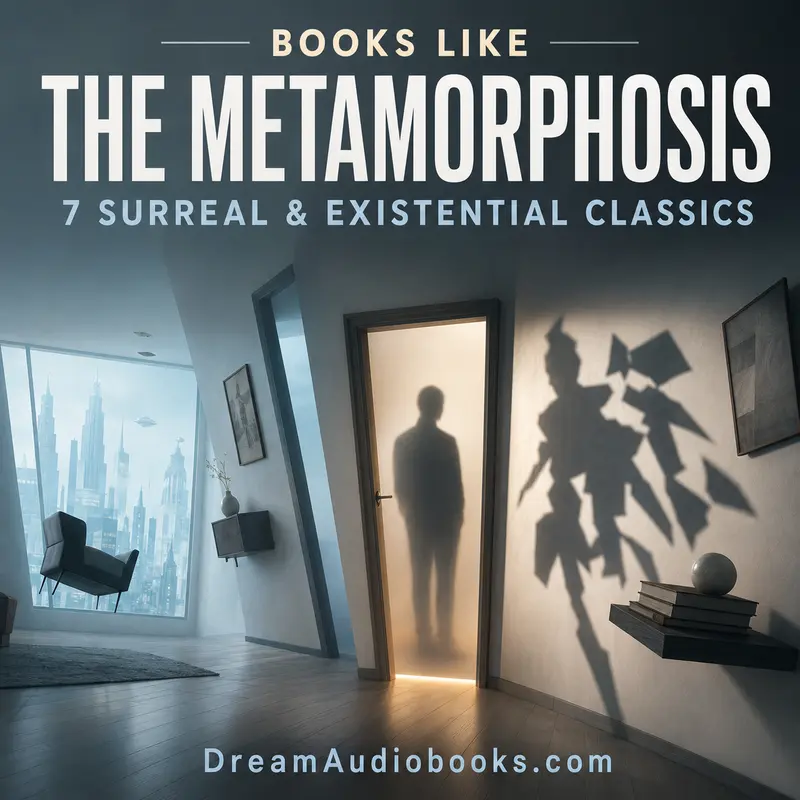
Books Like The Metamorphosis: 7 Surreal & Existential Classics
Books like The Metamorphosis begin where ordinary explanations stop working. A familiar room becomes a prison, a human identity becomes uncertain and the rules governing family, work and society suddenly reveal their absurdity.
Franz Kafka never explains why Gregor Samsa wakes inside a transformed body. The absence of an explanation is essential. Gregor cannot solve the event or return life to normal. He must endure the practical and emotional consequences while his family decides whether the person behind the bedroom door still belongs among them.
The seven classics below continue that experience through invisibility, artificial life, impossible worlds, geometric societies, supernatural visitors and machines that interfere with identity. Each approaches transformation differently, but all question how securely a person can understand reality or define the self.
Listen to The Metamorphosis on Spotify
Why These Are the Best Books Like The Metamorphosis
The most effective books like The Metamorphosis do not simply feature a physical transformation. Kafka’s story remains powerful because Gregor’s new body exposes conditions that already existed in his life.
Before the transformation, Gregor works constantly to support his parents and sister. He dislikes his job, fears his employer and has little meaningful life beyond responsibility. When he can no longer work, his family’s dependence gradually turns into resentment.
The impossible event therefore reveals a recognizable fear: what happens when a person who has always been useful suddenly becomes a burden? Gregor’s appearance changes, but his thoughts and concern for his family remain painfully human.
The seven recommendations explore related questions through different genres. The Invisible Man follows a scientist whose successful experiment separates him from ordinary human contact. Frankenstein examines a created being rejected because of appearance. Alice’s Adventures in Wonderland places its heroine inside a world where size, language and authority change without warning.
Flatland turns social hierarchy into geometry. The Mysterious Stranger questions reality and moral certainty, while The White People presents an inner world that ordinary society cannot interpret. The Ego Machine brings identity and manipulation into science fiction.
These books create different emotional experiences, but all weaken the boundary between the normal and the impossible. Their characters must continue acting even after familiar rules stop making sense.
Quick Comparison of the Seven Surreal and Existential Classics
| Audiobook | Author | Strange Element | Main Theme |
|---|---|---|---|
| The Invisible Man | H. G. Wells | Scientific invisibility | Isolation and power |
| Frankenstein | Mary Shelley | Artificial life | Rejection and identity |
| Alice’s Adventures in Wonderland | Lewis Carroll | A world of changing rules | Logic and authority |
| Flatland | Edwin A. Abbott | Two-dimensional society | Hierarchy and perception |
| The Mysterious Stranger | Mark Twain | A supernatural visitor | Free will and morality |
| The White People | Arthur Machen | A secret visionary world | Innocence and forbidden knowledge |
| The Ego Machine | Henry Kuttner | Technological manipulation | Identity and control |
1. The Invisible Man by H. G. Wells
The Invisible Man begins with a stranger arriving at a quiet English inn. His face is covered, his behavior is secretive and he demands privacy. The villagers do not initially understand that the clothing and bandages are hiding an invisible body.
Griffin has achieved a scientific breakthrough, but success creates practical problems he did not fully anticipate. He cannot move through public life without attracting suspicion. Food becomes visible inside his body, clothing must be worn if he wants to be seen and ordinary human contact becomes increasingly difficult.
Gregor Samsa experiences an unwanted transformation, while Griffin deliberately transforms himself. That difference makes the comparison especially interesting. Gregor retains his concern for others even after losing human form. Griffin gains unusual power and gradually treats other people as obstacles or tools.
Both characters become isolated inside bodies that no longer allow normal participation in society. Their rooms function as shelters and prisons. Outsiders respond with curiosity, fear and aggression because they cannot understand what stands behind the closed door.
Wells also examines the connection between invisibility and identity. Griffin imagines that being unseen will free him from ordinary restrictions. Instead, the absence of a visible body makes stable relationships almost impossible. He becomes less connected to the human world and less restrained by empathy.
The audiobook moves faster than Kafka’s story and contains more suspense, pursuit and black humor. Its scientific premise is explained more directly, but the result is equally concerned with alienation.
Choose this title first if physical transformation and social isolation were the most compelling parts of The Metamorphosis.
Listen to The Invisible Man on Spotify
View The Invisible Man Audiobook
2. Frankenstein by Mary Shelley
Frankenstein follows Victor Frankenstein, a student whose scientific ambition leads him to create life. The moment his creation opens its eyes, Victor is horrified by what he has accomplished and abandons it.
The creature enters the world with no family, language or social identity. It learns by observing people from a distance. Through reading and hidden contact with a household, it develops intelligence, emotional awareness and a desire for companionship.
Its appearance prevents that companionship from becoming possible. People react with fear or violence before learning anything about its thoughts. Like Gregor Samsa, the creature retains a complex inner life that others refuse to recognize because of its body.
The comparison also reveals an important difference. Gregor’s family remembers him as a human son and brother, yet their sympathy weakens as his usefulness disappears. Frankenstein’s creature has no earlier human identity to protect it. It must persuade others that an unfamiliar appearance can contain human feeling.
Rejection gradually changes the creature. It begins with curiosity and kindness but develops anger after repeated exclusion. Mary Shelley therefore refuses to present identity as purely natural. Treatment, loneliness and the absence of responsibility from a creator all contribute to what the creature becomes.
Victor experiences another form of alienation. His secret separates him from family and friends, while guilt turns every new tragedy into a reminder of the moment he refused responsibility.
Choose this audiobook if you want a longer gothic classic about creation, bodily difference, abandonment and the desperate need to be recognized by others.
Listen to Frankenstein on Spotify
3. Alice’s Adventures in Wonderland by Lewis Carroll
Alice’s Adventures in Wonderland is much lighter than The Metamorphosis, but its world repeatedly places identity and logic under pressure.
Alice follows the White Rabbit into a place where size changes unexpectedly, animals speak, words refuse to hold stable meanings and authority behaves without reason. She tries to apply familiar rules, but Wonderland answers with riddles, contradictions and arguments that lead nowhere.
The physical changes provide the clearest connection with Gregor Samsa. Alice grows and shrinks several times, and each new size changes her ability to move through rooms or communicate with the creatures around her. Unlike Gregor, she expects the changes to be temporary. Even so, they force her to question whether she remains the same person.
Kafka’s absurdity is quiet, oppressive and closely connected to work and family. Lewis Carroll’s absurdity is playful, verbal and full of comic invention. Both stories present authority figures who insist that unreasonable systems must be accepted as normal.
The trial near the end of Alice’s journey is particularly Kafkaesque. Procedures appear official, but evidence, verdict and punishment do not follow a meaningful order. The performance of justice matters more than justice itself.
The audiobook format brings the dialogue, wordplay and rapid changes of personality to life. It also makes the story accessible to younger listeners, although adults often notice its satire more clearly.
Choose this audiobook if you want another protagonist trapped inside an impossible world but prefer humor, imagination and nonsense to Kafka’s claustrophobic sadness.
Listen to Alice’s Adventures in Wonderland on Spotify
View Alice’s Adventures in Wonderland
4. Flatland by Edwin A. Abbott
Flatland: A Romance of Many Dimensions creates an entire society from geometric shapes. The narrator is A Square living inside a two-dimensional world where the number of a figure’s sides determines social status.
The society treats its structure as natural and complete. Circles occupy the highest positions, while lower shapes face strict limitations. Ideas that challenge accepted dimensions are not treated as opportunities for discovery but as threats to order.
A Square’s encounter with a Sphere reveals the existence of a third dimension. The discovery permanently alters his understanding of reality. Once he has experienced another dimension, he cannot return peacefully to the limited worldview demanded by Flatland.
The connection with The Metamorphosis lies in the power of social classification. Gregor’s family gradually stops responding to his inner identity and sees only the creature occupying the room. Flatland similarly reduces each inhabitant to a visible shape and assigns value accordingly.
Both stories also show individuals trapped within systems that appear reasonable to everyone inside them. The absurdity is easier for an outsider to recognize than for the characters who have been trained to accept it.
Abbott combines mathematical imagination with social satire. No advanced knowledge of geometry is required, although listeners familiar with dimensions will appreciate the structure of its central idea.
The audiobook is short enough to revisit. A first listen may emphasize the unusual world, while a second reveals more of the criticism directed at hierarchy, education and intellectual intolerance.
Choose Flatland if you want a compact philosophical fantasy about perception and the punishment awaiting those who describe a reality beyond officially accepted limits.
5. The Mysterious Stranger by Mark Twain
The Mysterious Stranger presents a darker and more philosophical Mark Twain. A supernatural visitor enters the lives of young people in a European village and demonstrates powers that make ordinary human assumptions appear small and unstable.
The stranger speaks about morality, free will and human behavior with unsettling detachment. Events that seem serious and permanent to the villagers can be changed or erased by a being operating outside their understanding of reality.
Gregor Samsa’s transformation forces him to recognize how conditional his position inside the family has always been. Twain’s stranger performs a broader version of that disruption. Human beings believe their moral systems and social conflicts possess absolute importance, but his perspective undermines their certainty.
Both stories produce discomfort by refusing the audience a secure explanation. Kafka never tells us why Gregor changes. Twain’s supernatural framework provides power without creating a reassuring moral order.
The stranger’s statements should not automatically be accepted as the author’s final truth. His purpose is partly to disturb confidence, expose cruelty and force listeners to examine beliefs that normally remain unquestioned.
The work has a complicated publication history, but its atmosphere remains coherent: familiar life is interrupted by a presence that transforms the scale on which reality is understood.
Choose this audiobook if the existential uncertainty of The Metamorphosis interests you more than its domestic setting. It replaces Gregor’s bedroom with a much wider challenge to free will, morality and the reliability of experience.
Listen to The Mysterious Stranger on Spotify
6. The White People by Arthur Machen
The White People unfolds largely through a young girl’s private manuscript. Her account describes secret rituals, strange landscapes, unusual words and experiences that exist beyond the understanding of the adults discussing the document.
The horror does not depend upon a conventional monster. It comes from the suggestion that the girl has entered a hidden reality without possessing the knowledge needed to understand its danger.
Like The Metamorphosis, the story places a barrier between inner experience and external interpretation. Gregor knows that he remains himself, but his changed voice and body prevent his family from understanding him. The girl’s manuscript records a world that other people can read about without fully entering.
Arthur Machen also complicates ordinary ideas about innocence. The narrator may describe disturbing events without recognizing them as disturbing. Knowledge and intention do not always exist together.
The structure requires careful listening. Much of the meaning lives in fragments, unfamiliar names and the contrast between the framing conversation and the manuscript itself. The absence of complete explanation creates its atmosphere.
Listeners looking for fast action may find the story too indirect. Those who enjoy strange fiction will appreciate its ability to make nature, childhood memory and imaginative play feel quietly dangerous.
Choose this audiobook when you want another story in which an individual’s private reality cannot be translated cleanly into the language of ordinary society.
Listen to The White People on Spotify
View The White People Audiobook
7. The Ego Machine by Henry Kuttner
The Ego Machine moves the collection into twentieth-century science fiction. Its central technology interferes with personality, behavior and the mental structures people use to understand themselves.
Kafka transforms Gregor without supplying a machine, scientist or visible cause. Henry Kuttner works inside a genre that expects speculative explanations, yet both stories share an interest in identity becoming unreliable.
A machine able to alter ego or behavior raises an uncomfortable question: how much of personality belongs permanently to the individual? If confidence, fear, desire or judgment can be adjusted from outside, then the self may be less stable than it appears.
This concern connects the story to modern anxieties about persuasion and technological control. A device does not need to replace a person completely if it can modify the internal process used to make decisions.
The tone is faster and more openly entertaining than Kafka’s. Science-fiction complications create movement and humor, while the underlying questions remain serious. Characters cannot assume that every thought or impulse originates naturally inside their own minds.
The audiobook is a useful final selection because it shows how themes associated with Kafka can enter popular speculative fiction. Alienation no longer comes only from family, work or society. Technology becomes another force capable of separating a person from a secure identity.
Choose The Ego Machine if you want a more energetic and accessible story about identity, manipulation and the fear that someone else may be interfering with the person you believe yourself to be.
Listen to The Ego Machine on Spotify
View The Ego Machine Audiobook
Themes Shared by These Surreal and Existential Classics
Transformation Reveals an Existing Truth
Gregor’s body changes overnight, but his transformation exposes an isolation that already existed. Frankenstein’s creature reveals Victor’s irresponsibility. Griffin’s invisibility exposes his desire for power without accountability.
The impossible event does not create every problem. It makes hidden problems impossible to ignore.
Identity Depends on Recognition
Gregor knows who he is, yet his family gradually stops treating him as Gregor. Frankenstein’s creature develops language and sympathy, but other people define him through appearance.
These books suggest that identity is both private and social. Knowing yourself may not be enough when no one else is willing to recognize the person you claim to be.
Absurd Authority
Wonderland’s trial and Flatland’s hierarchy follow rules that sound official without producing justice or truth. Gregor’s employer treats his absence from work as a moral failure before learning what has happened.
Authority becomes absurd when procedure matters more than the person trapped inside it.
Communication Fails
Gregor’s transformed voice prevents his family from understanding him. The girl’s manuscript in The White People records experiences that ordinary explanation cannot contain. Flatland’s inhabitants cannot imagine dimensions beyond their own.
Language exists, but shared understanding does not automatically follow.
Reality Becomes Unstable
Alice changes size, A Square discovers another dimension and Twain’s stranger manipulates events that appear permanent. The Ego Machine creates uncertainty about the origin of thought itself.
Each story weakens the assumption that reality is stable simply because it felt stable yesterday.
What Makes a Story Kafkaesque?
The word “Kafkaesque” is often used for any strange or frustrating situation, but Kafka’s distinctive atmosphere involves more than simple weirdness.
A Kafkaesque story usually places an ordinary person inside a system or event that cannot be explained clearly. The character attempts to respond rationally, but the surrounding rules remain inaccessible, contradictory or indifferent.
The humor is important. Gregor’s concern about work immediately after his transformation is tragic, but also darkly absurd. The situation becomes more disturbing because everyone continues discussing schedules, doors and family expenses while an impossible creature remains in the bedroom.
Kafkaesque fiction also shows how institutions reduce individuals to functions. Gregor is valued as long as he earns money. Once he cannot perform that function, his place inside the family changes.
Not every selection in this guide is Kafkaesque in the strict sense. Together, however, they explore the transformation, unstable logic, failed communication and loss of identity that make Kafka’s story unforgettable.
Which Book Like The Metamorphosis Should You Start With?
Begin with The Invisible Man if you want another transformation leading to social isolation. Choose Frankenstein for a deeper emotional story about bodily difference and rejection.
Select Alice’s Adventures in Wonderland when you want absurd rules, changing size and unstable logic presented with humor. Begin with Flatland for a short philosophical satire about hierarchy and limited perception.
Choose The Mysterious Stranger for existential uncertainty and dark arguments about free will. Select The White People for quiet, ambiguous weird fiction.
Begin with The Ego Machine when you want a faster science-fiction story about technological manipulation and unstable identity.
Recommended Listening Order
- The Metamorphosis — begin with Kafka’s unexplained transformation and domestic isolation.
- The Invisible Man — continue with another altered body and a very different personality.
- Frankenstein — explore appearance, rejection and responsibility in greater depth.
- Alice’s Adventures in Wonderland — enter a lighter but logically unstable world.
- Flatland — continue with geometric society and forbidden dimensions.
- The White People — move into private experience and ambiguous strange fiction.
- The Mysterious Stranger — question free will, morality and reality.
- The Ego Machine — finish with a technological version of unstable identity.
Related Audiobook Guides
For more psychological fiction about guilt, morality and alienation, explore Books Like Crime and Punishment: 7 Psychological Classics.
Continue the themes of creation and rejection through Books Like Frankenstein.
If you prefer beauty, secrecy and a divided public identity, visit Books Like The Picture of Dorian Gray.
For stranger worlds and unconventional narratives, explore the Best Weird Fiction Audiobooks.
Listeners interested in speculative transformations can also continue with the Best Science Fiction Audiobooks of All Time.
Frequently Asked Questions
What are the best books like The Metamorphosis?
The best classic books like The Metamorphosis include The Invisible Man, Frankenstein, Alice’s Adventures in Wonderland, Flatland, The Mysterious Stranger, The White People and The Ego Machine.
What should I listen to immediately after The Metamorphosis?
The Invisible Man is a strong next choice if you want another bodily transformation leading to isolation. Choose Frankenstein if rejection and the need for human recognition interest you most.
Why does Gregor Samsa transform?
Kafka does not provide a cause. The unexplained transformation allows the story to focus on Gregor’s identity, family relationships, economic role and isolation rather than solving a supernatural mystery.
Is The Metamorphosis an existentialist story?
It is frequently discussed alongside existentialist literature because it explores alienation, identity, absurdity, responsibility and the difficulty of finding meaning in an indifferent situation.
Is The Metamorphosis a horror story?
It contains disturbing imagery and psychological fear, but it is also surreal fiction, family tragedy, social criticism and dark comedy. Its horror comes less from the transformed body than from the way Gregor is gradually excluded.
Which recommendation is best for beginners?
The Invisible Man offers a fast plot and accessible science-fiction premise. Alice’s Adventures in Wonderland is a lighter choice, while Flatland is short and intellectually playful.
Can I listen to these audiobooks on Spotify?
Yes. The Metamorphosis and all seven recommended audiobooks have their own verified Spotify links on this page.
Final Thoughts
The most memorable books like The Metamorphosis make the familiar world feel suddenly unreliable. A body changes, a room becomes a prison, language stops producing understanding and institutions continue following rules that no longer make sense.
Begin with The Invisible Man for another isolated transformation or Frankenstein for a deeper examination of rejection. Choose Alice’s Adventures in Wonderland and Flatland for absurd rules and impossible worlds.
The White People presents a private reality that resists interpretation, while The Mysterious Stranger challenges human certainty on a larger philosophical scale. The Ego Machine brings the question of unstable identity into technological science fiction.
Each audiobook takes a different route, but all return to Kafka’s unsettling question: if your appearance, social function or understanding of reality changed overnight, what part of you would other people still be willing to recognize?