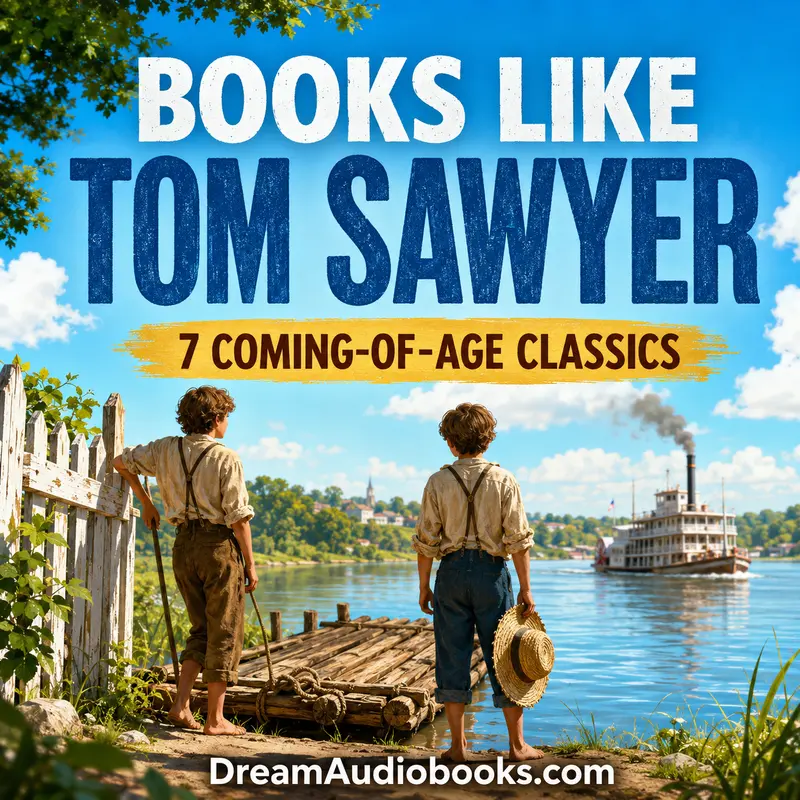
Books Like Tom Sawyer: 7 Coming-of-Age Classics
Books Like Tom Sawyer should capture more than barefoot freedom, whitewashed fences and summer adventures beside the Mississippi. Mark Twain’s novel is memorable because its comedy is tied to a serious understanding of childhood. Tom is imaginative, theatrical and often selfish, but he is also capable of loyalty, fear, remorse and unexpected courage. He treats ordinary life as material for a grand story until real danger forces him to recognise that games have consequences. The best books to read or hear after The Adventures of Tom Sawyer preserve that mixture of mischief and moral awakening.
Tom is not a quiet child waiting to be instructed. He negotiates with rules, turns punishment into opportunity and constantly rearranges the world to suit his imagination. The famous fence episode works because he understands desire before the adults around him realise what he is doing. By presenting work as a rare privilege, he persuades other boys to pay for the chance to complete his chore. The scene is comic, yet it also introduces one of the novel’s central ideas: social reality often depends on performance. Tom’s adventures repeatedly begin when he persuades himself or someone else that an ordinary situation is something more dramatic.
That appetite for performance connects the novel’s lightest and darkest moments. Tom stages pirate adventures, practises romantic gestures and imagines himself at the centre of ceremonies. He and Huck run away to Jackson’s Island, enjoying the fantasy of independence while their community believes them dead. Their return during their own funeral is both outrageous and revealing. Tom wants to witness the effect of his absence. He discovers that affection is real, but he still turns the discovery into an entrance designed for maximum attention.
Later, the world refuses to remain a stage. Tom and Huck witness a murder in the graveyard and must decide whether fear is stronger than conscience. Tom’s testimony places him in genuine danger. His adventures with Becky Thatcher in McDougal’s Cave also move beyond the harmless excitement he usually seeks. Darkness, hunger and the presence of Injun Joe give the episode a physical seriousness that no invented pirate code can control. Tom survives partly through the qualities that once caused trouble: curiosity, boldness, resourcefulness and refusal to surrender.
This tension makes the book a genuine coming-of-age story without turning it into a simple lesson about obedience. Tom does not become a model child, and Twain does not ask us to wish away his unruly energy. Instead, experience teaches him when imagination is liberating and when reality demands responsibility. A close companion book should therefore contain young characters who test boundaries, create private worlds or confront adult systems they do not fully understand. It should respect childhood as a distinct way of seeing rather than treating it only as preparation for adulthood.
If you have just finished The Adventures of Tom Sawyer audiobook, your next choice depends on what you most enjoyed. For the closest continuation of Twain’s river world, begin with The Adventures of Huckleberry Finn. If the treasure hunt and cave scenes were your favourite parts, Treasure Island provides a longer and more dangerous adventure. For children forced to survive without adult protection, The Children of the New Forest offers a historical alternative built around practical courage.
The other recommendations explore different dimensions of youth. Little Women follows four sisters whose ambitions and mistakes unfold inside a loving but financially constrained family. Peter Pan turns the desire to escape adulthood into fantasy, then quietly asks what endless childhood might cost. Alice’s Adventures in Wonderland transforms adult rules and language into a comic dream, while The Jungle Book follows a child learning the laws, loyalties and dangers of several communities.
These seven works are not interchangeable copies of Twain’s novel. Their value lies in the differences. Some take place in recognisable communities where reputation matters; others move into islands, forests or dream worlds. Some characters learn to accept responsibility, while others resist the very idea of growing up. Together they reveal why Tom’s story remains so attractive: childhood can be a period of freedom and invention, but it is also the first place where courage, loyalty and moral choice become real.
Audio adds another pleasure to these stories. Twain’s dialogue depends on rhythm, exaggeration and regional speech. Stevenson’s sailors need distinct voices. The March family becomes more intimate when arguments and reconciliations are heard rather than silently observed. Carroll’s wordplay gains comic force through timing, while Kipling’s animal characters become easier to distinguish in performance. A skilled narrator allows humour to breathe without hiding the serious emotions underneath it.
Every recommendation below links to its dedicated DreamAudiobooks page and to its own Spotify programme. The Spotify buttons are not generic playlist links: each one opens the correct audiobook. That makes it possible to compare the seven books here, choose the kind of adventure you want and begin listening without searching through unrelated results.
Why Books Like Tom Sawyer Still Matter
The strongest comparison books share several qualities with Twain’s novel. First, they take young people seriously without pretending that young people are always sensible. Their heroes can be generous in one scene and vain in the next. They misunderstand adults, test friends and invent rules that feel more meaningful than official ones. This inconsistency is not a flaw in the characterisation. It is part of the truth these books tell about growing up.
Second, place matters. St Petersburg, Missouri, is not merely scenery. The river promises movement, the island offers temporary independence, the cave turns adventure into danger and the town supplies the audience before which Tom performs. The seven recommendations also give childhood a landscape: the Mississippi, a pirate island, an English forest, a modest New England home, Neverland, Wonderland and the Indian jungle. In each case, setting creates both freedom and limits.
Finally, these stories ask what a child owes to other people. Tom’s decisive moments involve Becky, Muff Potter, Aunt Polly and Huck. His courage matters because someone else may suffer if he remains silent or gives up. The same pattern appears throughout this list. Jim depends on Huck’s moral decision. The March sisters learn that ambition cannot be separated from family. Mowgli survives because he belongs to a network of teachers and protectors. Coming of age begins when private desire meets responsibility.
Seven Coming-of-Age Audiobooks at a Glance
| Book | Closest connection | Mood | Best for |
|---|---|---|---|
| Huckleberry Finn | Mississippi freedom and moral choice | Funny, restless, serious | The closest follow-up |
| Treasure Island | Treasure, danger and youthful bravery | Suspenseful and adventurous | Pirate-story listeners |
| The Children of the New Forest | Young independence and survival | Historical and hopeful | Family adventure |
| Little Women | Mistakes, ambition and moral growth | Warm and reflective | Character-driven listening |
| Peter Pan | Adventure and resistance to adulthood | Magical and bittersweet | Fantasy lovers |
| Alice in Wonderland | Childhood logic confronting adult absurdity | Playful and dreamlike | Wordplay and imagination |
| The Jungle Book | Belonging, rules and identity | Wild and thoughtful | Animal adventure |
Best Books Like Tom Sawyer
1. The Adventures of Huckleberry Finn by Mark Twain
The Adventures of Huckleberry Finn audiobook is the natural first choice. Huck already belongs to Tom’s world, but his own journey carries Twain’s themes into rougher territory. He escapes an abusive father and travels down the Mississippi on a raft with Jim, an enslaved man seeking freedom. What begins as flight becomes a series of encounters with fraud, violence, prejudice and moral compromise.
Tom often imagines danger from the safety of a community that will eventually receive him again. Huck has far less protection. He must read strangers quickly, invent identities and decide whom he can trust. His practical intelligence resembles Tom’s resourcefulness, but his most important struggle is inward. The society around him has taught him that helping Jim is wrong. His growing loyalty forces him to judge inherited rules against his own experience of another person’s humanity.
The contrast between the boys makes this an essential companion. Tom loves the elaborate procedures of adventure stories; Huck cares about what will work. Tom can turn even a rescue into theatre, while Huck increasingly recognises the human cost of delay and performance. Listeners should be prepared for historical language and racial representations that require context, but the novel’s exposure of hypocrisy remains central to its power.
Choose this first if the Mississippi setting, Huck’s independence and Tom’s moments of conscience were the strongest parts of the original. The audiobook expands the world without merely repeating it, and its first-person voice makes Huck’s moral uncertainty immediate.
Listen to Huckleberry Finn on Spotify
2. Treasure Island by Robert Louis Stevenson
The Treasure Island audiobook takes the promise of buried riches and turns it into a test of judgment. Jim Hawkins begins in the ordinary world of his family’s inn, where the arrival of Billy Bones introduces maps, secrets and dangerous visitors. Soon Jim is aboard the Hispaniola, travelling towards an island where the crew’s loyalties are not what they appear to be.
Jim resembles Tom in his hunger for adventure and his willingness to act without permission. Both boys are drawn towards hidden places and discoveries that adults have missed. Yet Stevenson places Jim among men whose violence is not imaginary. Long John Silver can be charming, protective, manipulative and ruthless, sometimes within the same conversation. Jim must learn that courage without judgment can place everyone at risk.
The book is faster and more concentrated than Twain’s novel. It replaces the familiar rhythms of town life with the enclosed tension of a ship and the shifting alliances of an island. Its moral world is also deliberately complicated. Jim’s enemies may display admirable nerve, while respectable men make errors. Growing up means observing people carefully rather than trusting the role they claim to play.
Choose Treasure Island if you loved Jackson’s Island, McDougal’s Cave or the discovery of hidden money in Tom’s story. For more connected recommendations, the guide to books like Treasure Island extends this route through pirate and exploration classics.
Listen to Treasure Island on Spotify
3. The Children of the New Forest by Frederick Marryat
The Children of the New Forest audiobook follows four Beverley children during the English Civil War. After their family home is destroyed, they are hidden and protected by Jacob Armitage, who teaches them how to live in the forest. Their education is practical: tending animals, finding food, managing a household and keeping their identity secret in a politically dangerous landscape.
These children share Tom’s desire for independence, but circumstances make independence a necessity rather than a holiday. Tom and Huck can enjoy island life because they expect the town to remain nearby. The Beverleys must build routines that allow them to survive. Their adventures retain excitement, yet daily responsibility matters as much as dramatic action. Courage includes patience, work and care for younger family members.
The historical setting also offers a useful contrast with St Petersburg. Tom rebels against local expectations from inside a stable community. The Beverley children live through a conflict in which authority, property and loyalty have become uncertain. They must learn when to conceal their views, when to trust neighbours and how political events enter domestic life.
This is a strong choice for listeners who want family loyalty, forest survival and young characters growing through responsibility. The related guide to books like The Children of the New Forest provides a further path into historical and wilderness adventures.
Listen to The Children of the New Forest on Spotify
4. Little Women by Louisa May Alcott
The Little Women audiobook replaces Tom’s outdoor boyhood with the domestic and creative lives of the March sisters. Meg, Jo, Beth and Amy differ in temperament and ambition, but each must learn how desire affects other people. Jo’s fierce independence and quick temper make her the clearest parallel to Tom. She resists conventional expectations, values freedom and often understands the effect of her actions only after emotion has carried her too far.
Alcott’s adventures are usually smaller in scale than Twain’s, but they are not emotionally minor. A damaged manuscript, a dangerous afternoon on the ice, financial disappointment or a quarrel between sisters can reveal pride, jealousy and loyalty as clearly as a cave or courtroom. The March home becomes a place where character is tested through repeated contact rather than one spectacular event.
The novel is particularly valuable after Tom Sawyer because it broadens the meaning of coming of age. Growth does not require abandoning imagination. Jo continues to write and resist easy definitions of womanhood, but she must learn to distinguish independence from carelessness. Amy’s development similarly complicates first impressions, showing that ambition and social awareness can mature rather than disappear.
Choose this book if you want warmth, family conversation and flawed young characters who gradually become more responsible without losing their individuality. Its episodic structure also works well for listeners who prefer shorter daily sessions.
Listen to Little Women on Spotify
5. Peter Pan by J. M. Barrie
Peter Pan audiobook begins with the fantasy that Tom repeatedly approaches: leaving rules behind and turning life into permanent adventure. Peter brings Wendy, John and Michael Darling to Neverland, where pirates, mermaids, fairies and the Lost Boys make imagined play physically real. Captain Hook provides danger, but the deeper conflict concerns memory, attachment and change.
Tom runs away because he wants freedom and the satisfaction of being missed. Peter refuses the entire movement towards adulthood. That makes Neverland exhilarating and unsettling. Its adventures repeat, its roles are theatrical and its leader resists emotional obligations that might interrupt the game. Wendy gradually recognises that stories, family and growth can coexist. Peter treats growth as defeat.
Barrie’s humour and sadness are closely connected. Peter’s confidence resembles Tom’s gift for making himself the hero, yet his inability to sustain ordinary relationships reveals the limit of endless performance. Childhood freedom becomes meaningful partly because it does not last. The book therefore works as both an adventure and a counterargument to the wish that adventures should never end.
Choose Peter Pan if Tom’s runaway island episode was your favourite part and you want a more magical, more bittersweet exploration of the same desire. The audiobook benefits from clear character voices, especially in the quick movement between nursery comedy, pirate spectacle and quieter reflection.
Listen to Peter Pan on Spotify
6. Alice’s Adventures in Wonderland by Lewis Carroll
The Alice’s Adventures in Wonderland audiobook follows a curious child into a world where size, language, identity and authority refuse to remain stable. Alice is less deliberately mischievous than Tom, but she shares his impatience with rules that do not make sense. The difference is that Tom manipulates the social logic of his town, whereas Alice keeps trying to discover whether Wonderland has any logic at all.
Many adults in children’s classics represent order. Wonderland’s figures represent arbitrary power, circular arguments and bad manners. The Duchess offers morals that explain nothing, the Mad Hatter turns conversation into a trap and the Queen treats punishment as a substitute for judgment. Alice’s growth is visible in her increasing willingness to challenge them. She may be confused, but she gradually stops accepting confidence as proof of authority.
Carroll’s book is less concerned with a continuous plot than with encounters, transformations and verbal games. That makes it a good change of pace after Twain. Both writers expose adult pretension through a child’s perspective, but Carroll removes the realistic town and allows nonsense to become the entire environment.
Choose this audiobook for humour, imagination and language rather than realistic adventure. Listening makes puns, songs, interruptions and changes of tone especially vivid. It is also one of the shortest selections here, suitable for anyone who wants a compact journey before beginning a longer novel.
Listen to Alice in Wonderland on Spotify
7. The Jungle Book by Rudyard Kipling
The Jungle Book audiobook is a collection rather than a single continuous childhood novel, but the Mowgli stories make it a strong final recommendation. Raised among wolves, Mowgli learns the Law of the Jungle from Baloo and Bagheera while facing Shere Khan’s hostility. His survival depends on physical courage, attention and an understanding of the different communities to which he partly belongs.
Tom’s town gives him rules he enjoys breaking. Mowgli’s jungle gives him rules that keep its inhabitants alive. Yet both boys test limits and rely on loyal companions when confidence is not enough. Their environments also shape identity. Tom is inseparable from the river town even when he escapes it; Mowgli’s conflict comes from belonging fully neither to the wolf pack nor to the human village.
The collection adds another useful dimension through its animal stories. Discipline, leadership, work and belonging appear in forms that are accessible to younger listeners but still interesting to adults. Modern readers may also want to approach Kipling’s colonial context critically rather than treating every assumption in the stories as neutral. That context does not remove the book’s imaginative force, but it belongs in an honest reading.
Choose The Jungle Book if you want nature, mentorship and a young hero learning how communities function. Its varied episodes and distinctive animal voices make it especially well suited to audio.
Listen to The Jungle Book on Spotify
How to Choose Your Next Audiobook
For the closest continuation
Begin with The Adventures of Huckleberry Finn. It returns to the Mississippi, gives Huck the narrative centre and deepens the conflict between social rules and personal conscience. This is the clearest next step, though it is also darker and demands attention to its historical language.
For action, treasure and danger
Choose Treasure Island for pirates and suspense, or The Children of the New Forest for historical survival. Stevenson offers the faster plot; Marryat spends more time on family cooperation and the practical work of independence.
For character growth and family life
Little Women is the warmest option. It preserves youthful energy and error while giving relationships more space than physical danger. Listeners drawn to gardens, healing and domestic transformation can also explore books like The Secret Garden.
For fantasy and childhood imagination
Choose Peter Pan for an adventure about refusing adulthood, Alice’s Adventures in Wonderland for comic nonsense, or The Jungle Book for belonging and animal storytelling. All three are accessible to families, but each contains enough complexity to reward adult listeners.
From Mischief to Moral Courage
Tom’s most appealing quality is not obedience but vitality. He sees possibilities where other people see chores, routines or empty afternoons. A weaker moral story would punish that energy until he became conventional. Twain instead shows that the same imagination can produce manipulation, friendship, avoidance or courage. Character depends on where Tom directs it.
The seven recommendations follow this movement in different ways. Huck uses improvisation to protect himself and eventually to help Jim. Jim Hawkins acts boldly but learns to distrust appearances. The Beverley children turn independence into sustained responsibility. Jo March turns restless ambition towards writing. Alice questions absurd authority. Wendy accepts growth without rejecting imagination, and Mowgli learns that belonging involves knowledge and obligation.
This is why coming-of-age classics remain valuable in audio. They do not simply tell young listeners what to become. At their best, they allow every listener to hear uncertainty, pride and courage developing through action. Adults may recognise the rules they once resisted; younger listeners may recognise the frustration of being judged before being understood. The distance between those perspectives creates the humour and emotional force of the genre.
Frequently Asked Questions
What is the best book to listen to after Tom Sawyer?
The Adventures of Huckleberry Finn is the closest follow-up because it continues Twain’s Mississippi world and places Huck at the centre of a more demanding moral journey. Choose Treasure Island instead if you mainly want treasure hunting and suspense.
Are these books suitable for younger listeners?
Several are widely enjoyed by families, particularly Peter Pan, Alice’s Adventures in Wonderland and The Jungle Book. Adults should still consider a child’s age and discuss historical language, violence or dated social attitudes where appropriate.
Which recommendation is the funniest?
Alice’s Adventures in Wonderland offers the most concentrated wordplay and absurd comedy. Huckleberry Finn is also very funny, but its humour frequently sits beside harsher material.
Which audiobook has the most adventure?
Treasure Island provides the most continuous action, including a voyage, mutiny, hidden treasure and dangerous alliances. Peter Pan is the strongest fantasy-adventure alternative.
Can I listen to all seven audiobooks free on Spotify?
Each selection has its own Spotify link on this page. Availability can vary by country and may change if Spotify or a distributor updates its catalogue.
Final Recommendation
Start with The Adventures of Huckleberry Finn if you want the most meaningful continuation of Tom’s world. It carries forward the river, humour and improvisation while asking harder questions about freedom and conscience. Choose Treasure Island when you want pure narrative momentum, or Little Women when character and family matter more than danger.
The larger lesson of these books like Tom Sawyer is that growing up need not mean losing curiosity. It means learning when imagination opens the world and when another person’s safety, dignity or trust must come first. That balance between freedom and responsibility gives these seven classics their lasting power.