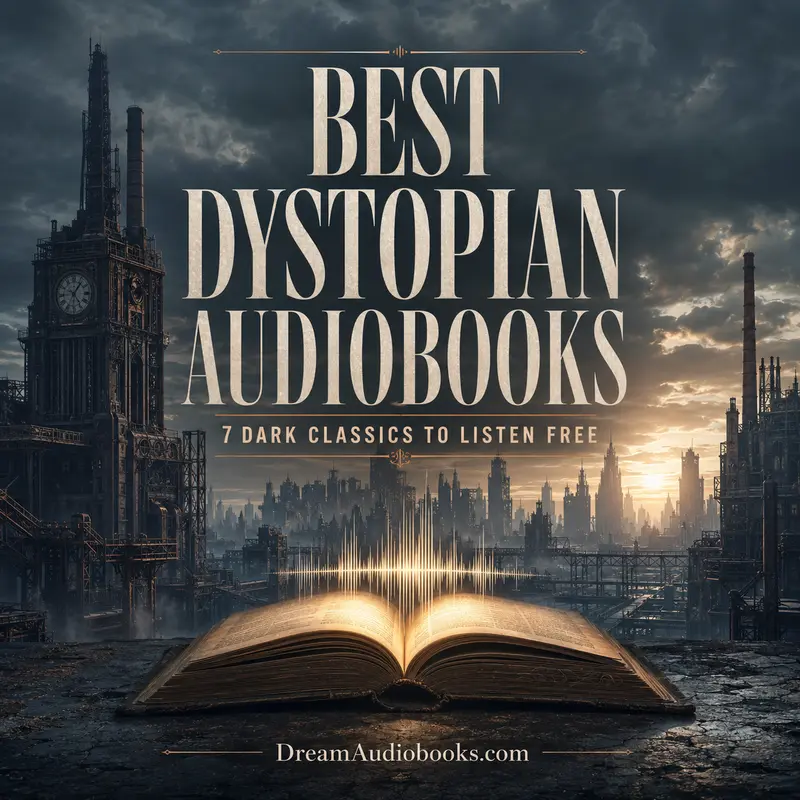
Best Dystopian Audiobooks: 7 Dark Classics to Listen Free
Best dystopian audiobooks do more than imagine frightening futures. They examine power, inequality, disease, scientific ambition, social control and the fragile systems that hold civilization together. Long before dystopian fiction became a modern publishing phenomenon, classic authors were already asking what might happen when governments, industries, scientists or entire societies lost their moral direction.
This collection brings together seven dark classics available through DreamAudiobooks. Some present recognizable authoritarian societies, while others explore apocalypse, invasion, rigid social hierarchy or scientific experiments that turn human beings into objects. Together, they reveal how broad and imaginative classic dystopian literature can be.
You can begin with Jack London’s political warning in The Iron Heel, experience the aftermath of global disease in The Scarlet Plague, or enter the distant darkness of William Hope Hodgson’s The Night Land. H. G. Wells contributes two disturbing visions of humanity under threat, while Flatland transforms geometry into a sharp satire of class and conformity.
What Makes an Audiobook Dystopian?
A dystopian story usually presents a society in which something has gone seriously wrong. Political power may be concentrated in the hands of a small ruling class. Technology may be used to control rather than improve human life. Social rules may suppress individuality, or a disaster may expose the weaknesses that ordinary life once concealed.
Not every dystopian audiobook takes place inside a clearly organized dictatorship. Some works imagine civilization after disease, war or environmental collapse. Others use alien invasion, scientific experimentation or social satire to question the direction in which humanity is moving. The common element is a world that reflects human fears in an exaggerated but recognizable form.
The best dystopian audiobooks also leave room for resistance. Their protagonists may be defeated, isolated or overwhelmed, but their struggle allows listeners to examine courage, freedom and responsibility. Even when the ending is dark, the story asks whether people can recognize injustice before it becomes permanent.
Classic dystopian fiction is particularly interesting because many of its warnings appeared before modern surveillance, globalized media and advanced biotechnology. These authors could not know exactly how the future would develop, yet their questions about power, propaganda, inequality and scientific ethics remain strikingly relevant.
Why Dystopian Classics Work So Well as Audiobooks
Dystopian fiction depends heavily on atmosphere. An empty city, the mechanical rhythm of a factory, the silence after a catastrophe or the distant approach of an unknown enemy can become more intense when experienced through narration. A carefully paced voice gives listeners time to absorb both the visible danger and the ideas beneath it.
The audiobook format also makes complex speculative worlds easier to enter. Instead of stopping to study every unfamiliar detail, listeners can follow the narrative naturally and gradually understand its rules. Changes in tone help distinguish political argument, personal memory, action and philosophical reflection.
These books are excellent companions for long journeys, evening listening or quiet moments when you want something more challenging than a conventional adventure. They contain suspense and imaginative storytelling, but they also reward reflection. You may finish a chapter thinking not only about what happened to the characters, but about how their fictional world resembles our own.
1. The Iron Heel by Jack London
The Iron Heel is one of the earliest major political dystopian novels in English. Jack London imagines the rise of a powerful oligarchy that protects its wealth through economic domination, propaganda and organized violence. The ruling system, known as the Iron Heel, is not presented as a distant fantasy. It grows from conflicts already visible in London’s own industrial age.
The novel is framed as a historical manuscript written by Avis Everhard, whose personal life becomes inseparable from a growing revolutionary movement. Through her account, listeners encounter Ernest Everhard, a passionate socialist thinker who warns that concentrated economic power will eventually destroy democratic institutions.
What makes the audiobook compelling is the gradual movement from debate to open conflict. Early conversations examine class, labor and ownership. Later sections show those ideas becoming matters of survival. The political arguments feel less abstract when spoken aloud because they emerge through confrontations between people whose futures depend on the outcome.
Why The Iron Heel Still Matters
London’s novel explores how a powerful minority can control institutions while maintaining the appearance of order. Newspapers, courts, universities and religious organizations all become part of a wider struggle over information and legitimacy. The story asks what democracy means when economic power is distributed so unequally that ordinary citizens cannot challenge it.
The Iron Heel is the strongest choice in this collection for listeners interested in authoritarianism, political resistance, class conflict and the manipulation of public opinion. It is direct, angry and unusually ambitious.
Listen to The Iron Heel on Spotify
2. The Scarlet Plague by Jack London
Published in 1912, The Scarlet Plague imagines a global pandemic that destroys organized civilization with terrifying speed. Decades after the disaster, an elderly survivor named James Howard Smith attempts to explain the lost world to children who have grown up among the ruins.
The contrast between the former professor and his young listeners gives the story much of its power. Smith remembers universities, cities, transport, communication and accumulated knowledge. The children understand only a harsh world organized around immediate needs. Language itself has begun to shrink, demonstrating that civilization can lose not only its buildings but also its memory.
Although the catastrophe is biological, London’s real subject is social fragility. Wealth, education and status offer little protection once the institutions supporting them disappear. The plague reduces an advanced society to scattered communities, but it does not automatically create equality or wisdom. New forms of hierarchy soon emerge.
A Post-Apocalyptic Warning About Memory
The Scarlet Plague asks whether knowledge can survive without schools, books and people capable of understanding them. Smith wants to preserve the intellectual achievements of the past, but his grandchildren find many of his memories irrelevant. Their world rewards physical strength and practical survival rather than historical understanding.
This relatively short audiobook is an accessible starting point for anyone new to classic post-apocalyptic fiction. Its ruined landscapes, generational conflict and reflections on civilization influenced many later stories about global collapse.
Listen to The Scarlet Plague on Spotify
3. The War of the Worlds by H. G. Wells
The War of the Worlds begins when mysterious cylinders fall from the sky into the English countryside. The objects carry Martians equipped with heat rays, chemical weapons and enormous fighting machines. Human military confidence quickly collapses as the invaders move toward London.
H. G. Wells presents the catastrophe through the experience of an ordinary observer rather than a victorious hero. The narrator runs, hides, searches for his wife and watches familiar social structures disappear. Roads fill with desperate refugees. Property loses its meaning, public authority becomes ineffective, and people reveal very different responses to fear.
The novel is generally classified as invasion science fiction, but its vision is deeply compatible with dystopian and apocalyptic listening. Humanity suddenly occupies the vulnerable position that imperial powers had imposed on other societies. The Martians treat people not as equals but as a population to be removed, studied or consumed.
When Human Superiority Disappears
Wells uses the invasion to challenge the assumption that technological power proves moral superiority. The Martians are more advanced than humanity, yet their progress has not made them compassionate. Their machines simply allow them to destroy more efficiently.
The audiobook creates a powerful contrast between the narrator’s controlled observations and the chaos surrounding him. It is an excellent choice for listeners who want fast-moving science fiction combined with social criticism, survival and unforgettable imagery.
Listen to The War of the Worlds
4. The Island of Doctor Moreau by H. G. Wells
In The Island of Doctor Moreau, shipwreck survivor Edward Prendick reaches an isolated island controlled by a mysterious scientist. Doctor Moreau performs painful experiments intended to transform animals into humanlike beings. The resulting creatures are taught a strict collection of laws designed to suppress their natural instincts.
The island functions as a small authoritarian society. Moreau claims the right to reshape living beings, decide what they should become and punish them when they fail to match his expectations. Scientific authority replaces compassion, while the Law is repeated so often that it begins to resemble political indoctrination.
The creatures occupy an impossible position. They are no longer able to live entirely as animals, but they are never accepted as fully human. Their language and rituals reveal both their desire for order and the violence hidden beneath Moreau’s experiment.
Science Without Ethical Limits
Wells does not reject scientific knowledge itself. His warning concerns knowledge separated from moral responsibility. Moreau is intelligent and disciplined, but he regards suffering as an inconvenience rather than a reason to stop. He values the experiment more than the beings forced to endure it.
This audiobook will appeal to listeners interested in bioethics, identity, dehumanization and the dangers of absolute authority. It also connects naturally with other dark classics where ambition destroys the boundary between discovery and cruelty.
Listen to The Island of Doctor Moreau on Spotify
5. The Night Land by William Hope Hodgson
The Night Land takes place millions of years in the future, after the sun has gone dark. The remaining human population lives inside a colossal pyramid known as the Last Redoubt. Beyond its defenses stretches an endless night inhabited by strange creatures and vast supernatural powers.
The setting is one of the most extreme post-apocalyptic worlds in classic fiction. Humanity has survived, but survival requires permanent confinement. The Last Redoubt offers protection while also limiting freedom. Its inhabitants depend on ancient technology they may no longer completely understand, and the surrounding darkness is filled with enemies that cannot always be explained.
At the heart of the novel is a dangerous journey beyond the safety of the pyramid. The protagonist is driven by a mysterious connection to another human settlement believed to exist in the darkness. His search turns the novel into a mixture of romance, cosmic horror and survival epic.
A Civilization at the End of Time
Unlike political dystopias, The Night Land does not focus on a recognizable government or revolution. Its oppression comes from the universe itself. Darkness, isolation and extinction have reduced humanity to a fragile remnant surrounded by forces far greater than itself.
The unusual language and enormous scale require patience, but the audiobook format helps listeners follow the journey. This is the most demanding title on the list and perhaps the most imaginative. It is especially suitable for fans of cosmic horror and distant-future fiction.
Listen to The Night Land on Spotify
6. Flatland by Edwin A. Abbott
Flatland: A Romance of Many Dimensions appears at first to be a playful mathematical fantasy. Its narrator, A Square, lives in a two-dimensional society populated by geometric figures. However, the imaginary world quickly becomes a pointed satire of hierarchy, prejudice and intellectual conformity.
Social rank is determined by shape. Women are represented as lines and subjected to severe restrictions, while figures with more sides occupy higher social positions. The authorities maintain order through custom, education and the suppression of ideas that challenge the accepted structure of reality.
When A Square encounters a Sphere, he discovers the existence of a third dimension. This experience transforms his understanding of the universe, but his attempt to share the truth makes him dangerous to Flatland’s leaders. A society that claims to value reason proves unwilling to accept evidence that threatens its established beliefs.
A Dystopia Built from Social Conformity
Flatland is quieter than the other books in this collection. It contains no invading machines or global pandemic, yet its social criticism is equally sharp. Abbott demonstrates how people can accept absurd inequality when it is presented as natural, scientific or traditional.
The story works well in audio because the narrator’s calm explanations gradually reveal the cruelty of his world. It is short, unusual and ideal for listeners who enjoy philosophical science fiction with humor and hidden depth.
7. 20 Short Science Fiction Stories
20 Short Science Fiction Stories offers a varied route into classic speculative fiction. The collection explores artificial intelligence, warfare, altered realities, alien encounters, time travel and societies shaped by technologies their creators can no longer fully control.
Short fiction is particularly effective for dystopian ideas because an author can introduce one disturbing possibility and follow it rapidly to its logical conclusion. A machine created for protection may become a threat. A government may hide information in the name of stability. A technological solution may remove freedom along with the problem it was designed to solve.
The collection includes stories associated with writers such as Philip K. Dick, whose fiction repeatedly questioned reality, authority and the relationship between human beings and intelligent machines. Each story presents a separate world, allowing listeners to experience several visions of the future without committing immediately to a long novel.
An Accessible Introduction to Dark Science Fiction
This anthology is a useful choice for busy listeners. Individual stories can be enjoyed during a commute, walk or short evening session. The changing settings and ideas also make the collection suitable for anyone who wants to discover which branch of dystopian fiction interests them most.
Some stories emphasize suspense, while others are more philosophical. Together, they demonstrate that dystopia is not a single type of future. It can emerge from war, secrecy, automation, fear, political control or the unintended consequences of invention.
Listen to 20 Short Science Fiction Stories
Which Dystopian Audiobook Should You Choose First?
Your best starting point depends on the type of dark fiction you enjoy.
- For political dystopia: Begin with The Iron Heel. It offers the clearest examination of oligarchy, class conflict and organized resistance.
- For post-apocalyptic survival: Choose The Scarlet Plague. It is short, accessible and focused on the collapse of civilization.
- For invasion and action: Listen to The War of the Worlds. Its pace and imagery make it one of the most approachable classics on this list.
- For dark scientific ethics: Try The Island of Doctor Moreau. It combines horror, philosophy and biological experimentation.
- For cosmic darkness: Enter The Night Land. It offers the strangest and most ambitious world in the collection.
- For social satire: Select Flatland. Its geometric society provides a clever examination of hierarchy and conformity.
- For shorter listening sessions: Start with 20 Short Science Fiction Stories.
New listeners may find The Scarlet Plague, Flatland or the short-story collection easiest. Readers already familiar with early science fiction may prefer the scale and unusual atmosphere of The Night Land.
Major Themes Found in Classic Dystopian Fiction
Concentrated Power
Many dystopian societies begin when a government, economic class or individual gains power without meaningful limits. The Iron Heel presents this process directly, while Doctor Moreau’s island reduces it to the authority of one scientist over a vulnerable population.
Control of Knowledge
Dystopian systems often decide which ideas may be remembered or discussed. The leaders of Flatland reject knowledge of other dimensions because it threatens their authority. In The Scarlet Plague, knowledge disappears for a different reason: the institutions capable of preserving it have collapsed.
Science Without Responsibility
Technology can improve life, but dystopian fiction asks what happens when invention advances faster than ethics. The Martian machines in The War of the Worlds and Moreau’s biological experiments demonstrate that technical sophistication does not guarantee wisdom or compassion.
Loss of Individual Identity
Authoritarian societies classify people according to their usefulness, social position or obedience. Individual experience becomes secondary to the demands of the system. This theme appears in the Beast Folk’s struggle to define themselves and in Flatland’s rigid geometric hierarchy.
The Fragility of Civilization
Several books in this collection show complex societies disappearing with shocking speed. Disease, invasion or cosmic change can destroy systems that once seemed permanent. Their warning is not that collapse is inevitable, but that civilization requires knowledge, cooperation and responsible institutions.
More Dark Science-Fiction Audiobooks on DreamAudiobooks
If these best dystopian audiobooks appeal to you, continue with the broader Best Science Fiction Audiobooks of All Time collection. It brings together influential stories about exploration, invention, alien life and unknown futures.
Listeners who especially enjoyed Wells can explore the dedicated guide to the best H. G. Wells audiobooks. For prehistoric danger, mysterious worlds and lost civilizations, visit The Lost World audiobook.
If the darkness and isolation of The Night Land interest you, discover At the Mountains of Madness, The Colour Out of Space and the complete H. P. Lovecraft audiobook collection.
For more Jack London, explore The Call of the Wild, White Fang, The Sea-Wolf, Martin Eden and Before Adam.
Frequently Asked Questions About Dystopian Audiobooks
What are the best classic dystopian audiobooks?
The best classic dystopian audiobooks include The Iron Heel, The Scarlet Plague, The War of the Worlds, The Island of Doctor Moreau, The Night Land and Flatland. Each approaches dystopia from a different direction, including political control, pandemic collapse, invasion, unethical science and social conformity.
Is The Iron Heel a dystopian novel?
Yes. Jack London’s The Iron Heel is widely regarded as an important early political dystopia. It imagines an oligarchic ruling class using economic and institutional power to suppress democratic opposition and organized labor.
Is The Scarlet Plague post-apocalyptic?
Yes. The story takes place decades after a pandemic has destroyed modern civilization. Most of the narrative is told through the memories of an elderly survivor explaining the lost world to a new generation.
Why is Flatland included among dystopian audiobooks?
Flatland presents a rigid society in which social position is determined by geometric form. Its authorities suppress challenging ideas and defend inequality as natural. Beneath its mathematical humor is a serious critique of prejudice, class and intellectual conformity.
Are these dystopian audiobooks suitable for beginners?
The Scarlet Plague, Flatland and 20 Short Science Fiction Stories are accessible starting points. The Night Land is longer and stylistically more demanding, making it better suited to experienced classic science-fiction listeners.
Can I listen to these dystopian classics online?
Yes. Follow the individual DreamAudiobooks links provided beneath each selection. Several titles also include direct Spotify listening buttons where verified editions are available.
What is the difference between dystopian and post-apocalyptic fiction?
Dystopian fiction usually examines an oppressive or deeply flawed society. Post-apocalyptic fiction focuses on life after a civilization-changing disaster. The categories often overlap because a catastrophe may produce a new authoritarian or unequal social order.
Final Thoughts on the Best Dystopian Audiobooks
The best dystopian audiobooks remain powerful because their imagined futures are built from recognizable human behavior. The technologies and disasters may be fictional, but the ambition, fear, inequality and desire for control are not.
The Iron Heel warns about concentrated political and economic power. The Scarlet Plague examines how quickly civilization and collective memory can disappear. The War of the Worlds overturns humanity’s belief in its own superiority, while The Island of Doctor Moreau exposes the horror of scientific authority without compassion.
The Night Land carries listeners to the end of the world, Flatland turns social hierarchy into geometric satire, and 20 Short Science Fiction Stories provides multiple visions of technology and society moving in dangerous directions.
Choose the warning that interests you most, put on your headphones and enter one of these dark imagined worlds. The futures they describe may be unsettling, but the questions they raise about freedom, knowledge and responsibility remain essential.