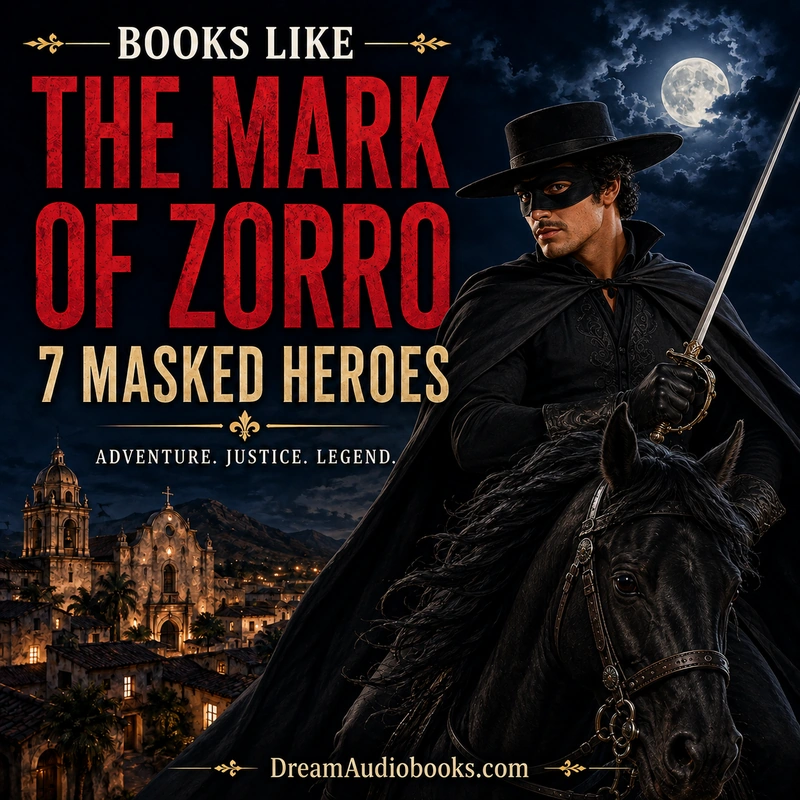
Books Like The Mark of Zorro: 7 Masked Heroes
Classic adventure · Secret identities · Noble outlaws
Books like The Mark of Zorro combine secret identities, masked heroes, historical danger, daring escapes, and courageous resistance against corrupt authority. Johnston McCulley’s famous adventure remains compelling because Zorro is more than a talented swordsman. He is a carefully constructed legend who uses intelligence, disguise, humor, speed, and theatrical confidence to protect people whom the official system has abandoned.
Don Diego Vega appears passive, wealthy, and uninterested in conflict. Behind that harmless public personality, however, he becomes the masked rider known as Zorro. His enemies dismiss Don Diego while fearing the mysterious outlaw, never realizing that both identities belong to the same man. The best books like The Mark of Zorro recreate this contrast between public appearance and hidden courage.
The seven classic adventures below feature noble outlaws, undercover agents, masters of disguise, secret rescuers, and heroes who operate outside ordinary authority. Some wear physical masks, while others hide behind false names, comic roles, misleading reputations, or carefully constructed identities. Each selection captures an important part of the excitement readers expect from books like The Mark of Zorro.
This guide does not simply collect seven historical novels containing swords or dangerous journeys. Every recommendation has been selected for a clearer connection to Zorro: the double life of The Scarlet Pimpernel, the resistance of Robin Hood, the inherited outlaw reputation of Black Jack, the reinvention of The Count of Monte Cristo, the hidden intelligence of Chicot the Jester, the undercover danger of The Valley of Fear, and the elaborate disguises of Arsène Lupin in 813.
Quick answer: Begin with The Scarlet Pimpernel for the closest secret-identity structure. Choose Robin Hood for resistance against corrupt authority, Black Jack for Western outlaw mythology, The Count of Monte Cristo for elaborate reinvention, Chicot the Jester for a hero hidden behind comedy, The Valley of Fear for dangerous undercover work, or 813 for a brilliant master of disguise.
Why Readers Love Books Like The Mark of Zorro
The central pleasure of
The Mark of Zorro audiobook
comes from contrast. Don Diego’s enemies see a weak nobleman who avoids danger. The listener knows that the same man becomes their most dangerous opponent after nightfall. Every conversation therefore contains dramatic irony: careless officials reveal information in front of the one person they should fear.
Zorro also represents a form of justice that operates beyond damaged institutions. The soldiers, magistrates, and officials surrounding him possess legal authority, but many use that authority to intimidate weaker people. Zorro becomes an outlaw because obeying an unjust system would mean allowing its abuses to continue.
A strong recommendation must capture at least part of that structure. The most satisfying books in this category usually contain several of the following elements:
- A hidden identity, false name, disguise, or carefully managed reputation.
- A hero who acts outside normal legal authority.
- Resistance against corruption, oppression, intimidation, or political violence.
- A combination of intelligence, courage, and physical ability.
- Daring escapes, secret missions, pursuit, infiltration, or rescue.
- A historical world where honor and reputation influence survival.
- A protagonist who becomes a symbol larger than an ordinary individual.
The word “masked” is used broadly in this guide. Zorro wears a physical mask, but Sir Percy Blakeney hides behind foolish behavior, Chicot hides behind comedy, Edmond Dantès constructs new identities, and a central figure in The Valley of Fear survives through an undercover role. Their masks may be made from cloth, reputation, language, social class, or deliberate performance.
Best Books Like The Mark of Zorro at a Glance
| Book | Main connection to Zorro | Tone | Best for |
|---|---|---|---|
|
The Scarlet Pimpernel |
A wealthy gentleman conceals a courageous rescuer behind a foolish public personality. | Romantic, witty, and suspenseful. | The closest secret-identity match. |
|
Robin Hood |
A legendary outlaw resists corrupt authority and protects powerless communities. | Heroic, lively, and traditional. | Justice, rebellion, and brotherhood. |
|
Black Jack |
An outlaw’s feared name shapes the identity and future of his son. | Rugged, tense, and morally uncertain. | Western adventure and reputation. |
|
The Count of Monte Cristo |
A betrayed man returns through carefully constructed identities. | Epic, dark, and emotionally complex. | Disguise, justice, and revenge. |
|
Chicot the Jester |
A brilliant political operator hides behind the role of a court fool. | Witty, historical, and conspiratorial. | Court intrigue and swordplay. |
|
The Valley of Fear |
An undercover identity becomes essential inside a violent secret organization. | Dark, investigative, and tense. | Mystery and dangerous infiltration. |
|
813 |
Arsène Lupin manipulates appearances through aliases, disguises, and strategy. | Clever, mysterious, and unpredictable. | Fans of brilliant antiheroes. |
These seven books like The Mark of Zorro do not reproduce the same plot. Instead, each recommendation develops a different part of Zorro’s appeal. Together, they create a varied listening path through historical adventure, outlaw fiction, mystery, espionage, political intrigue, and classic tales of personal justice.
1. The Scarlet Pimpernel by Baroness Orczy
The Scarlet Pimpernel is the closest literary companion to Zorro because both heroes construct deliberately misleading public identities. Sir Percy Blakeney appears to be a wealthy English aristocrat interested mainly in clothing, amusement, and fashionable conversation. Few people imagine that this apparently ridiculous gentleman secretly leads dangerous rescue operations during the French Revolution.
Like Don Diego Vega, Sir Percy understands that being underestimated is more useful than being admired. A famous warrior attracts observation. A foolish nobleman is ignored. That difference allows Percy to hear conversations, travel without immediate suspicion, and protect the people working beside him.
Why The Scarlet Pimpernel Feels Like Zorro
Both stories create suspense through dramatic irony. The audience understands the hero’s true ability while other characters continue to dismiss him. Every insult directed at Don Diego or Sir Percy becomes part of the hero’s protection. Their enemies unknowingly strengthen the disguise by repeating the false reputation.
The two men also use symbols and theatricality. Zorro leaves his famous letter as a warning, while the Scarlet Pimpernel leaves a small flower symbol associated with his rescue network. Neither hero acts only to win a physical confrontation. Each creates a legend that spreads fear among enemies and hope among threatened people.
The most important difference is the setting. Zorro challenges corruption in Spanish California, often through direct confrontations and sword fights. Sir Percy crosses borders, uses elaborate disguises, and organizes escapes from revolutionary France. His missions rely more heavily on espionage and deception.
Choose this audiobook if you enjoy:
- Heroes who pretend to be weak or foolish.
- Secret rescue missions and clever escapes.
- Historical romance and political danger.
- A battle of intelligence between hero and pursuer.
Start here when the double identity and secret heroism are the parts of Zorro you most want to experience again.
2. Robin Hood by J. Walker McSpadden
Robin Hood does not depend on one fixed secret civilian identity in the same way as Zorro, but the two legends share a powerful moral structure. Both heroes live outside official law because the people controlling that law have become corrupt. They challenge authorities who use taxes, soldiers, courts, and social rank to exploit those with less power.
In J. Walker McSpadden’s retelling, Robin’s strength comes from more than skill with a bow. He understands the forest, chooses loyal companions, plans ambushes, tests strangers, and uses humor to weaken the authority of his enemies. Like Zorro, he frequently defeats powerful officials by making them look foolish.
The Noble Outlaw as a Symbol of Justice
Zorro and Robin Hood are criminals in the eyes of the authorities they oppose. Yet their stories ask listeners to distinguish legality from justice. A law can be enforced correctly and still serve cruelty. A person can violate that law while defending a deeper moral principle.
Both heroes also become public symbols. Zorro’s name and carved mark travel ahead of him. Robin’s reputation spreads throughout England until Sherwood Forest represents an alternative form of justice. Ordinary people may not know when either hero will appear, but they understand what the name represents.
Robin’s Merry Men create a larger community than Zorro normally possesses. Little John, Friar Tuck, Will Scarlet, and the other outlaws contribute different abilities. Their loyalty transforms Robin’s resistance from the work of one exceptional individual into a shared cause.
For listeners who care more about Zorro’s opposition to abuse than his literal black mask, Robin Hood is one of the strongest choices. The setting changes, but the emotional satisfaction remains similar: arrogant officials discover that formal power does not guarantee moral victory.
Choose this audiobook if you enjoy:
- Noble outlaws and resistance against oppression.
- Forest adventures, archery, escapes, and ambushes.
- Loyal companions working toward a shared purpose.
- Heroes who humiliate arrogant officials.
3. Black Jack by Max Brand
Black Jack moves the outlaw theme from Spanish California to the American West. The story begins with the violent reputation of Black Jack Hollis, a notorious outlaw whose name continues to influence events after his death. His infant son, Terry, is raised in a respectable household without fully understanding the identity attached to his father.
As Terry grows older, other people become eager to decide what his ancestry means. Some assume that the son of a feared outlaw must eventually reveal the same violent nature. The name “Black Jack” therefore functions almost like a mask placed upon Terry by society before he has chosen the kind of man he wants to become.
When Reputation Becomes an Inherited Mask
Don Diego creates a misleading reputation intentionally. Terry faces the opposite problem: a reputation is waiting for him before he understands its origin. Both stories examine the power of names, but from different directions. “Zorro” gives Don Diego freedom to act. “Black Jack” threatens to limit Terry’s freedom by defining him through another man.
The Western environment also produces a familiar conflict between official justice and personal justice. Law is distant, inconsistent, or influenced by fear. Men survive through courage, alliances, speed, and reputation. A famous name can stop a confrontation before a weapon is drawn, but it can also attract enemies determined to destroy the legend.
This is a darker and less romantic recommendation than Zorro. Its central question is not simply whether a heroic outlaw can defeat corrupt officials. It asks whether identity is inherited, imposed by society, or created through personal decisions.
Among these books like The Mark of Zorro, Black Jack is the best choice for listeners who want the meaning of a secret or legendary identity explored through family history, social judgment, and Western danger.
Choose this audiobook if you enjoy:
- Western landscapes and dangerous frontier communities.
- Outlaws whose reputations become larger than their lives.
- Questions about destiny, family, and personal choice.
- Fast action combined with moral uncertainty.
4. The Count of Monte Cristo by Alexandre Dumas
Edmond Dantès does not wear Zorro’s black mask, but few heroes in classic literature create identities as carefully as the Count of Monte Cristo. Edmond begins as an honest young sailor whose future is destroyed by betrayal, jealousy, and political self-interest. His imprisonment removes his freedom, his marriage, his career, and eventually the identity he once understood.
After escaping and acquiring extraordinary wealth, Edmond returns to society as a man almost no one recognizes. The Count is not merely a new name. He is a complete performance supported by education, clothing, servants, property, language, confidence, and carefully controlled information.
A Darker Version of the Secret Avenger
Zorro uses his hidden identity to protect innocent people. Edmond uses his identities to expose and punish those responsible for his suffering. Both men plan patiently and understand the weaknesses of their opponents, but their moral paths are not the same.
Zorro’s justice is usually immediate and clearly directed against abuse. The Count’s justice becomes a complex campaign whose effects spread through families and innocent lives. As his plans succeed, Edmond must confront the possibility that punishment can grow beyond the limits he intended.
The novel therefore offers a more psychologically demanding version of the masked-avenger fantasy. It explores the satisfaction of seeing a powerless victim return with overwhelming ability, while also questioning whether personal vengeance can remain morally controlled.
For audiobook listeners, the length allows every transformation to develop gradually. Alliances, secrets, introductions, and apparently unimportant conversations eventually connect. The result feels less like a sequence of isolated adventures and more like an enormous strategic design.
Choose this audiobook if you enjoy:
- Long historical adventures with connected plots.
- Elaborate identities and carefully planned revelations.
- Prison escapes, hidden treasure, and social intrigue.
- Moral questions about justice, mercy, and vengeance.
5. Chicot the Jester by Alexandre Dumas
Chicot’s mask is not made of black cloth. It is the social role of a court fool. As the jester serving King Henry III of France, Chicot is expected to joke, mock, entertain, and speak with the unusual freedom sometimes granted to a fool. Powerful people often underestimate him because they confuse his official position with his real intelligence.
Beneath the comedy, Chicot is observant, politically informed, physically courageous, and capable of acting decisively. He watches the ambitions surrounding the crown and understands that courtly appearances rarely reveal true loyalty.
How Comedy Protects a Dangerous Man
Don Diego’s apparent weakness prevents his enemies from recognizing Zorro. Chicot’s humor performs a similar function. A person treated as entertainment can remain in rooms where serious political conversations occur. A joke can reveal a truth while allowing the speaker to pretend that he meant nothing dangerous.
Both characters use underestimation as protection. Their enemies believe courage should look proud, aggressive, and serious. Don Diego and Chicot survive because they present the opposite image. One appears passive; the other appears ridiculous. Behind those public roles, both men study the people around them.
Dumas surrounds Chicot with royal rivalries, religious conflict, secret alliances, romance, swordplay, and betrayal. The result is broader and more politically complicated than a typical Zorro adventure, but the rhythm of clever escapes, dangerous conversations, and sudden reversals feels familiar.
Chicot is also a useful reminder that secret heroism does not require invisibility. He is present at court and frequently attracts attention, but observers still misunderstand his value. The strongest disguise is sometimes not disappearing—it is allowing other people to see exactly what they expect to see.
Choose this audiobook if you enjoy:
- Heroes who use wit as effectively as weapons.
- Royal conspiracies and dangerous political rivalries.
- Historical swordplay with dark humor.
- Characters who are consistently underestimated.
6. The Valley of Fear by Arthur Conan Doyle
The Valley of Fear begins as a Sherlock Holmes investigation involving a coded warning, a violent death, strange physical evidence, and a country house filled with uncertainty. The mystery gradually opens into a larger history of secret organizations, intimidation, concealed identities, and danger carried across years.
Its strongest connection to Zorro appears in the undercover element. A person entering a violent organization cannot depend on physical courage alone. He must control his reactions, remember every detail of his assumed identity, gain the confidence of dangerous men, and continue performing even when discovery could mean death.
A Mask That Cannot Safely Be Removed
Zorro can often escape into the night and return to Don Diego’s protected social position. The undercover figure in The Valley of Fear faces a more claustrophobic challenge. His enemies are close, suspicious, and capable of testing loyalty at any moment.
The performance must continue during ordinary conversations as well as moments of direct danger. A wrong expression, a careless question, or knowledge the false identity should not possess could destroy the mission.
Sherlock Holmes adds the opposite perspective. While one person works to maintain a disguise, Holmes works to dismantle appearances through evidence. Mud, weapons, messages, time, architecture, and inconsistent testimony become tools for recovering the truth.
This is the darkest recommendation in the guide. It contains less romance and humor than Zorro, but it offers one of the strongest explorations of the personal cost of living under a dangerous identity. It also shows that a secret hero may need patience, emotional control, and endurance as much as physical skill.
Choose this audiobook if you enjoy:
- Undercover missions and secret societies.
- Sherlock Holmes investigations and coded clues.
- Stories where a small mistake could expose everything.
- A darker alternative to romantic swashbuckling fiction.
7. 813 by Maurice Leblanc
Arsène Lupin is not a conventional hero. He is a gentleman thief, strategist, performer, investigator, and master of disguise whose morality changes according to the danger before him. In 813, those abilities are tested inside a dark mystery involving murder, political intrigue, hidden enemies, and identities that cannot be trusted.
Lupin shares Zorro’s delight in performance. He understands that a convincing disguise requires more than changing clothes. Voice, posture, vocabulary, confidence, timing, social knowledge, and the expectations of the observer must all work together.
When the Masked Hero Becomes an Antihero
Zorro’s purpose is morally direct: he protects victims of corruption. Lupin is more ambiguous. He may act against dangerous criminals, solve mysteries, or prevent a larger disaster, but he also pursues his own interests and enjoys proving that ordinary rules cannot contain him.
That moral uncertainty makes 813 especially interesting after The Mark of Zorro. Both protagonists control a room by understanding what everyone believes. Zorro allows officials to believe that Don Diego is harmless. Lupin may create several possible identities, forcing enemies and investigators to question every conclusion.
The audiobook rewards attention because information changes meaning as new identities and motives emerge. A character who appears reliable may be performing. An apparent defeat may be part of a longer strategy. Even Lupin’s confidence cannot guarantee that he controls every force involved.
For listeners who love Zorro’s intelligence more than his swordsmanship, this is one of the strongest choices. Lupin wins through nerve, speed of thought, observation, disguise, and an extraordinary ability to turn confusion into opportunity.
Choose this audiobook if you enjoy:
- Brilliant protagonists who manipulate appearances.
- False names, disguises, mysteries, and political secrets.
- Heroes who operate close to the boundary of crime.
- Plots filled with reversals and competing strategies.
How to Choose Among These Books Like The Mark of Zorro
Choose The Scarlet Pimpernel for the closest overall match. Sir Percy and Don Diego both hide courageous secret lives behind deliberately unheroic public personalities.
Choose Robin Hood when your favorite part of Zorro is his defense of ordinary people against corrupt officials and abusive authority.
Choose Black Jack for a Western adventure about outlaw reputation, inherited identity, and the uncertain line between legend and personal choice.
Choose The Count of Monte Cristo for an epic transformation involving imprisonment, wealth, disguise, justice, and revenge.
Choose Chicot the Jester when you want swordplay and political intrigue led by a hero whom powerful people dismiss as comic entertainment.
Choose The Valley of Fear for undercover danger, secret organizations, detective reasoning, and a much darker atmosphere.
Choose 813 when you want a master of disguises whose intelligence is extraordinary but whose moral position remains unpredictable.
First-time listeners should generally begin with The Scarlet Pimpernel or Robin Hood. Both have clear moral conflicts and accessible adventure structures. The former provides the closest double-identity pattern, while the latter develops the idea of an outlaw who becomes a symbol of justice.
Listeners who want a longer and more complex experience should choose The Count of Monte Cristo. Its patient construction, numerous characters, and moral questions make it a substantial listening project rather than a quick adventure.
For mystery rather than romance, move toward The Valley of Fear or 813. The first combines detection with undercover suspense, while the second turns disguise into an intellectual game led by a charismatic antihero.
For a change of landscape, Black Jack carries the outlaw legend into the American West. For wit, court politics, and a protagonist hidden in plain sight, choose Chicot the Jester.
The correct choice therefore depends on what you enjoyed most about Zorro. A reader searching for swordplay may choose differently from one interested in public reputation, political resistance, secret identity, or the moral difference between lawful authority and genuine justice.
Related Classic Audiobook Guides
After exploring these books like The Mark of Zorro, continue building your adventure and secret-identity cluster through these Dream Audiobooks guides:
-
Books Like The Scarlet Pimpernel: 7 Secret Heroes
for daring rescuers, secret identities, espionage, and historical danger. -
Best Adventure Audiobooks for Adults
for exploration, heroic action, dangerous journeys, and fast-moving classics. -
Best Detective Audiobooks
for investigations, hidden motives, secret societies, and classic crime. -
Books Like Sherlock Holmes
for intelligent mysteries, concealed histories, and memorable investigators. -
Free Classic Audiobooks on Spotify
for a wider listening collection across adventure, mystery, horror, and literature.
Questions About Books Like The Mark of Zorro
What should I listen to after The Mark of Zorro?
Start with The Scarlet Pimpernel when you want another hero who hides a dangerous secret life behind a harmless public personality. Choose Robin Hood when resistance against corrupt authority is the part of Zorro you enjoyed most.
Which book is most similar to The Mark of Zorro?
The Scarlet Pimpernel is the closest match because Sir Percy Blakeney, like Don Diego Vega, appears foolish or weak in public while secretly performing courageous missions. Both heroes use deception, symbols, intelligence, and dramatic escapes.
What makes the best books like The Mark of Zorro?
The best books like The Mark of Zorro usually feature a secret identity, resistance against injustice, clever deception, historical adventure, and a hero who must operate outside ordinary authority. A physical mask is optional; the essential element is the contrast between the character’s public appearance and hidden purpose.
Do all seven heroes wear physical masks?
No. Zorro wears a literal mask, while other characters use social roles, disguises, false names, outlaw identities, or concealed histories. In this guide, a mask can be physical, social, or psychological.
Which recommendation has the most sword fighting?
Chicot the Jester offers historical swordplay, conspiracies, and the energetic storytelling associated with Alexandre Dumas. Robin Hood also contains frequent action, archery, ambushes, rescues, and confrontations.
Which book has the most elaborate secret identity?
The Count of Monte Cristo provides the most elaborate reinvention because Edmond Dantès constructs an entirely new social presence. 813 offers the greatest variety of aliases and disguises, while The Scarlet Pimpernel remains the closest structural match to Zorro.
Which audiobook is best for mystery fans?
Choose The Valley of Fear for a Sherlock Holmes investigation involving hidden identities, coded messages, past crimes, and a dangerous secret organization. Choose 813 for a more unpredictable mystery led by Arsène Lupin.
Which recommendation is the darkest?
The Valley of Fear is the darkest because it explores violence, intimidation, secret societies, and the psychological danger of undercover life. The Count of Monte Cristo is also dark because of its focus on imprisonment, punishment, and revenge.
Are these books available as free audiobooks?
Each recommendation links to its dedicated Dream Audiobooks page, where you can review the available listening platforms for that title. Platform access, advertising, account requirements, and regional availability may vary.
Final Thoughts on Books Like The Mark of Zorro
The best books like The Mark of Zorro understand that a mask is not only something worn across the face. A mask can be a foolish reputation, a comic profession, a feared outlaw name, an aristocratic title, a false history, or an identity maintained inside a dangerous organization.
Don Diego Vega succeeds because his enemies believe they understand him. Sir Percy Blakeney uses the same advantage. Robin Hood transforms outlaw status into a symbol of resistance. Terry Hollis must decide whether another man’s reputation will control his future. Edmond Dantès builds a new self from education, wealth, and disciplined performance. Chicot turns comedy into political protection. The hidden figures of The Valley of Fear survive through controlled deception, while Arsène Lupin treats identity as an art that can be changed whenever circumstances demand it.
These stories also explore different forms of justice. Zorro and Robin Hood protect people who cannot rely on official institutions. The Scarlet Pimpernel risks his life to rescue prisoners. The Count of Monte Cristo pursues punishment so intensely that he must reconsider its consequences. Sherlock Holmes reconstructs truth through evidence, while Lupin often decides for himself which rules deserve obedience.
Among these books like The Mark of Zorro, begin with
The Scarlet Pimpernel
for the closest double-identity adventure, or choose
Robin Hood
for another legendary defender of powerless people. Each audiobook shows that courage does not always announce itself openly. Sometimes the person everyone dismisses is quietly preparing to challenge an entire system.