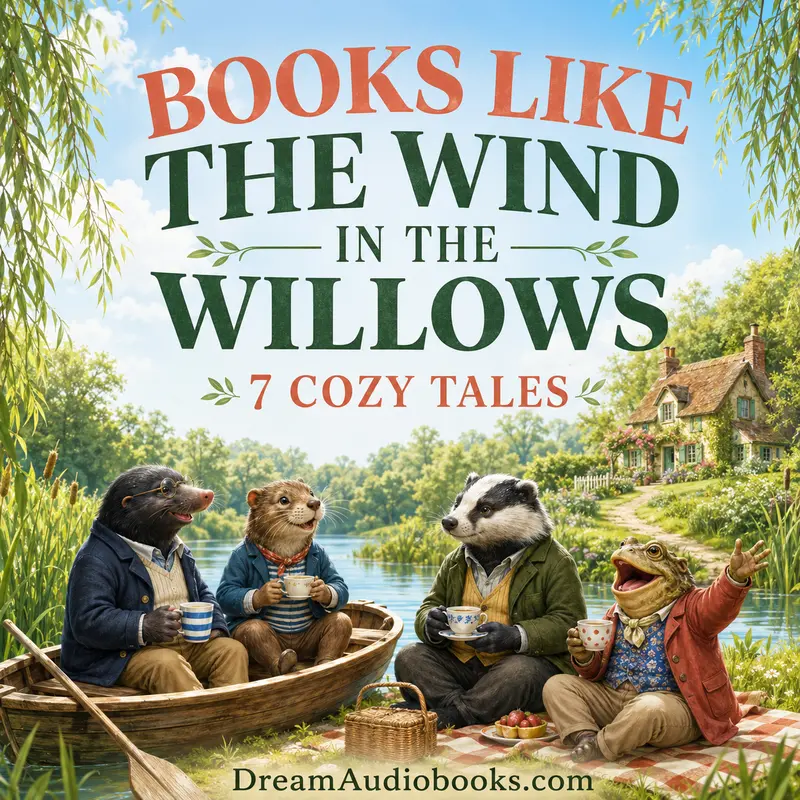
Books Like The Wind in the Willows: 7 Cozy Tales
Books Like The Wind in the Willows should offer more than talking animals and a peaceful country setting. Kenneth Grahame’s classic remains comforting because it understands two opposite desires: the wish to stay near a familiar home and the sudden urge to leave it behind. Mole abandons his spring cleaning for the river, Rat is happiest beside the water, Badger protects the order of the Wild Wood and Toad turns every new enthusiasm into a disaster. Their differences create comedy, but their loyalty gives the book its emotional centre.
The River Bank is one of literature’s most inviting places. Meals appear at exactly the right moment, boats move at a companionable pace and each bend suggests a modest adventure. Grahame pays attention to baskets, fires, small rooms and seasonal changes. Comfort never feels abstract. It is made from material details and repeated habits: a familiar path, a shared lunch, a lamp in a window and the knowledge that someone will notice when a friend has not returned.
Yet the novel is not simply calm. Mole becomes lost in the Wild Wood. Toad’s obsession with motorcars leads to theft, imprisonment and escape. The friends eventually confront the weasels who have occupied Toad Hall. Danger enters the story without permanently destroying its atmosphere of reassurance. Home can be lost, but courage and friendship can recover it.
Toad is crucial to this balance. His vanity, impulsiveness and appetite for applause repeatedly exhaust those who care about him. Grahame does not pretend that friendship means approving every choice. Rat, Mole and Badger intervene, argue, rescue and finally stand beside Toad when real action is needed. Their loyalty includes boundaries as well as affection.
The book also contains moments of deeper wonder. Nature sometimes feels older and more mysterious than the domestic world along the river. These passages remind us that the landscape is not merely a decorative background for animal characters. It can offer sanctuary, fear, memory and a sense of something beyond ordinary explanation. That depth separates the novel from a collection of pleasant adventures.
The seven recommendations below preserve different parts of this experience. The Adventures of Paddy the Beaver offers the closest woodland community and practical animal hero. The Jungle Book presents talking animals and laws of belonging in a much wilder environment. Winnie-the-Pooh captures the warmth of a small group whose contrasting personalities make friendship funny and enduring.
The Adventures of a Bear, and a Great Bear Too follows animal characters through a more roaming sequence of encounters. The Secret Garden removes talking animals but preserves the healing power of a private natural place. Peter Pan develops the desire to escape ordinary life into theatrical fantasy, while The Wonderful Wizard of Oz sends a young traveller through a strange world before returning her to the meaning of home.
If you have just finished The Wind in the Willows audiobook, begin with Paddy the Beaver when animal community and constructive work were your favourite elements. Choose Winnie-the-Pooh for the gentlest emotional continuation. If you want talking animals but more danger, move to The Jungle Book. For gardens, changing seasons and children restored by nature, select The Secret Garden.
These books vary in age, tone and structure. Some are ideal for short family listening sessions, while others contain dated language or attitudes that adults may want to discuss with younger listeners. Their common value lies in the way they treat friendship and place. Characters do not merely pass through scenery; they build relationships with woods, gardens, roads and homes.
Audio strengthens that sense of company. A narrator can give Mole’s uncertainty, Rat’s hospitality, Badger’s authority and Toad’s self-importance distinct rhythms. The recommended books offer similar pleasures: Pooh’s reflective pauses, Paddy’s practical confidence, Mowgli’s animal teachers and Dorothy’s companions all depend on voices that remain recognisable across episodic adventures.
Every recommendation includes a dedicated DreamAudiobooks page and its own direct Spotify button. None of the buttons opens a generic playlist. You can compare the seven stories here, choose the mood that suits your next listening session and open the correct audiobook immediately.
What Makes Books Like The Wind in the Willows Special?
The first quality is companionship. Grahame’s animals are memorable individually, but the book’s warmth comes from the spaces between them. Rat welcomes Mole without demanding that he already understand river life. Badger appears severe but becomes dependable when danger arrives. Friendship grows through hospitality, correction and shared experience rather than through perfect agreement.
The second quality is a meaningful home. Toad Hall, Mole End and Rat’s riverside dwelling express their inhabitants’ personalities. Leaving home creates freedom, but returning gives adventure its shape. The recommended books preserve this movement in different ways. Dorothy travels to Oz to understand Kansas differently; Mary Lennox enters a locked garden and changes the house around it; Pooh’s expeditions always remain connected to the Hundred Acre Wood.
The third quality is gentle adventure. Cozy does not mean nothing happens. A storm, wrong turning, boastful decision or mysterious visitor can create real tension. The difference lies in emotional security. The story may lead into uncertainty, but friendship, humour and a recognisable world remain available. Even when the danger is stronger, as in The Jungle Book, community gives survival a moral structure.
Seven Cozy Audiobooks at a Glance
| Book | Closest connection | Mood | Best for |
|---|---|---|---|
| Paddy the Beaver | Woodland neighbours and practical work | Gentle and instructive | The closest animal tale |
| The Jungle Book | Animal society, loyalty and natural law | Wild and thoughtful | More adventure |
| Winnie-the-Pooh | A small community of distinct friends | Warm and humorous | The coziest choice |
| The Adventures of a Bear | Animal viewpoint and roaming adventure | Whimsical and lively | A lesser-known discovery |
| The Secret Garden | Nature, sanctuary and emotional renewal | Restorative and hopeful | Garden lovers |
| Peter Pan | Escape, adventure and the pull of home | Magical and bittersweet | Fantasy listeners |
| The Wizard of Oz | Journey, unusual friends and homecoming | Bright and adventurous | Family listening |
Best Books Like The Wind in the Willows
1. The Adventures of Paddy the Beaver by Thornton W. Burgess
The Adventures of Paddy the Beaver audiobook is the closest thematic match. Paddy arrives in the Green Forest and immediately changes the local stream by building a dam and lodge. His work attracts curiosity, suspicion and admiration from the neighbouring animals, whose reactions reveal how a new arrival can alter an established community.
Paddy resembles Rat and Badger more than Toad. He understands his environment, plans carefully and creates something useful. The detailed attention to how a beaver builds gives the story a practical pleasure similar to the boating, picnics and housekeeping in Grahame. Nature is not an abstract lesson; it is a place of materials, habits and consequences.
Thornton W. Burgess writes directly for younger listeners, so the moral structure is clearer than in The Wind in the Willows. Even so, the characters have enough personality to keep the lessons from feeling detached from the story. Curiosity about Paddy gradually becomes an opportunity to understand cooperation and ecological change.
Choose this audiobook first if riverside animals and friendly woodland society were the strongest attractions in Grahame’s book. Its chapters work well in short sessions, making it practical for family listening or a calm bedtime routine.
Listen to Paddy the Beaver on Spotify
2. The Jungle Book by Rudyard Kipling
The Jungle Book audiobook offers a wilder animal society. Mowgli is raised among wolves and taught by Baloo and Bagheera, while Shere Khan’s hostility places his place in the jungle under constant pressure. The animals speak and organise communal life, but their world is governed by survival more directly than the River Bank.
The comparison lies in belonging. Mole learns the customs of a new riverside community through Rat’s friendship; Mowgli learns the Law of the Jungle through teachers and experience. Both books show that freedom depends partly on understanding the obligations that hold a community together. Toad resists every limit, whereas Mowgli’s safety often depends on recognising one.
Kipling’s collection contains stories beyond Mowgli, widening its treatment of work, courage and loyalty. The tone can shift from playful to dangerous, so this is not the gentlest selection. Modern families may also wish to discuss the book’s colonial context and dated assumptions rather than presenting them as neutral.
Choose this title when you want talking animals and memorable voices but more physical adventure. DreamAudiobooks’ best animal story audiobooks page provides further listening in this direction.
Listen to The Jungle Book on Spotify
3. Winnie-the-Pooh by A. A. Milne
The Winnie-the-Pooh audiobook is the coziest emotional companion. Pooh, Piglet, Rabbit, Owl, Eeyore, Kanga, Roo and Christopher Robin inhabit a small world where expeditions, missing objects, weather and visitors become sufficient material for adventure. Their personalities create misunderstandings, but belonging rarely feels in doubt.
Milne shares Grahame’s ability to write on two levels. Younger listeners can follow the immediate event, while adults hear the affectionate comedy in the characters’ habits of speech. Pooh’s reasoning is often circular, Eeyore interprets everything through disappointment and Owl’s authority exceeds his accuracy. Like Toad, each friend is both absurd and loved.
The Hundred Acre Wood also resembles the River Bank as an emotional map. Paths connect familiar homes, and a journey feels meaningful because everyone expects to return. The landscape gives friendship a shape. Even a small bridge or patch of trees can hold memory because the characters repeatedly meet there.
Choose this audiobook for humour, reassurance and short episodes. It is especially suitable when you want a calm family listen rather than a continuous high-stakes plot. The wider children’s audiobook collection offers more classics for shared listening.
Listen to Winnie-the-Pooh on Spotify
4. The Adventures of a Bear, and a Great Bear Too by Alfred Elwes
The Adventures of a Bear audiobook is the least familiar book in this guide and one of the most curious. Alfred Elwes follows bear characters through encounters with animals, humans and unfamiliar surroundings. The roaming structure creates a sequence of challenges rather than one tightly organised quest.
The connection to Grahame lies in the animal perspective and the mixture of humour with danger. A bear’s needs and instincts shape how the world is understood, just as Rat’s river knowledge or Mole’s underground home shapes his outlook. Human behaviour can appear strange when observed from outside the human point of view.
The book belongs to an older tradition of animal adventure, and some language or attitudes may feel distant to modern listeners. That distance is part of its interest, but it also makes this a better choice for listeners who enjoy discovering forgotten classics than for those wanting the smoothest contemporary family experience.
Choose it when you want an uncommon title, travelling animals and episodic adventure. The audiobook format helps maintain continuity across its changes of place and gives the animals clearer individual presence.
Listen to The Adventures of a Bear on Spotify
5. The Secret Garden by Frances Hodgson Burnett
The Secret Garden audiobook removes anthropomorphic animals but preserves the restorative relationship between character and place. Mary Lennox arrives at Misselthwaite Manor isolated, contrary and accustomed to neglect. Her discovery of a locked garden gives her curiosity a direction and gradually brings her into friendship with Dickon and Colin.
Mole’s return to Mole End is one of Grahame’s most affecting scenes because the neglected home still carries memory and belonging. Burnett builds an entire novel around a similar recovery. The garden has been closed by grief, and reopening it changes the people connected to the house. Care for a place becomes care for one another.
The natural world is treated with an enthusiasm that can feel almost magical, although the transformation develops through air, movement, attention and companionship. Mary becomes less self-centred as she begins to notice plants, animals and other people. Colin’s recovery similarly challenges the fearful identity built around him by adults.
Choose this audiobook when the homecoming, seasonal atmosphere and sanctuary of The Wind in the Willows mattered more than talking animals. Continue with books like The Secret Garden for more nature-centred classics.
Listen to The Secret Garden on Spotify
6. Peter Pan by J. M. Barrie
Peter Pan audiobook magnifies Toad’s appetite for novelty into a fantasy about refusing adulthood. Peter brings Wendy, John and Michael Darling to Neverland, where pirates, fairies, mermaids and the Lost Boys turn imagined play into an environment. The adventure is exhilarating, but Barrie never completely separates it from loneliness and forgetting.
Both books balance escape with home. Toad wants every new machine or role to replace the life he already has, while his friends understand the value of Toad Hall more clearly than he does. Peter makes endless adventure his identity. Wendy gradually recognises that returning home and accepting change need not mean surrendering imagination.
The tone is more theatrical and dangerous than the River Bank. Captain Hook, the ticking crocodile and the uncertain rules of Neverland create suspense. Still, friendship and storytelling remain central, and the Darling nursery frames the fantasy with warmth.
Choose Peter Pan if Toad’s reckless escapes were your favourite episodes and you want a more magical, bittersweet treatment of the same restlessness. It works especially well when the narrator can distinguish Peter’s confidence, Wendy’s practical warmth and Hook’s dramatic pride.
Listen to Peter Pan on Spotify
7. The Wonderful Wizard of Oz by L. Frank Baum
The Wonderful Wizard of Oz audiobook is the strongest choice for a journey built around unusual friendship and homecoming. A cyclone carries Dorothy from Kansas to Oz, where she follows the yellow brick road with the Scarecrow, Tin Woodman and Cowardly Lion. Each companion believes he lacks a quality that his actions repeatedly demonstrate.
The group resembles Grahame’s friends because contrasting temperaments become complementary. Practical judgment, compassion and courage do not belong to one perfect hero. They emerge through cooperation. Dorothy keeps the journey directed towards home, while the friends she gathers make reaching it possible.
Baum’s world is brighter and more openly fantastic than the River Bank, but both books distrust impressive appearances. Toad repeatedly performs greatness without possessing good judgment. The Wizard’s authority also depends on performance. Ordinary loyalty proves more dependable than status or spectacle.
Choose this title for accessible family adventure, a clear quest and a satisfying return home. Listeners who prefer more dreamlike recommendations can continue with books like Alice in Wonderland.
Listen to The Wonderful Wizard of Oz on Spotify
How to Choose Your Next Cozy Audiobook
For the closest animal community
Begin with The Adventures of Paddy the Beaver. It preserves the woodland neighbours, riverside setting and practical curiosity that make Grahame’s book inviting. Choose Winnie-the-Pooh instead when friendship and humour matter more than natural history.
For nature and emotional restoration
The Secret Garden is the strongest choice. It gives a hidden natural place the same emotional importance that the River Bank and Mole End possess. DreamAudiobooks’ best nature audiobooks page provides a broader route through this theme.
For a more adventurous story
Choose The Jungle Book for animal society and danger, Peter Pan for fantasy and pirates, or The Wonderful Wizard of Oz for the clearest quest. Each is less consistently cozy but retains companionship as protection against an unfamiliar world.
For a forgotten animal classic
The Adventures of a Bear, and a Great Bear Too is the most unusual selection. Its age and episodic form make it less immediately familiar, but that is exactly its appeal for listeners who have already heard the better-known books.
Home, Adventure and the Meaning of Comfort
Cozy stories are sometimes mistaken for stories without conflict. Grahame’s book demonstrates the opposite. Mole gets lost, Toad loses his freedom and Toad Hall is occupied. Comfort matters because it can be interrupted. A warm room is emotionally powerful after cold, uncertainty or absence.
The same pattern shapes the recommendations. Dorothy understands home after Oz. Mary learns to create belonging after neglect. Wendy values family after Neverland, while Pooh’s expeditions remain reassuring because the Hundred Acre Wood continues to hold familiar friends. The journey does not cancel the home; it teaches the character how to see it.
Friendship provides another form of home. Rat’s hospitality gives Mole a place before Mole fully understands where he belongs. Toad’s friends refuse to abandon him even when they refuse to excuse him. These relationships are comforting because they combine acceptance with honest response. Affection is not passive agreement.
Why These Tales Work So Well in Audio
Episodic classics are naturally suited to listening. A chapter can accompany breakfast, a short journey or the end of the day without requiring the listener to finish an entire plot movement. Repeated places and voices make returning easy. After a pause, Rat’s river, Pooh’s wood or Dorothy’s road quickly restores orientation.
Voice performance also protects the humour. Toad’s boasts, Pooh’s logic and Paddy’s unwavering confidence are funny partly because the character speaks with complete seriousness. A narrator who trusts the words does not need to force the joke. Younger listeners hear the event, while adults notice the affectionate distance between what a character believes and what the audience understands.
For the calmest sequence, begin with Paddy, continue with Pooh and then move to The Secret Garden. Add Oz when you want a stronger plot. Save The Jungle Book and Peter Pan for listeners comfortable with more danger and emotional complexity. DreamAudiobooks’ best family audiobooks collection offers additional shared-listening options.
Listening to Older Children’s Classics Today
Part of the pleasure of an older children’s classic is hearing the rhythm of a world that does not sound like the present. Meals take time, journeys are slower and characters often notice weather, tools, clothes and household routines that a modern story might pass over quickly. In The Wind in the Willows, those details create the texture of River Bank life. Paddy’s dam, Mary’s garden and Dorothy’s road serve a similar purpose: each gives the listener a place that can be pictured, revisited and remembered. A good recording lets these descriptions breathe without turning them into a museum piece.
Age also brings complications. Several books on this list reflect the language and assumptions of the periods in which they were written. The Jungle Book emerges from the British imperial world; Peter Pan includes racial caricatures; other selections use social conventions that can feel unfamiliar or exclusionary now. That does not require families to avoid every older story, but it does reward informed listening. An adult can introduce the setting, pause when a passage needs context and ask what the story understands well—and what it fails to see. The aim is neither to excuse a book nor to reduce it to its flaws.
For a first shared listen, choose the work that best suits the child in front of you rather than the title with the greatest reputation. A sensitive listener may prefer the lower stakes of Paddy or Pooh. A child who enjoys peril and quick changes of scene may respond more strongly to Oz or Peter Pan. The Secret Garden asks for patience with difficult children before their transformation becomes clear. The Adventures of a Bear asks for patience with an older episodic manner. Sampling the opening chapter is often more useful than relying on a fixed age label.
Listening together creates room for questions that silent reading can postpone. Why do Rat and Mole make space for Toad after his repeated selfishness? When does loyalty become responsibility? Why does a particular landscape feel safe to one character and threatening to another? These are not lessons pasted onto the stories; they grow from the choices the characters make. That is one reason these classics remain rewarding. Their rivers, gardens, woods and roads provide adventure, while their friendships give families something substantial to discuss after the headphones come off.
Frequently Asked Questions
What is the best book to listen to after The Wind in the Willows?
The Adventures of Paddy the Beaver is the closest match for riverside animals and woodland community. Winnie-the-Pooh is the best choice when you want the warmest friendship-centred follow-up.
Which recommendation is the coziest?
Winnie-the-Pooh is the gentlest selection because its small adventures remain grounded in a secure community of familiar friends. The Secret Garden offers a longer and more emotionally restorative alternative.
Which book has the most adventure?
Peter Pan contains pirates, flight and Neverland danger, while The Jungle Book offers the strongest wilderness conflict. The Wonderful Wizard of Oz provides the most balanced family quest.
Are all seven books suitable for young children?
No single age recommendation fits every listener. Some books contain danger, dated language or historical attitudes that adults may wish to discuss. Parents should consider the child and the specific recording.
Can I listen to these seven audiobooks free on Spotify?
Each recommendation includes its own direct Spotify button. Availability may vary by country and can change when Spotify or the distributor updates its catalogue.
Final Recommendation
Start with The Adventures of Paddy the Beaver for the nearest return to a riverbank community. Choose Winnie-the-Pooh for maximum warmth, or The Secret Garden when you want nature to support a deeper story of emotional renewal. Move to Oz, Neverland or the jungle when you are ready for a larger adventure.
These books like The Wind in the Willows understand that comfort is not the absence of movement. It is the confidence that friendship, memory and home can give an adventure somewhere meaningful to return.