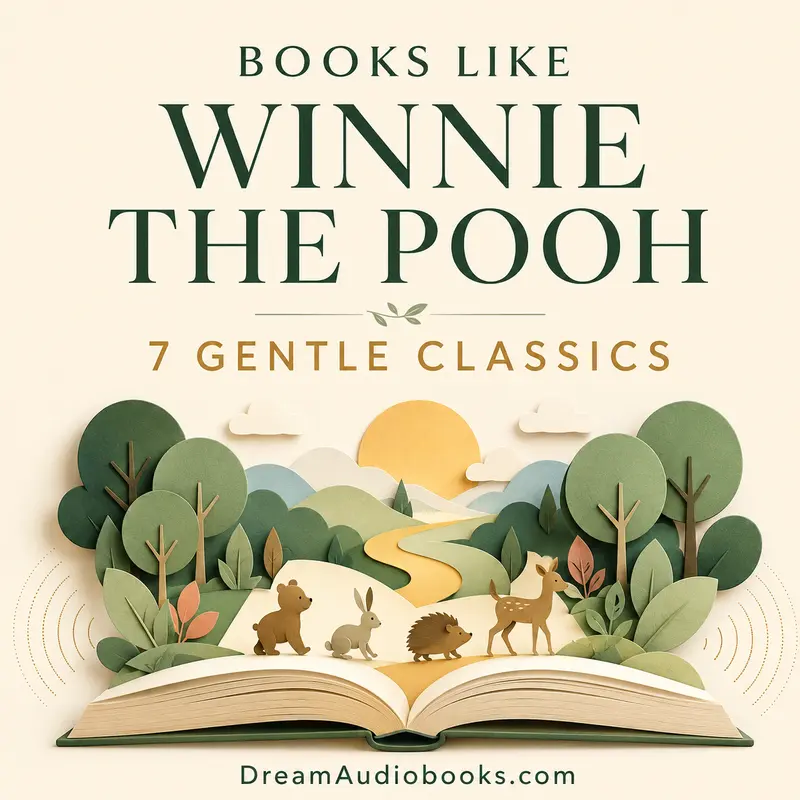
Books Like Winnie the Pooh – 7 Gentle Classics
Books Like Winnie the Pooh are not simply stories with talking animals. The best of them understand why A. A. Milne’s Hundred Acre Wood feels so welcoming: it is a small world where friendship matters, mistakes are survivable and an ordinary walk can become an expedition. Pooh, Piglet, Eeyore, Rabbit, Owl and Christopher Robin do not need a grand quest to hold our attention. A missing tail, a jar of honey or a set of tracks in the snow is enough to reveal who they are.
That modest scale is one of the book’s greatest strengths. The characters worry, misunderstand one another and occasionally behave selfishly, but the stories never lose their emotional safety. Piglet can be frightened without being mocked for his fear. Eeyore can be gloomy without being excluded from the group. Pooh can get an idea wrong and still remain loved. Kindness does not erase personality; it gives every personality room to belong.
Milne’s humour is equally important. Children hear the comic adventure, while adults recognise the delicate logic behind Pooh’s reasoning and the social tension hidden inside Rabbit’s plans. The prose does not announce every joke. It trusts pauses, repetition and the distance between what a character believes and what the reader understands. That is why the book rewards family listening: different ages can enjoy the same scene for different reasons.
The setting also does more work than it first appears. The Hundred Acre Wood is based on a real landscape, yet it feels like a map of childhood imagination. Trees, bridges, sandy pits and familiar paths become important because the friends return to them. Adventure begins close to home, and home remains available when the adventure ends. This dependable geography gives the stories their calm rhythm.
Finding a true follow-up therefore requires more than choosing another famous children’s book. A good match should preserve several qualities: a memorable community, gentle humour, sympathy for vulnerable characters, a meaningful natural setting and a pace that leaves room for small observations. Some recommendations below come very close to Milne’s woodland atmosphere; others keep the warmth while adding a stronger plot or a larger imaginative world.
The Wind in the Willows is the closest overall companion because Mole, Rat, Badger and Toad form another unforgettable animal community shaped by friendship and place. The Adventures of Paddy the Beaver is the easiest choice for younger listeners who want a calm woodland story. The Secret Garden replaces talking animals with children whose lives change through friendship and nature.
The Adventures of a Bear, and a Great Bear Too offers a less familiar animal classic with an episodic structure. Peter Pan expands childhood imagination into a more theatrical and dangerous fantasy. The Wonderful Wizard of Oz brings together a group of companions who discover their value by helping one another. Finally, Alice’s Adventures in Wonderland is the strongest choice for listeners who love Milne’s verbal play and want something stranger.
If you have just finished the Winnie the Pooh audiobook, begin with The Wind in the Willows for the nearest emotional match. Choose Paddy for shorter, gentler nature listening. Try The Secret Garden when you want warmth with deeper character growth, or Oz when you want a clear journey without losing the comfort of loyal companions.
Every recommendation in this guide has its own DreamAudiobooks page and a dedicated Spotify button. The buttons do not open a generic catalogue or search page. They lead directly to the selected audiobook, although availability can vary by country and may change when a platform updates its catalogue.
These classics come from different periods and should not be treated as interchangeable. Some contain dated language, social assumptions or scenes that adults may want to discuss with younger listeners. Their value lies not in pretending that every old book is harmless, but in choosing thoughtfully and listening with enough attention to notice both what remains generous and what belongs to its historical moment.
What to Look for in Books Like Winnie the Pooh
The first quality is emotional gentleness. This does not mean that nothing unpleasant can happen. Piglet becomes afraid, Eeyore feels neglected and Pooh sometimes finds himself in genuine difficulty. The difference is that the story never treats distress as entertainment. The reader trusts that friendship will remain present even when a plan goes wrong. The best books on this list create a similar sense of security.
The second quality is a community of contrasting characters. Pooh’s simplicity, Piglet’s courage, Rabbit’s need for order and Eeyore’s melancholy could easily clash. Milne turns those differences into the source of both humour and affection. A comparable story should not offer seven versions of the same agreeable personality. It should show how friendship develops among people—or animals—who see the world differently.
The third quality is a place worth returning to. The Hundred Acre Wood is more than scenery. Its familiar landmarks allow each episode to feel new without making the listener start again in a completely unknown world. The River Bank, the secret garden and the Yellow Brick Road serve different purposes, but each setting becomes emotionally inseparable from the characters who travel through it.
Finally, language matters. Milne can be precise, playful and quietly philosophical without becoming heavy. A sentence that looks simple may reveal a character’s whole way of thinking. Alice’s Adventures in Wonderland pushes wordplay toward nonsense, while The Wind in the Willows uses richer description. Both can appeal to Pooh listeners, but for different reasons.
Seven Gentle Classics at a Glance
| Audiobook | Closest connection | Mood | Best for |
|---|---|---|---|
| The Wind in the Willows | Animal friends and a beloved landscape | Cozy, comic and reflective | The closest overall match |
| Paddy the Beaver | Woodland animals and small adventures | Warm and instructive | Younger listeners |
| The Secret Garden | Friendship, nature and emotional healing | Hopeful and restorative | A deeper gentle story |
| The Adventures of a Bear | An episodic animal viewpoint | Curious and old-fashioned | A forgotten classic |
| Peter Pan | Childhood imagination and play | Whimsical but bittersweet | More fantasy and action |
| The Wonderful Wizard of Oz | Loyal companions helping one another | Bright and adventurous | A clear family quest |
| Alice’s Adventures in Wonderland | Talking animals and verbal humour | Dreamlike and absurd | Wordplay lovers |
Seven Books Like Winnie the Pooh
1. The Wind in the Willows by Kenneth Grahame
The Wind in the Willows is the most natural book to hear after Winnie-the-Pooh. Mole leaves his spring cleaning, discovers the river and forms a friendship with the hospitable Water Rat. Their circle includes the reclusive Badger and the irrepressible Toad, whose enthusiasm for every new fashion repeatedly creates trouble. Like Milne, Grahame builds a community in which personality is stronger than plot.
The closest connection is the affection between characters who are not always easy. Rat and Mole enjoy one another’s company, while Toad tests the limits of everyone’s patience. His friends challenge his behaviour, rescue him and help reclaim his home without pretending that his vanity has disappeared. Their loyalty includes honesty, a feature that gives the comedy emotional substance.
Grahame’s landscape is richer and more sensuous than Milne’s. Boats, picnic baskets, firesides, winter roads and the Wild Wood create a vivid world of seasons. There is also more danger, including imprisonment and the occupation of Toad Hall. Yet the story repeatedly returns to food, shelter and companionship, so tension never erases its fundamental warmth.
Choose this first when the Hundred Acre Wood itself was your favourite part of Pooh. It provides the nearest combination of animal friendship, humour, nature and a home that feels meaningful. You can also compare all seven titles in our books like The Wind in the Willows guide.
Explore The Wind in the Willows audiobook
Listen to The Wind in the Willows on Spotify
2. The Adventures of Paddy the Beaver by Thornton W. Burgess
Thornton W. Burgess’s woodland stories are simpler than Milne’s, but they share an interest in familiar animal neighbours. Paddy arrives in the Green Forest and begins changing the landscape by building a dam. The other animals respond with curiosity, suspicion or admiration, allowing the story to explain beaver behaviour through character and incident.
Paddy is practical, confident and busy. His work affects everyone around him, so the plot grows naturally from the woodland community rather than from a villain or distant quest. Young listeners can follow the physical problem of water, trees and construction, while adults can appreciate the calm emphasis on patience and competence.
This is the least demanding audiobook on the list and one of the best choices for shorter family sessions. It does not have Milne’s layered verbal humour, but it preserves the pleasure of returning to a small natural world populated by recognisable personalities. Its gentleness comes from clarity rather than sentimentality.
Choose Paddy when you want talking animals, nature and a reassuring pace without the greater danger of Oz or Neverland. For a wider catalogue route, visit the best animal story audiobooks collection.
Explore The Adventures of Paddy the Beaver
Listen to Paddy the Beaver on Spotify
3. The Secret Garden by Frances Hodgson Burnett
The Secret Garden contains no community of talking animals, yet it understands the restorative power of a particular place. Mary Lennox arrives at Misselthwaite Manor lonely, disagreeable and emotionally neglected. The discovery of a locked garden gives her something to care for. As the neglected space returns to life, Mary, Colin and the adults around them also begin to change.
The connection to Pooh lies in the attention paid to small discoveries. A key in the soil, a robin near a wall or a new shoot breaking through the ground can become an event. Nature is not a decorative background. It offers work, mystery and a language through which isolated children begin to trust the world and one another.
Burnett’s novel has more sadness and a stronger transformation than Milne’s episodes. Mary and Colin can be difficult because illness, grief and neglect have shaped them. Their improvement is gradual enough to feel earned. Friendship helps, but so do fresh air, movement, responsibility and the repeated experience of being expected to participate in life.
Choose this audiobook when Pooh’s kindness mattered more to you than his talking-animal setting. It is particularly rewarding for older children and adults who want comfort with emotional depth. Our books like The Secret Garden page continues the nature-and-healing cluster.
Explore The Secret Garden audiobook
Listen to The Secret Garden on Spotify
4. The Adventures of a Bear, and a Great Bear Too by Alfred Elwes
Alfred Elwes’s The Adventures of a Bear, and a Great Bear Too is the least familiar title in this guide. That obscurity is part of its value. Listeners who already know the major children’s classics can encounter an older animal narrative without arriving with fixed images from film or television. The episodic movement makes it suitable for listening in sections.
The bear’s perspective creates curiosity about human behaviour and changing surroundings. Where Pooh’s adventures remain rooted in a stable wood, this story is more mobile and less protected. Its historical manner can feel distant, but it also shows how animal protagonists were used long before modern animation to explore sympathy, observation and moral choice.
This is not the closest tonal match. The prose is more openly old-fashioned, and the story does not reproduce Milne’s delicately balanced group of friends. It belongs here because it offers an authentic alternative rather than another obvious bestseller. A recommendation page should sometimes help listeners find the book they did not already know to search for.
Choose it after Paddy when you want another animal-led story but are ready for a less polished, more historical listening experience. It can also help older children notice how the conventions of animal fiction changed between the nineteenth and twentieth centuries.
Explore The Adventures of a Bear audiobook
Listen to The Adventures of a Bear on Spotify
5. Peter Pan by J. M. Barrie
Peter Pan begins with the same conviction that childhood imagination can alter an ordinary room. Peter enters the Darling nursery, teaches Wendy, John and Michael to fly and takes them to Neverland. The island gives games physical reality: pirates, mermaids, underground homes and battles all become part of a world organised around a refusal to grow up.
Barrie’s fantasy is more dangerous and emotionally unsettled than Winnie-the-Pooh. Peter is charming, courageous and often careless about other people’s feelings. Wendy wants adventure but also values memory, family and responsibility. The tension between them makes the book more bittersweet than its famous images of flight suggest.
The strongest connection is not a similar plot but a similar interest in how children transform language and play. Both authors understand that games can be completely serious while they last. In Pooh, an expedition to the North Pole grows from conversation. In Peter Pan, the imagined island becomes a whole theatrical universe.
Choose this title when you want to move from a safe wood into a larger fantasy. Adults sharing the audiobook should be prepared to discuss the book’s dated racial representation and its more unsettling ideas about memory and abandonment. Those elements make informed listening more valuable, not less necessary.
Explore Peter Pan by J. M. Barrie
Listen to Peter Pan on Spotify
6. The Wonderful Wizard of Oz by L. Frank Baum
The Wonderful Wizard of Oz offers the clearest adventure on this list. A cyclone carries Dorothy from Kansas to the Land of Oz, where she follows the Yellow Brick Road in the hope that the Wizard can send her home. Along the way she meets the Scarecrow, Tin Woodman and Cowardly Lion, each of whom believes he lacks an essential quality.
The companions create the connection to Pooh. Their differences make the journey possible: one thinks, one feels deeply, one acts despite fear and Dorothy keeps the group directed toward a shared purpose. Like Piglet, the Lion shows that courage does not require the absence of fear. Like Pooh, the Scarecrow repeatedly displays the very intelligence he believes he lacks.
Baum’s chapters introduce obstacles at a steady pace, making the audiobook easy to follow during family listening or travel. The world is brighter and more changeable than the Hundred Acre Wood, but friendship again turns unfamiliar territory into a place where the characters can function. The story’s reassurance comes from cooperation rather than from a consistently cozy setting.
Choose Oz for listeners who are ready for a stronger plot but still want warmth, humour and a satisfying return to home. It is less verbally subtle than Pooh and more eventful, which can make it a useful next step for children developing longer attention spans.
Explore The Wonderful Wizard of Oz audiobook
Listen to The Wonderful Wizard of Oz on Spotify
7. Alice’s Adventures in Wonderland by Lewis Carroll
Alice’s Adventures in Wonderland is the least gentle recommendation in terms of logic. Alice follows a White Rabbit underground and enters a world where size changes, conversations contradict themselves and authority depends on confidence rather than sense. Talking animals appear everywhere, but they rarely provide the stable friendship found in Milne’s wood.
Why include it? Because listeners who love Pooh often love the way his reasoning bends ordinary language. Carroll makes that bending the foundation of an entire world. Riddles have no answers, definitions shift mid-conversation and familiar expressions become literal events. A good narrator helps the listener distinguish voices while preserving the speed and precision of the jokes.
Alice is also a useful contrast to Pooh. She spends much of the book trying to impose reason on unreasonable creatures, while Pooh calmly follows his own logic. Both stories respect a child’s ability to notice when adult rules are arbitrary. Carroll’s satire is sharper, but his nonsense rewards the same pleasure in words spoken aloud.
Choose this last if dialogue and wordplay were your favourite parts of Winnie-the-Pooh. It is not ideal for a listener seeking pure calm, but it is excellent for families who enjoy pausing over jokes and asking how a sentence produced its strange effect. Continue with our books like Alice in Wonderland guide for more dreamlike classics.
Explore Alice’s Adventures in Wonderland
Listen to Alice’s Adventures in Wonderland on Spotify
How to Choose Your Next Gentle Classic
For the closest overall match
Start with The Wind in the Willows. Its group of animal friends, country setting, episodic adventures and return to home make it the strongest continuation. It contains more lyrical description and greater danger than Pooh, but its emotional centre is equally companionable.
For a younger or easily distracted listener
Try The Adventures of Paddy the Beaver. The goal is concrete, the woodland community is easy to understand and the story can be enjoyed in smaller sections. It also gives adults opportunities to talk about animal behaviour and the effect of a beaver’s work on its environment.
For comfort with deeper character growth
Choose The Secret Garden. Mary’s transformation requires more patience than a Pooh episode, but the gradual revival of the garden provides a clear emotional pattern. It is the strongest selection for listeners interested in loneliness, healing, friendship and the way daily activity can change a life.
For a larger adventure
Select Oz for a clear quest and supportive companions, or Peter Pan for a stranger and more bittersweet fantasy. Oz is generally the easier shared listen. Barrie’s book asks more difficult questions about growing up and contains historical material that needs context.
For language and nonsense
Choose Alice. It is less emotionally reassuring, but no other book on the list offers as much concentrated verbal play. Listening makes the rhythm of the arguments, poems and absurd conversations especially vivid.
Why These Classics Work for Listening Together
Shared listening allows a family to experience the same story without expecting every person to understand it in the same way. A younger child may follow the animal characters and immediate action. An older listener may notice the narrator’s irony, the historical setting or the emotional consequences hidden beneath a comic scene. Neither response cancels the other.
Short, regular sessions often work better than treating a classic as an endurance test. Stop at a natural chapter break, briefly recall where the characters are and let the next session begin before attention becomes tired. Episodic books such as Pooh, Paddy and The Wind in the Willows are particularly forgiving. Oz provides stronger forward momentum when a family wants a continuing quest.
Older texts also invite questions. A child may notice a word, attitude or social rule that feels unfamiliar. Rather than rushing past it, an adult can explain the context and ask what the listener thinks. This is especially important with Peter Pan and with any historical work whose portrayal of people or cultures no longer meets modern expectations.
The narrator matters, but the most dramatic voice is not always the best choice. Gentle classics benefit from clear character distinction, patient pacing and confidence in the prose. Humour can disappear when every line is pushed too hard. Pooh’s logic, Toad’s vanity and Alice’s arguments are often funniest when the speaker treats them with complete seriousness.
For more shared-listening options, explore the best family audiobooks and best children’s audiobooks collections. Listeners who want the calmest possible route can also use the best cozy audiobooks guide.
What Winnie the Pooh Teaches About Friendship
Milne’s most lasting insight is that friendship does not require matching temperaments. Pooh does not become organised for Rabbit, Piglet does not stop feeling fear and Eeyore is not transformed into a cheerful optimist. The friends learn how to include one another without removing the traits that make inclusion difficult.
The recommended books repeat this pattern in different forms. Rat and Mole stand by Toad without approving his recklessness. Dorothy’s companions help one another before receiving the qualities they think they need. Mary, Colin and Dickon grow through shared work rather than through instant agreement. Community becomes meaningful because it asks something of its members.
That is also why these stories remain comforting for adults. They do not promise that every day will be impressive or that every friend will be easy. They suggest something smaller and more believable: a familiar voice, a repeated path, a shared task or a person who notices when you are missing can be enough to make a world feel inhabitable.
Frequently Asked Questions
What is the best book to listen to after Winnie the Pooh?
The Wind in the Willows is the closest overall match because it combines animal friendship, gentle humour, nature and episodic adventure. Choose Paddy the Beaver for a simpler woodland story.
Which recommendation is the gentlest?
The Adventures of Paddy the Beaver is the calmest and most accessible selection. The Secret Garden is also comforting, but it begins with loneliness and loss before moving toward healing.
Are these books suitable for bedtime listening?
Paddy, The Wind in the Willows and parts of The Secret Garden work especially well at bedtime. Oz, Alice and Peter Pan contain more excitement, danger or absurd energy and may suit daytime listening better for some children.
Can adults enjoy books like Winnie the Pooh?
Yes. Milne’s humour, observations about personality and understanding of friendship often become more noticeable to adult listeners. Grahame, Carroll and Barrie also wrote children’s classics with substantial adult resonance.
Can I listen to all seven audiobooks free on Spotify?
Each recommendation has its own direct Spotify button in this guide. Spotify availability can vary by location and may change if the platform or distributor updates the catalogue.
Final Recommendation
Begin with The Wind in the Willows for the closest return to animal friendship and a comforting landscape. Move to Paddy when you want something simpler, or to The Secret Garden when you want a longer story of healing. Choose Oz for adventure, Alice for wordplay and Peter Pan for a more complicated reflection on childhood.
The best books like Winnie-the-Pooh do not copy honey pots, bears or woodland names. They preserve the deeper pleasure of Milne’s stories: the assurance that a small world can hold great affection, and that even a very ordinary day becomes worth remembering when it is shared with the right companions.