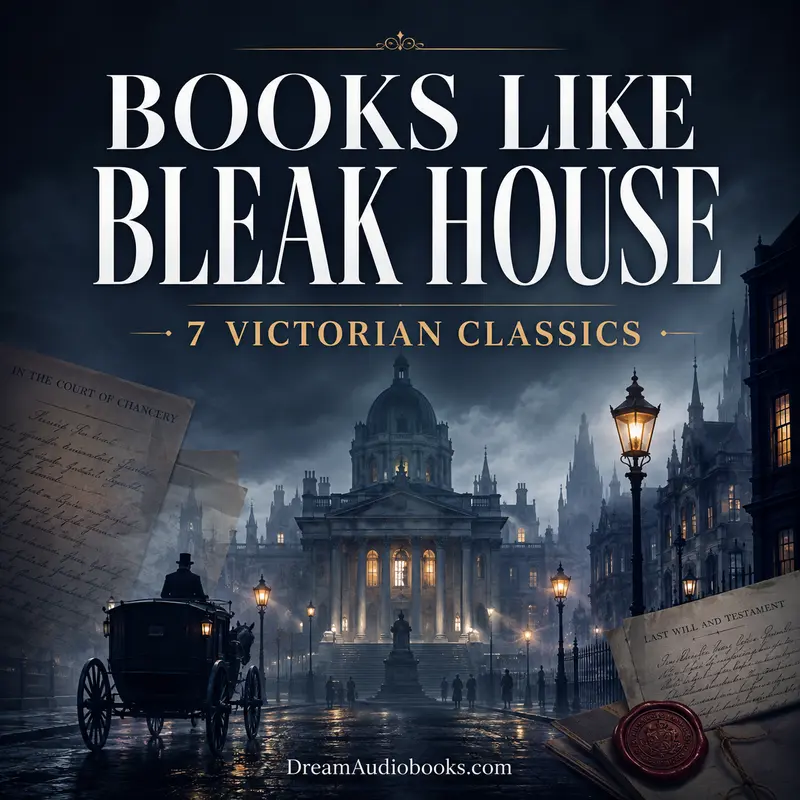
Books Like Bleak House: 7 Victorian Classics
Books like Bleak House should offer more than fog, secrets and a crowded Victorian setting. Charles Dickens built his novel around an inheritance case that has outlived the people who first brought it to court. Yet the legal machinery is only the frame. Inside it, we meet young people trying to understand their origins, women negotiating a society designed to limit their choices, wealthy families protecting old reputations and vulnerable characters paying for decisions made far above them.
That unusual mixture explains why Bleak House remains so rewarding. It works as a mystery, a social novel, a family drama and a bitter comedy about institutions. Inspector Bucket follows clues with professional patience, Lady Dedlock guards a dangerous history, Esther Summerson searches for belonging, and the Court of Chancery quietly consumes time, money and hope. Dickens moves between drawing rooms, poor streets, law offices and country houses until the reader can see how every part of society touches another.
No single novel reproduces all of those qualities. The best follow-up depends on what held your attention. If you admired the enormous social canvas, Middlemarch is the natural next step. If Esther’s moral independence mattered most, begin with Jane Eyre or Tess of the d’Urbervilles. For hidden corruption beneath respectable appearances, Oscar Wilde and Robert Louis Stevenson provide darker, more concentrated choices. Thomas Hardy offers rural communities where class, gossip and chance shape private lives, while H. G. Wells turns Victorian fear of the outsider into a fast and unsettling scientific thriller.
The seven selections below are genuine nineteenth-century British classics connected to the Victorian period. They are not included merely because they are famous. Each shares a specific element with Dickens’s novel: social systems that fail ordinary people, mysteries built around identity, the destructive force of reputation, unequal treatment under moral rules or characters trapped between personal truth and public expectation.
Every recommendation also has a dedicated DreamAudiobooks page and its own Spotify destination. The green button beneath each entry leads to that individual audiobook rather than to a generic profile or playlist. This gives you a practical listening route through the list while strengthening the connection between the recommendation guide and the existing audiobook catalogue.
Why Books Like Bleak House Are Hard to Find
Bleak House is difficult to match because Dickens combines two very different storytelling methods. One narrator offers a broad, present-tense view of London and its institutions. Esther tells the other part of the story in a personal, reflective voice. The movement between those perspectives lets the novel examine society from above while remaining emotionally close to one individual.
The Jarndyce lawsuit connects characters who may not initially appear related. Some expect an inheritance. Others work around the court, depend on its clients or suffer from the habits it encourages. The suit produces paperwork rather than resolution, and its existence becomes a form of power. Dickens’s target is not simply one corrupt judge. He shows how a system can harm people even when no single participant accepts responsibility for the result.
The novel’s mystery is equally important. Lady Dedlock’s secret, Esther’s parentage, anonymous letters and Inspector Bucket’s investigation provide momentum without turning the book into a conventional detective story. The clues matter because they expose the human cost of rigid ideas about legitimacy, class and female respectability.
For this reason, the recommendations favor novels with both intimate lives and wider social pressure. Some are panoramic; others are shorter and darker. Together they preserve the central pleasure of Dickens’s book: discovering that a private secret is never entirely private when law, money, family and reputation are involved.
Seven Victorian Classics at a Glance
| Audiobook | Closest Connection | Best For |
|---|---|---|
| Middlemarch | Interconnected lives and social institutions | A large, thoughtful social novel |
| Jane Eyre | Hidden family history and female independence | Personal narration with Gothic mystery |
| Far from the Madding Crowd | Community, class, choice and consequence | Rural Victorian drama |
| Tess of the d’Urbervilles | Institutional injustice and moral double standards | Social tragedy |
| The Picture of Dorian Gray | Respectability concealing corruption | Elegant Gothic fiction |
| Dr. Jekyll and Mr. Hyde | A lawyer investigating a dangerous secret | A short Victorian mystery |
| The Invisible Man | Isolation, fear and failed accountability | Fast psychological suspense |
1. Middlemarch by George Eliot
Middlemarch is the closest recommendation for listeners who loved the scale of Bleak House. George Eliot creates a provincial community in which marriages, debts, professional ambitions, elections, inheritances and private disappointments continually affect one another. There is no single villain controlling the town. The pressure comes from a network of habits, expectations and financial dependencies.
Dorothea Brooke wants to devote her life to meaningful work but attaches that hope to the wrong marriage. Dr. Lydgate arrives with serious plans to reform medicine, only to discover that talent cannot protect him from debt, gossip and domestic incompatibility. The banker Bulstrode hides a past that threatens his respectable public identity. Like Dickens, Eliot gradually reveals how money and secrecy move through an entire community.
The tone is less theatrical than Bleak House, and there is no Inspector Bucket guiding us through a central investigation. What replaces the detective plot is Eliot’s extraordinary attention to motive. She asks why intelligent people misunderstand themselves, how good intentions become compromised and why social improvement is so difficult. Choose this audiobook when you want another long novel that rewards patient attention and makes a whole society feel alive.
Listen to Middlemarch on Spotify
2. Jane Eyre by Charlotte Brontë
Jane Eyre narrows the social panorama to one unforgettable voice. Jane begins as an unwanted orphan, survives the discipline and deprivation of Lowood School and later becomes a governess at Thornfield Hall. Her position gives her education and responsibility but very little social power. Like Esther Summerson, she must build a sense of personal worth while carrying the consequences of a childhood she did not choose.
Thornfield also offers the kind of domestic mystery that attracts many readers to Bleak House. Strange sounds, unexplained incidents and Mr. Rochester’s guarded history suggest that the house contains more than ordinary family tension. The eventual revelation changes the meaning of Jane’s relationship with Rochester and forces her to choose between desire and principle.
Charlotte Brontë is more emotionally direct than Dickens. Jane speaks with an intensity that makes every injustice personal, whether it comes from relatives, teachers, employers or religious authority. Yet the two novels share a concern with legitimacy, dependency and the narrow futures offered to women without wealth. Start here if Esther’s story was the emotional center of Bleak House for you, or if you want a Victorian classic that combines moral independence, romance and a carefully sustained Gothic secret.
Listen to Jane Eyre on Spotify
3. Far from the Madding Crowd by Thomas Hardy
Thomas Hardy moves away from London courts and into the farms and villages of Wessex, but his community is just as alert to status, rumor and personal conduct. Bathsheba Everdene inherits a farm and insists on managing it herself. Her independence challenges expectations about authority and marriage, while her choices connect the lives of Gabriel Oak, William Boldwood and Sergeant Troy.
The strongest link with Bleak House is the way a small action can acquire consequences far beyond its original intention. A playful Valentine sent to Boldwood becomes the beginning of an obsession. A marriage made under emotional pressure changes work, property and reputation. Weather, chance and timing repeatedly interrupt human plans. Hardy’s world may look more open than Dickens’s fog-bound London, but individuals remain tied to economic necessity and community judgment.
This is also one of the most accessible choices on the list. The plot has romance, betrayal, suspense and memorable contrasts between steady loyalty and dangerous charm. Listen to it after Bleak House if you want another story about a capable woman navigating social expectations, but prefer a rural setting, a smaller cast and a more direct narrative line.
Listen to Far from the Madding Crowd on Spotify
4. Tess of the d’Urbervilles by Thomas Hardy
If the injustice of Bleak House affected you more than its comedy, Tess of the d’Urbervilles is the most powerful next listen. Tess Durbeyfield is sent toward a supposedly noble family connection because her poor household hopes the name may improve its fortunes. Instead, class privilege, sexual double standards and economic vulnerability place her in situations from which Victorian society offers little protection.
Hardy’s subtitle, “A Pure Woman Faithfully Presented,” directly challenges the moral judgment imposed on Tess. Men are permitted complexity, repentance and renewed respectability. Tess is expected to carry permanent blame. That imbalance resembles Dickens’s anger at institutions that speak about justice while protecting power and sacrificing people who have the fewest choices.
The novel is tragic, but it is not emotionally careless. Hardy gives Tess intelligence, dignity and a close relationship with the natural world. Seasonal work, farms and changing landscapes make her life tangible rather than symbolic. Choose this audiobook if you want a serious Victorian critique of class and gender, or if Lady Dedlock’s fear of exposure made you think about the unequal price women pay for a damaged reputation.
Listen to Tess of the d’Urbervilles on Spotify
5. The Picture of Dorian Gray by Oscar Wilde
Oscar Wilde replaces legal paperwork with a supernatural portrait, but his central concern is recognizably Victorian: the distance between public appearance and private truth. Dorian remains young and admired while the hidden canvas records the moral damage of his choices. Society continues to welcome him because beauty and status make suspicion easy to dismiss.
Bleak House repeatedly shows respectable people ignoring suffering that does not threaten their comfort. Wilde makes that hypocrisy more intimate. Dorian’s polished exterior allows him to move through drawing rooms while the evidence against him remains locked away. Like Lady Dedlock, he lives under the pressure of discovery, although his secret grows from deliberate corruption rather than an old relationship condemned by society.
This is a much shorter and more concentrated book than Dickens’s novel. Wilde’s dialogue is sharp, memorable and particularly effective in audio, while the portrait supplies a clear line of suspense. Choose it if you enjoyed the contrast between elegant homes and concealed wrongdoing, or if you want a Gothic classic that examines reputation without requiring the commitment of another enormous Victorian novel.
Listen to The Picture of Dorian Gray on Spotify
6. The Strange Case of Dr. Jekyll and Mr. Hyde
Robert Louis Stevenson’s novella is the strongest choice for readers who want the investigative side of Bleak House. Gabriel John Utterson is a lawyer rather than a professional detective, yet he follows documents, witnesses, wills and troubling inconsistencies as he tries to understand the connection between the respected Dr. Henry Jekyll and the violent Edward Hyde.
The legal details are not decoration. Jekyll’s unusual will gives Hyde access to his property and raises the possibility of blackmail. Utterson’s professional discretion initially makes him cautious, just as Victorian respectability encourages characters to protect private reputations. The mystery grows because people would rather avoid scandal than ask direct questions.
Stevenson compresses the foggy streets, locked rooms and hidden identities of a much larger social novel into a tense short work. Its final documents reshape everything that came before, much as revelations about family history alter our understanding of Dickens’s characters. Begin here if you want a fast audiobook with a lawyer at its center, a genuine mystery structure and a dark examination of what respectable society forces people to conceal.
Listen to Dr. Jekyll and Mr. Hyde on Spotify
7. The Invisible Man by H. G. Wells
The Invisible Man may appear to be the least obvious companion, but H. G. Wells shares Dickens’s interest in accountability. Griffin believes invisibility will free him from ordinary limits. Instead, the absence of witnesses encourages theft, coercion and fantasies of absolute power. His scientific achievement removes the social checks that once restrained him without giving him the wisdom to govern himself.
The surrounding community also matters. Villagers respond to the unknown stranger with curiosity, gossip, fear and eventually collective resistance. Their reactions turn an individual experiment into a public crisis. Like the fog in Bleak House, invisibility becomes both a physical condition and a moral image: dangerous actions are easiest to continue when nobody can see clearly or identify responsibility.
Wells writes with speed and clarity. The result is useful after a long, layered novel because it preserves questions about secrecy, power and social order in a more immediate form. Choose this audiobook if you want Victorian suspense with scientific imagination, a memorable outsider and a plot that moves quickly from mystery to pursuit.
Listen to The Invisible Man on Spotify
Which Victorian Audiobook Should You Choose First?
Start with Middlemarch for the closest match in scale, social observation and interconnected lives. Choose Jane Eyre if you want a first-person heroine, a family mystery and greater emotional intensity. Far from the Madding Crowd is the most approachable option for romance and community drama, while Tess of the d’Urbervilles offers the strongest criticism of gender inequality and moral judgment.
For a shorter listen, choose Dr. Jekyll and Mr. Hyde for legal clues and hidden identity, or The Picture of Dorian Gray for social hypocrisy and elegant Gothic atmosphere. Select The Invisible Man when you want the fastest plot and the strongest element of science fiction.
Themes Shared with Bleak House
Respectability and Concealed Truth
Lady Dedlock, Dorian Gray and Dr. Jekyll all understand that a public identity can be destroyed by private knowledge. Their stories differ morally, but each reveals a society more interested in appearances than honest understanding.
Institutions and Unequal Power
Dickens attacks Chancery; Eliot examines money, medicine and local politics; Hardy exposes class and gender rules. These systems rarely appear as a single enemy. Their power comes from customs that many people accept and few feel able to change.
Women Seeking an Independent Life
Esther, Jane, Dorothea, Bathsheba and Tess face different circumstances, yet all must define themselves within structures that connect female security to family, inheritance or marriage. Their choices give these novels much of their continuing emotional force.
Mystery as Social Revelation
The best mysteries here do more than identify a culprit. A secret will, an unknown parent, a locked room or a hidden portrait exposes assumptions about class, legitimacy and moral authority. Solving the mystery changes how we understand the society around it.
For a broader route through the period, visit Best Classic Literature Audiobooks. That collection serves a wider discovery intent, while this guide remains focused specifically on what to listen to after Bleak House.
Frequently Asked Questions
What should I listen to after Bleak House?
Middlemarch is the strongest next choice for another large social novel with interconnected characters. Choose Jane Eyre for a more personal story involving identity, class and a hidden family secret.
Which book is most similar to Bleak House?
No book duplicates its exact mixture of law, mystery and social satire. Among these seven selections, Middlemarch is closest in social scale, while Dr. Jekyll and Mr. Hyde is closest to its investigative tension.
Are these all Victorian classics?
Yes. The seven works were published between 1847 and 1897 and belong to, or are closely associated with, the British literary culture of the Victorian period.
Which recommendation is best for beginners?
Dr. Jekyll and Mr. Hyde is short, focused and easy to complete. Far from the Madding Crowd is longer but has a clear plot, memorable characters and an accessible mixture of romance and drama.
Which audiobook has the strongest social criticism?
Middlemarch provides the widest social analysis. Tess of the d’Urbervilles offers the sharpest emotional criticism of class, gender inequality and Victorian moral double standards.
Do the Spotify buttons lead to the individual audiobooks?
Yes. Each green button uses a separate verified Spotify URL for the named audiobook. None of the seven buttons leads to a generic DreamAudiobooks profile.
Final Thoughts on Books Like Bleak House
The best books like Bleak House preserve Dickens’s interest in lives shaped by forces larger than any one character. Middlemarch rebuilds the social web, Jane Eyre gives hidden identity a powerful personal voice, and Hardy exposes the cost of class and moral judgment. Wilde, Stevenson and Wells then carry Victorian secrecy into Gothic and scientific territory. Choose the connection that mattered most to you, use the individual Spotify button and let one demanding classic lead naturally to the next.